Saturday, February 28, 2026

Pharaoh: King of Ancient Egypt


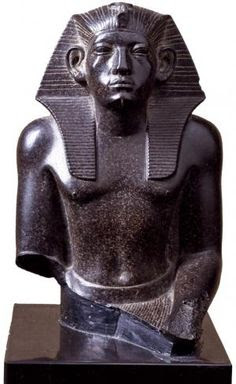
Statue of Pharaoh Amenemhet III 19th cent. BC
"Pharaoh: King of Ancient Egypt," was a major loan exhibition of ancient masterpieces from the British Museum in London that opened March 13, 2016 at the Cleveland Museum of Art. The British Museum famously acquired all the booty gathered by Napoleon after the British defeated the French occupation of Egypt in 1801. The show was meant to reveal both the beauty and meaning of ancient Egyptian art.


Figure of a squatting baboon, about 1391-1353 B.C., Red quartzite. New Kingdom, Dynasty 18, reign of Amenhotep III

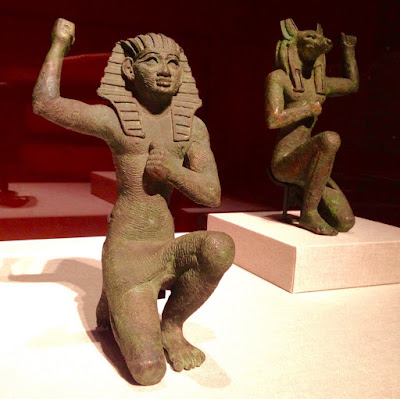
Kneeling king in pose of jubilation, about 715-332 BC. Late Period. Egypt. Bronze

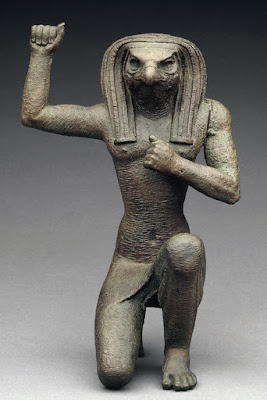
Kneeling falcon-headed deity in pose of jubilation, about 715-332 BC. Late Period. Egypt. Bronze

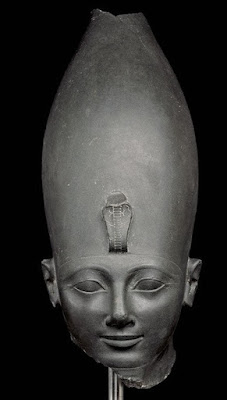
Head of Pharaoh Tuthmosis III, about 1479-1425 BC. New Kingdom. Karnak, Thebes, Egypt. Green siltstone

Fragment from the sarcophagus lid of Pharaoh Ramses VI, about 1143-1136 BC. New Kingdom, Dynasty 20, reign of Ramses VI

Shabti of Pharaoh Seti I, about 1294-1279 BC. New Kingdom, Dynasty 19

Figurine of Pharaoh Tuthmosis IV, about 1401-1391 BC. Bronze

Seated statue of Pharaoh Seti II, about 1200-1194 BC. New Kingdom, Dynasty 19

Statue of the god Ra-Horakhty, about 1279-1213. New Kingdom, Dynasty 19

Hathor capital, about 874-850 BC. Third Intermediate Period, Dynasty 22, reign of Osorkon II. Red granite

Figurine of the god Amun-Ra, about 1069-715 BC. Gilded silver

Figured ostracon: Ramses II suckled by a goddess, about 1279-1213 BC. New Kingdom, Dynasty 19. Painted limestone

Seated statue of Pharaoh Seti II, about 1200-1194 BC. New Kingdom, Dynasty 19, Quartzite sandstone

Bust of Amenhotep III

Friday, February 27, 2026

Tipu Sultan - the Tiger of Mysore

Tipu Sultan (20 November 1750 – 4 May 1799), also known as the Tiger of Mysore, was the Indian ruler who resisted the East India Company’s conquest of southern India. Opinion in England considered him a vicious tyrant, while modern Indian nationalists hail him as a freedom fighter.

A flintlock blunderbuss, built for Tipu Sultan in Srirangapatna, 1793–94.

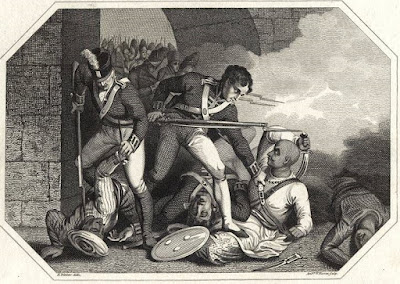
In the Fourth Anglo-Mysore War, the combined forces of the British East India Company and the Nizam of Hyderabad defeated Tipu, and he was killed on 4 May 1799 while defending his fort of Srirangapatna.

Tipu's Tiger, c.1790. Made for the amusement of Sultan Tipu; the tiger has a miniature organ with keyboard and bellows to simulate the groans of a dying British officer.

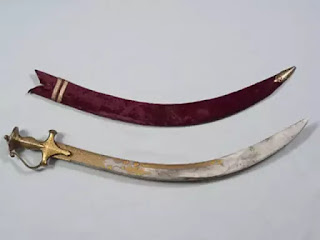
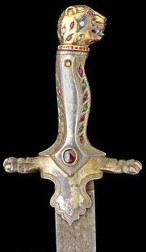
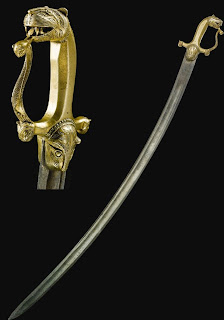
Inscribed Sword of Tipu Sultan. Former liquor magnate Vijay Mallya bought the sword in 2004 but gave it away saying it brought him bad luck.

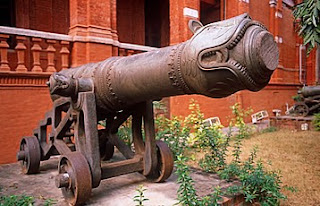
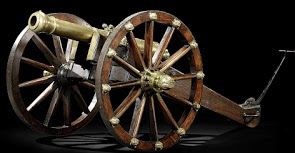
Cannon used by Tipu Sultan at Srirangapatna in 1799
A gem-set sword bearing the head of a tiger from the armoury of Tipu Sultan headlined a sale at Bonhams. The lot made £2.1m ($3.1m) when it crossed the block in 2014.

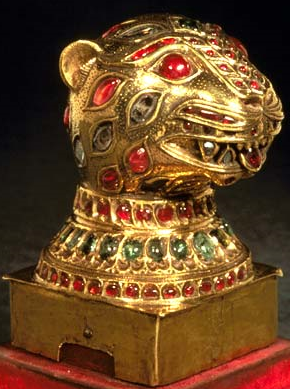
A gem-encrusted gold tiger finial from the throne of Tipu Sultan sold for £434,400.
Tipu Sultan ruled a vast swathe of southern India during the 18th century. He fought ferociously against the British East India Company, but was defeated.

'In this world I would rather live two days like a tiger, than two hundred years like a sheep.' - Tipu Sultan
A 3-pounder bronze cannon sold for £1.4m ($2.1m). A flintlock pistol with left-hand lock, made for Tipu Sultan at Seringapatam, dated AD 1797-98.

Inscription on the barrel reads: 'The peerless rifle of the Khusraw of India to which the forked lightning in second can seal the enemy's fate if his forehead is made the target.'
A two shot superimposed-load silver-mounted flintlock from the armoury of Tipu Sultan, dated AD 1793-94. A pair of silver-mounted Flintlock pistols with left and right-hand locks, made for Tipu Sultan, dated AD 1794-95. Sold For: £134,500

A Tipu Sultan sword fitted with a captured English blade.

Thursday, February 26, 2026

Ancient Gold

The ancient Egyptians believed their gods had skin made from gold.
The Aztec word for gold, teocuitlatl, literally translates as “excrement of the gods.” Gold has always had a special relationship with humans. Ancient views are quaint, but scientists have also struggled to fully understand the origins of gold. It was a puzzle how gold came into existence in the first place. The answer only arrived in 2017 with the first ever detection of gravitational waves. Those waves were produced by the merger of two neutron stars in an event known as a kilonova.
The source of the gravitational waves contained the signatures of gold and platinum in significant quantities. At long last, humans had discovered the cosmic deity capable of excreting gold.

Wednesday, February 25, 2026

Aquila - SPQR


Jaws flapped about Trump's use of the Nazi eagle.
Students of history would recognize the Nazi eagle as that stolen from the Romans. The Nazi swastika was also hijacked from ancient sources.
The word swastika comes from the Sanskrit svastika, which means “good fortune” or “well-being."
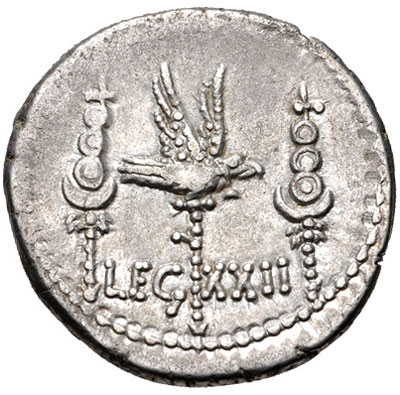
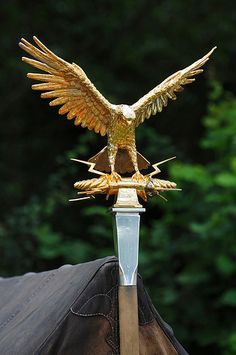
An aquila, or eagle, was a prominent symbol used in ancient Rome, especially as the standard of a Roman legion. A legionary known as an aquilifer, or eagle-bearer, carried this standard. Each legion carried one eagle.
The eagle was very important to the Roman military, beyond merely being a symbol of a legion. A lost standard was considered an extremely grave event. The Roman military often went to great lengths to protect a standard and to recover it if lost. In the aftermath of the Battle of the Teutoburg Forest the Romans spent decades trying to recover the lost standards of the three destroyed legions. SPQR stood for Senatus Populusque Romanus. The meaning was "The Senate and People of Rome". No legionary eagles are known to have survived.

Monday, February 23, 2026

The first circulating coins

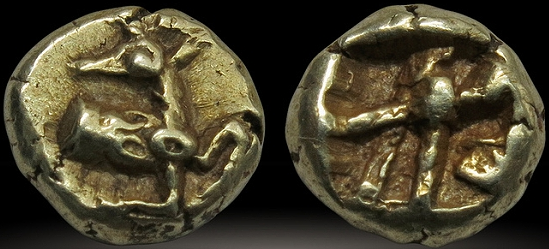
Little is known about this electrum (natural alloy of gold and silver) coin.

Ionia, Circa 650-600 BC. Hekte (one-sixth stater)
It was minted in Ionia, somewhere in central Western Anatolia on the shores of the Aegean, but the precise city-state that produced it is unknown. It could have been minted in Miletus, a city often referred to as the origin of the modern world. This type likely represents the first true coins which circulated in everyday use. This type are small, 1/24th staters which represented about a day’s pay. Larger denominations are rare. Even fewer trites (one-third stater) are known, and only three staters have ever been found.
During the excavation of the Temple of Artemis at Ephesus (present day Turkey near the Black Sea), a group of coins was found which are thought to be its 'foundation deposit', a custom that supposedly prevented the building from falling into ruin. The largest type in the group, a stater, had an inscription stating, 'I am the badge of Phanes'. It's meaning has been lost to antiquity. Coins revolutionized commerce, offering an accessible, neutral medium through which transactions could be processed quickly and fairly.