Tuesday, July 29, 2025

Ancient Greek murder victim unusual

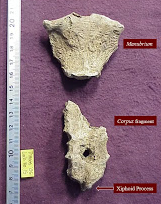
About 2,000 years ago, a heavily muscled man was murdered on a Greek island. The killer drove a spear into the man's chest with such force that it left a nearly perfect circle in his sternum.
Such an injury is rare according to researchers. Archaeologists found the man's remains in 2002 while excavating a section of an ancient necropolis in Thasos, the northernmost Aegean island.
The murder weapon was likely an ancient spear — known as a styrax. The pointed end of a thrusting spear wasn't thrown at the victim from a distance. Instead, it was likely thrust inward at close range and with precision, possibly for an execution.
An injury like that would have caused cardiac shock and arrest, likely killing the man within a minute. A dental analysis showed that just before the man's death, his diet worsened, suggesting that he was a prisoner or captive in his last days.

Monday, July 28, 2025

Treasures of the Atocha

It's a pleasant September morning in the year of our Lord 1622. A Spanish galleon sits in the port of Havana, along with 27 other ships of the combined fleet, their crews awaiting departure orders. The Nuestra SeƱora de Atocha ("Our Lady of Atocha") sits low in the water, weighed down by treasure.
The ship contains 964 silver bars, 161 gold bars or disks, 255,000 silver coins, and chests filled with emeralds. The Atocha is a 20-cannon, 500-ton colossus. It's the rear guard of the fleet and includes soldiers. It protects the smaller and slower moving vessels.
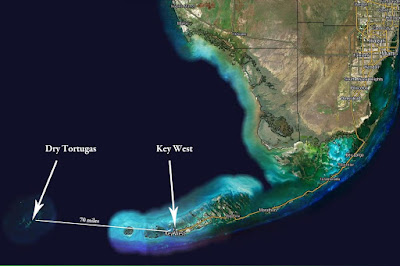
The treasure arriving by mule to Panama City was so immense that summer that it took 2 months to record and load the cargo on the Atocha. After more delays in Havana, the convoy did not depart for Spain until 4 September 1622, a full six weeks behind schedule and well into hurricane season. On 6 September the Atocha was driven by a severe hurricane onto the coral reefs near the Dry Tortugas, about 35 miles (56 km) west of Key West.
The vessel quickly sank, drowning everyone on board except for three sailors and two slaves. They were all that remained of the 265 passengers and crew. The Atocha sunk in 55 feet of water, making it difficult for divers to retrieve any of the cargo.
A second hurricane in October of that year made attempts at salvage even more difficult by scattering the wreckage of the ship further.
Mr. Mel Fisher formed a company called Treasure Salvors and began searching in earnest for the much talked about Atocha.

His effort over a sixteen-year period from 1970 to 1986 lead to the discovery of the Santa Margarita in 1980 and the Atocha on July 20, 1985, her hull lying in 55 feet of water, exactly as recorded by the first salvagers in 1622.

A gold crucifix with inlaid Colombian emerald jewels went for $119,000.
40 items from his impressive cache went up for auction in New York on August 5, 2015.

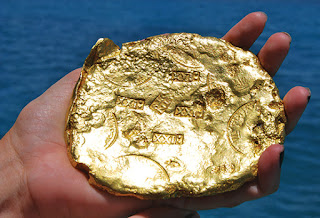
A gold bar from the Atocha made $93,750.
The golden spoon was thought to be used by priests during Communion to convert South American natives. $62,000.

A gold chalice from the Margarita was the top selling lot, fetching $413,000.
A collection of shipwrecked 17th and 18th century Spanish treasure discovered off the coast of Florida sold in New York for about $2m.

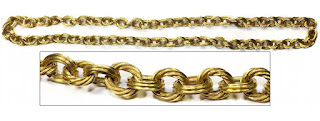
The haul includes two spectacular gold chains, one called a 'money chain'. Fisher wore it on the 'Tonight Show Starring Johnny Carson' soon after the ship's discovery.
__________________________

$75,000
In the Colonial era, the Spanish king placed a 20 percent tariff on gold bullion called the Royal Fifth.

But if the gold was turned into jewelry, the tax was forgiven. Each link of the 'money chain' is of equal size and weight and could be twisted off and used as formal currency.

Also up for auction was a Bezoar Stone, which was believed to remove poisons and toxins from liquids. The pendant, about the size of an egg, is encased in a gold mounting with four arms grasping the stone.
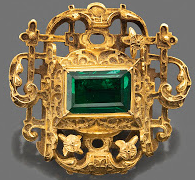
A magnificent emerald jewel from the lost Atocha. It made $ 410,000 in 2013

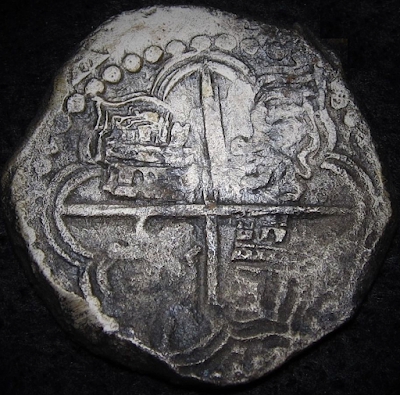
The Guernsey's sale also offered about 100 silver coins from the Atocha sister ship, the Santa Margarita, ranging from $1,000 and up.

Sunday, July 27, 2025

3,800 yo warrior kurgan discovered in Azerbaijan

A monumental discovery emerged from the windswept plains of Ceyranchol in western Azerbaijan: a 3,800-year-old Middle Bronze Age kurgan, the burial site of a high status warrior.


At the heart of this burial mound, a richly furnished tomb was revealed. The burial chamber—2 meters wide, 6 meters long, and 3 meters deep—was divided into three symbolic sections: one for the human remains and weaponry, another for ceramic vessels, and a third intentionally left empty. The remains belonged to an individual over 2 meters tall. A rare four-pronged bronze spearhead was found in the warrior’s hand, an exceptional weapon type.
Other grave goods included bronze ankle adornments, obsidian tools, paste beads and 12 elaborately decorated ceramic jugs, featuring white inlays and intricate motifs. Cooked animal bones (goat, horse, cow, and boar), were also found, likely as ritual food offerings. Above the tomb, 14 large limestone slabs (each approx. 1 ton) were discovered, alongside a bull-shaped stone idol and a circular limestone seal.

Tuesday, July 22, 2025

Gold found on Minoan island dedicated to purple

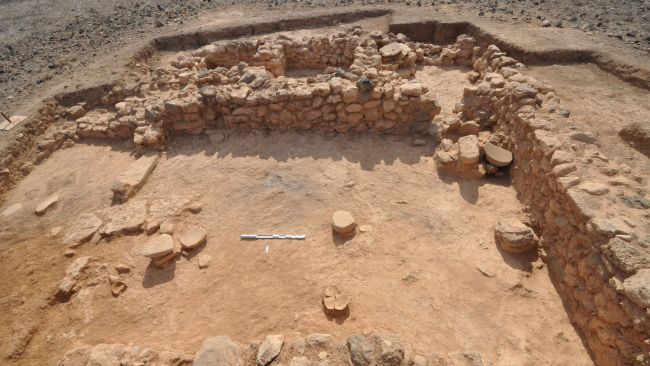
A storehouse of ancient objects, including precious jewels and gold beads, was uncovered on an island near Crete in 2019.
Chrysi, now uninhabited, was once devoted to making a precious purple dye from sea snails. The huge value placed on the rare purple dye supported a flourishing settlement between 3,800 and 3,500 years ago, during the Minoan civilization on Crete. The prosperity of the island settlement is not seen by the remains of its simple buildings, but by the high quality of the artifacts found.
Archaeologists have investigated the settlement on Chrysi since 2008, revealing various discoveries, including the remains of large carved stone tanks near the waterline on the beach.
Researchers believe the tanks were used to farm the shellfish — a species of Murex called Hexaplex trunculus. The difficulty of making the dye led to it only being used by the elite, and it became known as "Royal purple." It was also known as "Tyrian purple," after the ancient Phoenican coastal city of Tyre which also produced it.

Monday, July 21, 2025

House of the Tragic Poet

The House of the Tragic Poet is a Roman house in Pompeii famous for its elaborate mosaic floors and frescoes depicting scenes from Greek mythology.
The house itself is not remarkable, but its interior decorations are not only numerous but of the highest quality among all others from ancient Pompeii. The mismatch between the size of the house and the quality of its decoration has been pondered. Little is known about the lives of the homeowners. The house originally contained more than twenty painted and mosaic panels, six of which have been relocated to the National Archaeological Museum in Naples.

The House of the Tragic Poet was discovered in 1824 by archaeologist Antonio Bonucci.

Anzu wyliei - Chicken from Hell

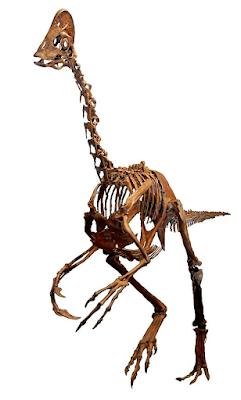
A birdlike dinosaur some 2.1 metres tall (7 feet) that weighed around 226 kilograms (500 pounds) roamed western North America some 66 million to 68 million years ago.
The dinosaur’s remains were excavated from the uppermost level of the Hell Creek rock formation in North and South Dakota. The dinosaur lived in a hot, humid landscape and ate plants and perhaps small animals. Anzu wyliei is one of the earliest oviraptorosaurs, living close to the dinosaur extinction event 65 million years ago.

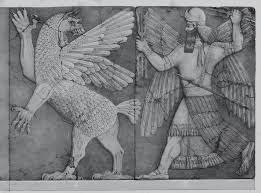
Its scientific name refers to Anzu, a bird-like demon in Mesopotamian mythology.
Oviraptorosaurs are a group of dinosaurs that are closely related to birds and often have strange crests on their heads.

Saturday, July 19, 2025

Returned Stolen Treasure

Two Roman ballista balls from Gamla were returned. The 2,000-year-old stones were left in a bag at the courtyard of the Museum of Islamic and Near Eastern Cultures.
In 1993, a retired Red Army officer dropped off 101 drawings by masters like Goya, Manet, and Delacroix at the German embassy in Moscow. They had been looted from the Bremen museum in 1945 by Soviet soldiers.
The looting of the Baghdad Museum as Saddam Hussein’s government crumbled was devastating for antiquities lovers. In 2003, three men anonymously returned one of Iraq’s most precious treasures in the back of a car. The Sacred Vase of Warka, a massive limestone bowl, dates to around 3200 B.C.
In 2001 a London dealer received an anonymous phone call that led him to his doorstep to six fragments of Roman frescoes taken from Pompeii.

They had been stolen 16 years earlier.

In 2006, just a year after a 1,500-year-old stone box from the Mayan civilization was found in Guatemala, it mysteriously vanished. After a national investigation, it returned through an anonymous delivery at the country’s Ministry of Culture.
In 1950 a group of 11 small ancient clay figurines were found in a Utah canyon. They belonged to a long-vanished people called the Fremont Culture, who had lived in the region from 700 to 1300 A.D. For two decades, these pieces, which came to be known as the Pilling Collection, toured around Utah museums. In the early 1970s, one of the figures mysteriously failed to show up. In 2011, an anthropologist at Utah State University received a box with the missing piece.
In 2007 the J Paul Getty Museum returned disputed antiquities, including a prized statue of the goddess Aphrodite. Italian authorities believe the 7ft statue, bought by the Getty for $18m in 1988, was looted from an ancient Greek settlement in Sicily.
In April 2015 some 123 artefacts were seized by US customs as part of a five year investigation into international smuggling networks dubbed Operation Mummy's Curse. One item, a 2,300 year-old sarcophagus was found in a garage in Brooklyn.