 The thief cited the current coronavirus outbreak as the reason for returning the artifact. | A man has returned an ancient Roman projectile that he took from an ancient site in Jerusalem 15 years ago. The man took the ballista stone from the City of David in the Jerusalem Walls National Park.  |  The ballista stones at the City of David likely date to the Roman siege of Jerusalem and the destruction of the Second Temple in 70 CE. The ballista stones at the City of David likely date to the Roman siege of Jerusalem and the destruction of the Second Temple in 70 CE. |

Monday, March 16, 2020
Stolen Roman ballista stone returned

Wednesday, March 11, 2020
Hummingbird sized dinosaur - Oculudentavis khaungraae
 | A hummingbird-sized predatory bird is the smallest known dinosaur to live during the Mesozoic Era, between 252 million and 66 million years ago. Of modern birds the bee hummingbird is the smallest. The new species, dubbed Oculudentavis khaungraae, was similar in size. The earliest birds, such as Archaeopteryx, arose around 150 million years ago, and this find suggests that bird body sizes were reaching their lower limit by 99 million years ago. |
 | Tomography scans reveal a 3-D image of the bird’s skull, preserved in amber. They show the deep eye sockets and sharp teeth of a predator. Researchers need to figure out where the new species belongs on the tree of life. |  |
Tuesday, March 10, 2020
SS Central America - Territorial Gold Coins
 Second finest known 1854 Kellogg $20 Territorial gold coin, graded PCGS MS62+ | Coins from the SS Central America include rare Territorial Gold Coins. "Territorial" is a term that encompasses a wide range of coins issued by private minters, semi-official entities, entrepreneurs, and opportunists. | 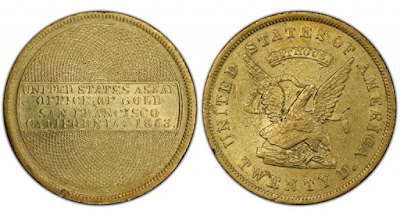 Rare 884 THOUS variety 1853 U.S. Assay Office $20, graded PCGS AU55+ |
 Small Head variety 1852 Wass Molitor $5 gold coin, with a counterstamp advertising Sacramento dentist W.W. Light | The coins arose out of necessity and were created to fill a void that government would not fill. Until they intervened, these issues flourished; once the government entered the market, they were made illegal. |  One of the finest known 1855 Wass Molitor Small Head variety $20 gold coins, PCGS AU58 |
Saturday, March 7, 2020
Ancient Jade Axe found in China.
 A Ritual Jade Yue (battle-axe), Western Zhou Dynasty 西周玉鉞. Mottled with teeth inlays on the edge, for ritual purposes in Shang and Zhou Dynasty. | Archeologists discovered jade ware that dates back over 4,000 years in 2018 at a site in central China's Hubei Province. Jade battle-axes, an astronomical instrument and a tube, dating back to between 4,600 to 5,100 years ago, have been unearthed at the Mulintou site in Baokang County. Skeletons, stoneware and pottery have also been found at the site. A jade battle-axe was a symbol of power. |  The Qujialing culture is a late Neolithic culture discovered in the middle reaches of the Yangtze River. The Qujialing culture is a late Neolithic culture discovered in the middle reaches of the Yangtze River. |
Subscribe to:
Posts (Atom)