Wednesday, April 29, 2020

Ancient handshake about to go extinct

Assyrian King Shalmaneser III shaking hands with a Babylonian ruler.The handshake goes back to the dawning of ancient history but the reason and origin of it are not known. One of the oldest depictions of the handshake is from a ninth-century B.C. relief. A handshake was a symbol of loyalty and friendship in ancient Rome and clasped hands are often found on coins.

Tuesday, April 21, 2020

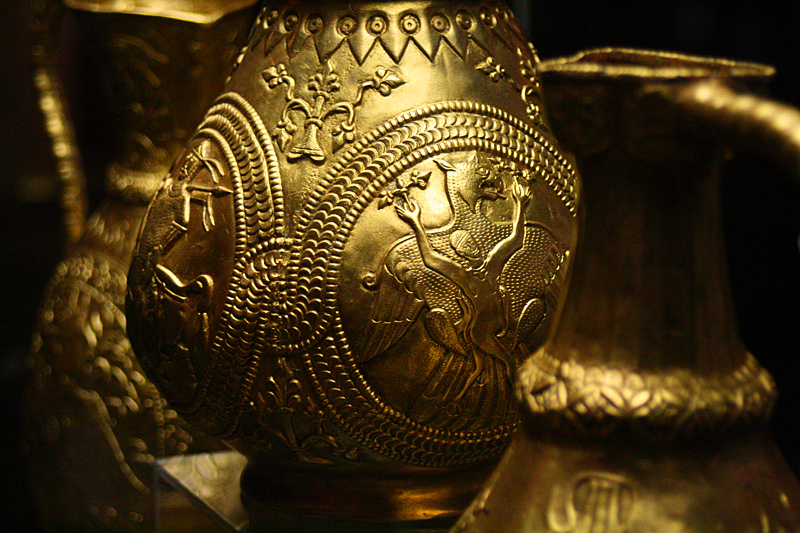
Gold Treasure of Nagyszentmiklos

The Gold Treasure of Nagyszentmiklos is the largest known hoard of early medieval gold vessels. The Treasure of Nagyszentmiklos was discovered accidentally in the Banat region of the Habsburg Empire in 1799. Its total weight is about 10 kg. It is remarkable for its quality and precision of craftsmanship.
Studies over the last few decades have revealed that the treasure was gathered over a long period of time, from the late 7th to the late 8th century AD, and seem to confirm its links to the Avar culture.

Thursday, April 16, 2020

Golden Kingdoms: the Ancient Americas


Octopus Frontlet, 300–600, Moche culture
Golden Kingdoms: Luxury and Legacy in the Ancient Americas, was on view at the Getty Center in 2018. It traced the development of gold working and other luxury arts in the ancient Americas from about 1000 BC to the arrival of Europeans in the early 16th century. The exhibit reveals the ways ancient Americans used not only metals, but also jade, shell, and feathers.
Ear Ornament Depicting a Warrior, 640–680, Moche.
It was a world where feathers were more valuable than gold. The rarest feathers, including the iridescent green feathers of the quetzal, were reserved for the Aztec emperor himself.

The unprecedented exhibition featured 300 works from 53 lenders in 12 countries.
The MET exhibition traced the development of gold-working in the Americas from its origins in the Andes, to its expansion northward into Central America, and finally to Mexico, where gold-working comes into its own only after 1000 AD.
Jade plaque showing a seated king and palace attendant, 600–800 AD

Tuesday, April 14, 2020

Hawaiian Kona-style statue of the god of war Ku-ka’ili-moku - $7.5m

Offered in the 'Collection Vérité' on 21 November 2017 at Christie’s in Paris.

Hawaiian figurative sculptures are incredibly rare. Kamehameha I associated himself with the war god Ku-ka’ili-moku — the ‘land snatcher’ or ‘island eater’. This example was made circa 1780-1820 from the Metrosideros, a tree found in the high mountains of Hawaii. The figures that are known are all in museums. The statue made a whooping $7.5m blowing well past it's $3.5m estimate.


Also being auctioned is a Uli figure, which is a type of wooden statue carved only in the villages of New Ireland in Papua New Guinea. $ 3.4m


Tribal art is rising in value and has been doing so for many years. The reason is extreme rarity, there are more and more museums, but fewer and fewer pieces.

Sunday, April 12, 2020

Teotihuacan: City of Water, City of Fire

In 2017 the de Young Museum hosted the exhibit “Teotihuacan: City of Water, City of Fire.” More than 200 artifacts were featured, some never displayed before. Teotihuacan was established in the first century BC. By the fifth century it had evolved into an important urban center and multicultural metropolis, becoming the largest city in the Western Hemisphere. The so-called “City of the Gods” is estimated to contain 100,000 people at it's peak. Around 550 CE, the city was destroyed by fire.
900 years after its destruction, the Aztecs made their way into a ghost city in the northeastern part of the Valley of Mexico. There, the Aztecs considered Teotihuacan to be the city where the gods brought the world into existence.

Teotihuacan means the place where men become gods.

Tuesday, April 7, 2020

The Carambolo Treasure

While archaeologists believe the horde was deliberately buried in the sixth century B.C., most of the jewelry was likely made two centuries earlier.The Carambolo Treasure is a hoard of ancient gold discovered by construction workers near Seville in 1958. It is a collection of 21 pieces of goldwork, including a necklace, several chest decorations shaped like ox skins, and lavish bracelets.
Analysis revealed that the gold likely came from the same mines associated with underground tombs at Valencina de la Concepcion, which date to the third millennium B.C.
While the gold was sourced locally, the jewelry was mostly manufactured using Phoenician techniques. A Phoenician temple has been identified in the area where the Carambolo Treasure horde was found.

Monday, April 6, 2020

Ancient looted Chinese bronze makes $580k

A 3,000-year-old bronze vessel looted by a British soldier from an imperial palace in Beijing has fetched £410,000 (US$581k) in 2018. The water vessel, which dates back to the Western Zhou dynasty (1047-772BC), is believed to be one of only seven similar archaic vessels to exist, five of which are held in museums. The vessel was looted from the Summer Palace in Beijing by Harry Lewis Evans, a Royal Marines captain who fought in the Second Opium War (1856-60).

China’s State Administration of Cultural Heritage denounced the auction of "looted cultural relics."