![]() | Last year the bidding for the sixth known surviving piece from the John Bartlam factory in Cain Hoy, South Carolina opened at £10,000. It rose quickly in increments of £5000 up to £200,000. Then bids continued in increments of £10,000. | The teapot was estimated at £10,000-20,000. It was found at a flea market. |
Friday, October 25, 2019
£15 Early American teapot makes £460k
Thursday, October 10, 2019
Largest Creatures to ever walk Earth
![]() | In 2016 paleontologists in Patagonia, southern Argentina announced they unearthed a 90-million year-old fossil of what they claim is the largest dinosaur found to date. The dinosaur weighed about 80 tons, the equivalent of 14 grown elephants. The new dinosaur dwarfs even the Argentinosaurus, the previous largest contender. ![]() |
![]() | A complete skeleton was found in a field discovered by a farm worker in 2014, where up to seven such complete skeletons are believed to exist. | ![]() |
![]() | The titanosaur lived during the Cretaceous and was a sauropod – a huge plant-eater. Vertebrae and rib bones were among the finds from the quarry at La Flecha ranch, Chubut Province in Argentina. | ![]() |
![]() |
Tuesday, October 8, 2019
Utah Dinosaur 'death trap' reveals tove of predators
| A nine-ton block of sandstone that was pulled from a Utah mountain in 2014 holds the biggest fossil trove ever found of the giant predatory dinosaur known as Utahraptor. Utahraptor was covered in feathers, with a huge sickle claw on each second toe. All the Utahraptor fossils are contained within a large block of sandstone that was once what geologists call a "dewatering feature," or quicksand. The Utahraptor was the largest of a group of lightly-built carnivores, called the dromaeosaurs ('swift lizards'). It had large eyes, long grasping hands and powerfully clawed feet. | |
| It was carnivorous and relied on a hooked, slashing claw on each foot rather than the jaws and teeth of a typical predator. Its toe joints were specially enlarged so that its massive claw could be raised upward and backward to avoid damage while running.![]() | ![]() The dromaeosaur group also included Velociraptor, made famous by Steven Spielberg in 'Jurassic Park'. |
![]() | By chipping off smaller pieces of the block, researchers uncovered bones from a 16-foot-long adult Utahraptor, four juveniles, and a baby that would have been only about three feet long. |
Other bones at the site belong to a beaked, bipedal herbivore called an iguanodont. The dinosaurs may have been what attracted the Utahraptor group to the site.![]() | ![]() |
Monday, October 7, 2019
Nasa admits 'missing' rogue space rock
![]() | Known as 2019 TW1, the 52ft wide object is currently powering towards Earth at roughly 26,000 mph. First spotted 2 days ago it's estimated it will careen past this morning. TW1 will pass by at a distance of around 351,000 miles, which is nearly one and a half times the distance from Earth to the Moon. That is alarmingly close in space terms. Near Earth Objects fly past us regularly. The largest, 2019 RK, is only slightly smaller than the famous Chelyabinsk meteor that detonated over Russia in 2013. | ![]() |
Friday, October 4, 2019
Ancient Mysteries
![]() | Tarim Mummies. During an excavation beneath the Tarim Basin in western China, archaeologists were surprised to discover more than 100 mummified corpses that dated back 2,000 years. Victor Mair was stupefied when he found blonde-haired and long-nosed Tarim mummies after they were dug up and put on display at a museum. In 1993 Mair returned to collect DNA samples from the mummies. Test results validated his hunch that the bodies were of European genetic stock. While ancient Chinese texts describe groups of far-East dwelling Caucasian people, there is no mention of how or why they ended up there. | ![]() ![]() |
![]() | The Carnac Stones. With over 3,000 standing stones, Carnac (in Brittany) is the largest megalithic site in the world. Not all of the Carnac stones were set up for the same purpose. There are stone circles, rows of stones aligned perfectly, and even mausoleums with roofs made of large stones. Stones may have been periodically placed over thousands of years, but a rough calculation for the beginning of the stone placements is 4000 BC. | ![]() |
![]() Minoan Palace Ruins at Knossos | Fall of the Minoans. The Minoans were an Aegean Bronze Age civilization that arose on the island of Crete and flourished from about 2600 to 1400 BC. The Minoan eruption on the island of Thera (present-day Santorini) was among the largest volcanic explosions in history. The eruption is believed to have severely affected the Minoan culture. Evidence found on Crete indicate that a massive tsunami, generated by the Theran eruption, devastated the coastal areas of Crete and destroyed many Minoan settlements. | ![]() |
![]() ![]() | Bog Bodies. A bog body is a human cadaver that has been naturally mummified in a peat bog. Such bodies, sometimes known as bog people, are widespread. Bog bodies have retained their skin and internal organs due to the unusual conditions of the bog. These conditions include highly acidic water, low temperature, and a lack of oxygen. The overwhelming majority of bog bodies have been found in Northern Europe, particularly Denmark, Germany, the Netherlands, the United Kingdom and Ireland. | ![]() ![]() |
![]() The Helike Delta with the Gulf of Corinth at left. | Lost City of Helike Helike was situated on the northwestern part of the Peloponnesian peninsula. During its heyday, Helike was an important economic, cultural and religious centre. One night during the winter of 373 B.C., the city of Helike was obliterated. The rescue party that came in the following morning found no survivors. No trace of the legendary society existed outside of ancient Greek texts until 1861 when an archaeologist found a bronze coin with the unmistakable head of Poseidon. In 2001, a pair of archaeologists located the ruins of Helike. | ![]() |
![]() | Rongorongo. Rongorongo is an indecipherable hieroglyphic script used by the early inhabitants on Easter Island. While no other neighboring oceanic people possessed a written language, Rongorongo appeared mysteriously in the 1700s. The language was lost—along with the best hopes for ever deciphering it—after early European colonizers banned it. | ![]() |
![]() | Frozen for 40,000 years, this mammoth calf was discovered in 2007 by reindeer herders in Siberia. The remains of two Ice Age puppies were found perfectly preserved in 2015. Long extinct Siberian Cave Lion Cubs were discovered in 2014. Other long-frozen remains may emerge from shrinking ice sheets. | ![]() |
Thursday, October 3, 2019
Roman shipwreck yields intact amphorae
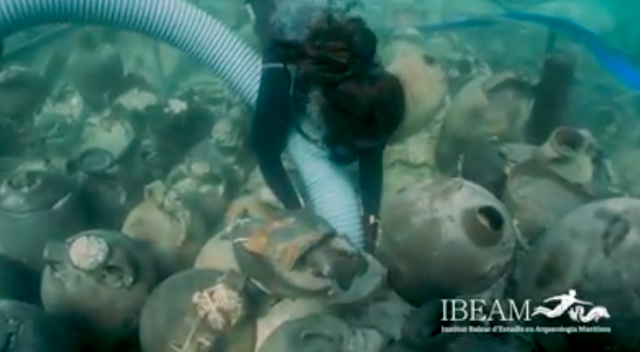
![]() | An ancient Roman shipwreck has been discovered off the coast of Mallorca in Spain with 93 sealed amphorae inside. Believed to be the wreck of a merchant ship, it was likely carrying a shipment of oil, salt and wine in amphorae from the south of the Iberian Peninsula. The ship was relatively small, measuring just 33 feet long and 5 feet wide, with amphorae stowed in the hold. Many of the vessels remain intact and sealed, meaning their contents may have been preserved. Experts estimate the ship was dated to the third century A.D |
Wednesday, October 2, 2019
Green rock of Hattusa a mystery
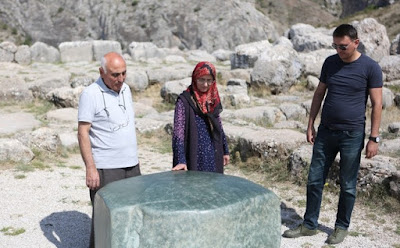
![]() | A giant ancient green rock located in the capital of the Hittite Empire in central Turkey is a centuries-old mystery. Visitors to Hattusa, the capital of the empire which lies near modern Boğazkale in Çorum province, admire the beauty of the rock. | ![]() |
![]() | Called a "wish stone" by locals, the rock's purpose has yet to be revealed. The rock is different from all others found at the site and is serpentine or nephrite. Researchers believe the stone was used by all civilizations after the Hittites. | ![]() |
Tuesday, October 1, 2019
Golden Man arrives in Malaysia
![]() | ![]() ![]() |
Subscribe to:
Comments (Atom)

The teapot was estimated at £10,000-20,000. It was found at a flea market.