 | The peak of the Tolita culture lasted around 700 years. Its demise was marked by the abandonment of the Island of La Tolita around 400 AD. The artisans of the Tumaco culture excelled in the work of gold, platinum and tumbaga (an alloy of gold and copper). These metals were mainly used for artistic objects. The earliest evidence of the use of metals in the region comes from the archaeological site near the Islandof la Tolita, where a sheet of gold was found that was dated between 915 and 780 BC.
|

Wednesday, March 26, 2025
Tolita-Tumaco gold figure
Discovered near the border of Colombia and Ecuador, the 100 BC figure is from the Tumaco-Tolita culture. The Tumaco-La Tolita lived on the coasts of Ecuador and extended as far north as Buenaventura, in Colombia.


Tuesday, March 25, 2025
Trove of 11th century gold coins in ancient Caesarea
 | In 2018 six rare Byzantine gold coins and 18 Fatimid-era coins testified to a wealthy family fleeing conquest on the eve of the bloody 1101 crusade. 24 gold coins and a gold earring was discovered in a well-hidden bronze pot during excavations in the ancient harbor of Caesarea. The dinars were all 24k gold, whereas the Byzantine coins were 22k. The treasure was likely hidden during flight from the bloody Crusader battle of 1101 at the seaside stronghold, in which the ruling Fatimid empire was routed and its people massacred or taken as slaves. The hoard was immensely valuable. One or two of the gold coins were the equivalent of the annual salary of a farmer. |
 | Baldwin I of Jerusalem was behind the Crusader conquest of Caesarea in 1101. After his coronation on Dec 25, 1100, he captured a series of port cities from the Egypt-based Fatimid empire. |  Five of the six rare 'Christian' coins belong to the reign of Byzantine Emperor Michael VII Doukas (1071–1079). |
 |  | Caesarea was the capital of the Roman province of Judaea in 6 ce. It was a centre of early Christianity. The Jewish revolt against Rome was touched off at Caesarea in 66 ce. Caesarea was the capital of the province renamed Syria-Palaestina by Hadrian. |
 Under the Byzantines it was capital of the province of Palaestina Prima. The city declined under later Byzantine and Arab rule. Its port and part of the ancient citadel were rebuilt by the crusaders; the city was successively taken and retaken by Muslim and crusader forces. Under the Byzantines it was capital of the province of Palaestina Prima. The city declined under later Byzantine and Arab rule. Its port and part of the ancient citadel were rebuilt by the crusaders; the city was successively taken and retaken by Muslim and crusader forces. |  |
Sunday, March 23, 2025
Iron shackles from Ghozza reflect harsh reality
 | Excavations at a 2,200-year-old mining village in Ghozza, Egypt in 2020 revealed a grim reality ... forced slave labour. Egyptian gold mining activity in the region saw a rise in the Hellenistic period (332–30 BC). |
 | The new dynasty founded by Ptolemy I needed gold to fund military campaigns, prestige projects abroad and monumental buildings in Alexandria to reflect its power and wealth. Ghozza was the northern-most Ptolemaic gold mine and the workforce processed ore with hand grinding stones. Hundreds of ostraca (pottery sherds used as surfaces for writing) found at the site provide a record of daily activities. They showed that some miners received wages. Two sets of iron shackles revealed some labour was forced. These were clearly for human use and could not have been removed without assistance. While they allowed the hands to remain free, walking with them would have been slow and exhausting. |
 | Ancient writers identified the miners as prisoners of war and convicted criminals and that some were also slaves. They vividly described the harsh conditions endured by gold miners under the Ptolemies: “And those who have been condemned in this way—and they are of a great multitude and all have their feet bound—work at their tasks unceasingly both by day and throughout the entire night.” The shackles closely resemble those uncovered in the silver mines of Laurion, Greece. Its possible the technological knowledge used in Egyptian gold mines during the Hellenistic period was imported by Greek and Macedonian engineers. Beneath the grandeur of Egypt's wealth lies human exploitation and suffering. |
Friday, March 21, 2025
The Monster of Troy
In Greek myth, a terrible sea monster suddenly appears on the Trojan coast, where it causes great destruction. To appease the beast, the king of Troy, Laomedon, sends his daughter Hesione as a sacrifice. At the last moment the hero Hercules arrives to slay the monster and rescue the princess.
Some suggest that the Monster of Troy resembles a Plesiosaur, a Mesozoic marine reptile.
 | A menacing creature lurks on an ancient Greek vase in the Museum of Fine Arts in Boston. The scene is on a Corinthian krater dating to around 550 B.C. It is the oldest illustration of the ancient legend of the Monster of Troy. The vase shows Hesione and Hercules fighting the monster. |  Hesione throws rocks from a pile at her feet while Hercules shoots arrows. |

| Plesiosaurs are amoung the largest marine apex predators in the fossil record.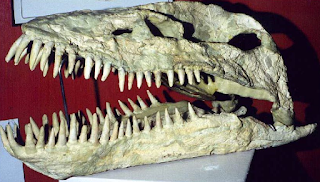 |  Hercules and the Princess of Troy (1965) Hercules and the Princess of Troy (1965) |
 |  |
Thursday, March 20, 2025
The Lycurgus Cup - dichroic glass
 | While nanoparticles sound like a recent discovery, the tiny structures have been used for centuries. The Lycurgus cup, made by 4th century Roman artisans, features dichroic glass. The Lycurgus Cup, with gold and silver nanoparticles sprinkled throughout, produces a green appearance when light is shining on it from the front, and a red appearance when illuminated from behind. The cup was perhaps made in Alexandria or Rome about 290-325 AD. In 1958 Victor, Lord Rothschild sold the cup to the British Museum for £20,000. |
 | The cup is also a very rare example of a complete Roman cage-cup, or diatretum, where the glass has been painstakingly cut and ground back to leave only a decorative "cage" at the original surface-level. The cup features a composition with figures, showing the mythical King Lycurgus, who tried to kill Ambrosia, a follower of the god Dionysus (Bacchus to the Romans). She was transformed into a vine that twined around the enraged king and restrained him, eventually killing him. Dionysus and two followers are shown taunting the king. |
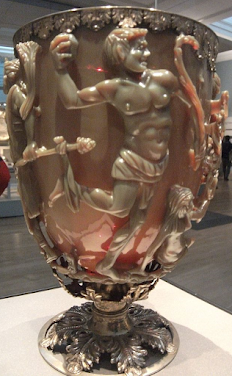 | The process used to create the dichroic effect remains unclear, and it's likely that it wasn't well understood or controlled by the makers. | 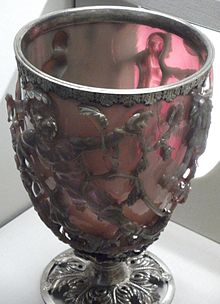 |
Monday, March 17, 2025
Ancient Gold of Kazakhstan - Golden Man of Saka
Ancient burial mounds built by the Saka people of central Asia contained unfathomable gold riches. The Saka flourished from around the eighth century BC to the third century BC.
 | A discovery from the Yeleke Sazy burial mound in 2018 was male and about 18, dressed in gold. The finds date to the 7th or 8th century BC. Rockfall shielded his grave from looters for 2,500 years. The “golden man” was found in one of the burial mounds of the Eleke Sazy cemetery. His was only the second intact Saka burial to be discovered in Kazakhstan. The Saka people were feared warriors but were also skilled artisans who crafted gold and metal. |
 | Archaeologists found the remains along with gold-embroidered armour and other precious artefacts during a dig. The garments and boots of the young man were embroidered with gold beads. There was a 1 kg gold torc on his neck. |  The finds are from the Tarbagatai district, East Kazakhstan. |
 |  He had a golden dagger and a golden quiver. |
 | The gold jewelry and items bear evidence of cutting-edge technology. People of that time had developed metallurgical expertise; mining, ore concentration, and smelting. |  |
 | Discovered in the burial of Alike Sazy were arrow tips made of bronze. The artifacts are extremely well preserved and still remain sharp. The arrows were likely used for ritual purposes or as grave goods as they would be extremely valuable. |  Grave of princess of Ukok |
 |  |
Sunday, March 16, 2025
The St Albans Hoard
 | In October 2012, a novice treasure hunter who bought a basic metal detector returned to the shop in Hertfordshire weeks later, clutching part of England's finest ever hoard of late Roman gold coins. Wesley Carrington took his new metal detector out into a field near St. Albans and struck ancient gold. He showed stunned staff at the store 40 gold solidi, before asking: 'What do I do with this?' They contacted local experts and together got the permits they needed, headed back to the scene and found another 119 coins. The find of such a large hoard of solidi is very rare, as the coins were not in regular circulation due to their extremely high value. |
 | The man had bought a Garrett Ace 150, retailing at around £135 and described as "the ideal metal detector for parent-child expeditions or for adults interested in exploring a potential hobby". After finding an old spoon and then a half penny, Carrington's machine beeped again. He dug seven inches down to uncover a gold coin with a Roman figure on it. Others followed. |
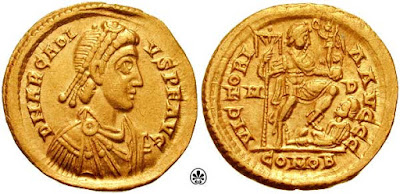 | The hoard is a nationally significant find. The coins are a rare example of the solidus, dating from the last days of Roman rule in Britain. The last consignments of them reached UK shores in 408 AD. St Albans was the site of the Roman town of Verulamium. |  |
Saturday, March 15, 2025
"Ides of March" Coins
 | Brutus issued a silver denarius celebrating the assassination of Caesar on the Ides of March (March 15). The denarius has a portrait of Brutus on the obverse, with on the reverse a liberty cap flanked by two daggers over the inscription EID(ibus) MAR(tiis). The liberty cap was the garment given to a manumitted slave to indicate his free status, so the reverse side symbolizes Brutus and Cassius liberating Rome with their daggers. There are about 60 known copies of the silver denarius. A superb example made $332k in a 2016 auction. Silver specimens in extremely fine condition have sold at auction for $120k. Low grade silver examples come on the market for around $50k. |
 | An ‘Ides of March’ aureus is one of three known examples. It was recently discovered hidden away in a private European collection. The coin is in mint condition and has been described as “the undisputed masterpiece of ancient coinage.” It made $3.5m. However its 'providence' was questioned. The coin was looted and then fraudulently sold at auction. It was seized and returned to Italy. |  |
 | The famous Eid Mar from the British Museum made $2.2m in May 2022. In October of 42 B.C., months after the coins were struck, Brutus and Cassius were routed by Marc Anthony and Octavian’s forces and died in the Battles of Philippi. Their coins were outlawed and few survived. |
Gold of the Royal Cemetery of Ur
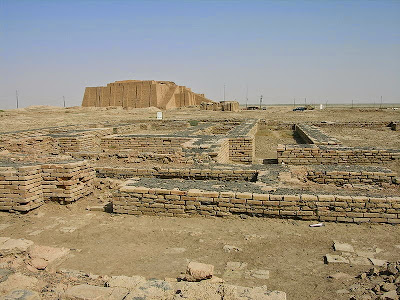 | Ur was an important Sumerian city-state in ancient Mesopotamia, located at the site of modern Tell el-Muqayyar in southern Iraq. Although Ur was once a coastal city near the mouth of the Euphrates on the Gulf, the coastline has shifted and the city is now inland, south of the Euphrates, 16 kilometres (9.9 mi) from Nasiriyah. | 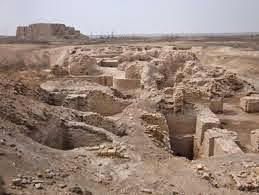 |
 |  Electrum drinking tumbler. |  | The city dates from 3800 BC. According to one estimate, Ur was the largest city in the world from c.2030 to 1980 BC. Research indicates that the area was struck by severe drought from 2200 to 2000 BC. |
 | Close to temples at the center of the city, a dump built up over centuries. Unable to use the area for building, people buried their dead there. The cemetery was used 2600-2000 BC. Many graves contained rich materials. The tomb of Pu-abi was excavated along with 1800 others at the "Royal Cemetery of Ur" between 1922 and 1934.  |  |
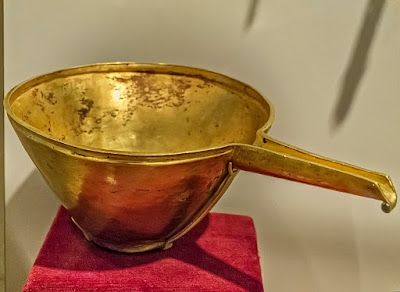 | Pu-abi's tomb was unique because of the large amount of high quality and well-preserved grave goods and because her tomb had been untouched by looters through millennia. Along a wall, three lyres and a harp deteriorated by time stood still in silence.  |  |
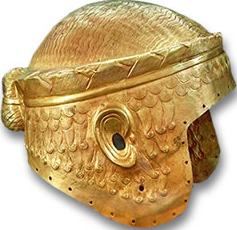 Gold Helmet of Sumerian King Meskalamdug |  Fluted Gold Bowl from Pu-abi's tomb 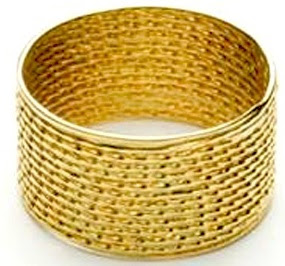 Queen Pu-abi's gold ring |  Gold and lapis lazuli bull's head was attached to a lyre. |
 Gold bull amulet, originally part of a necklace. The bearded bull was considered divine | 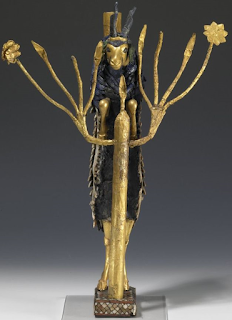 | 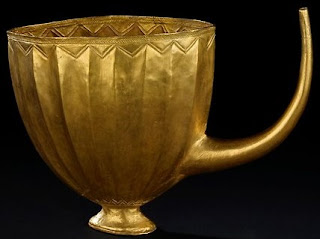 Gold spouted cup from the Royal Tomb of Queen Pu-abi | 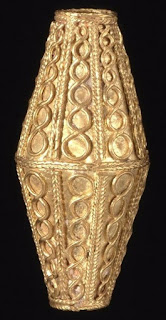 Gold bead with filigree |
Subscribe to:
Posts (Atom)