Friday, February 28, 2025

Minoan Gold


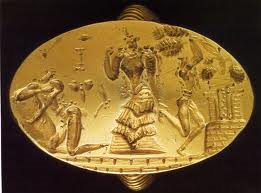
Minoan, about 1850-1550 BC. 'Master (or Mistress) of the Animals'
The Minoan civilization was a Bronze Age society that arose on the island of Crete and flourished from about the 27th century BC to the 15th century BC. 'Minoan' was coined after the mythic King Minos.
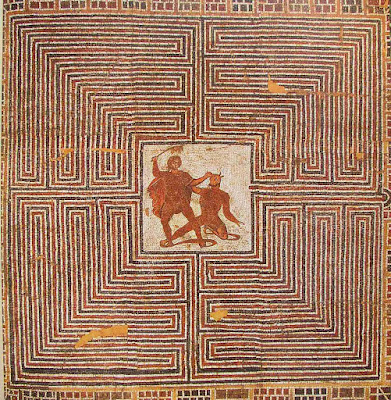
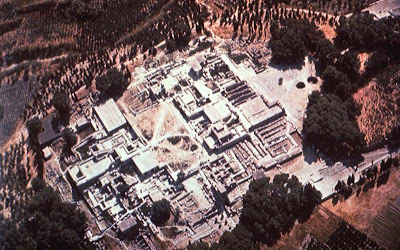
Minos is associated in myth with the labyrinth, which identifies with the site at Knossos.

The Minoan civilization developed from local Neolithic culture around 3100 BC, with complex urban settlements starting around 2000 BC. According to Greek mythology, King Minos of Crete had the craftsman Daedalus construct the Labyrinth in order to conceal the Minotaur.
Salzburg Multiple lane labyrinth with Theseus and the Minotauros in the center.

The Minotaur was a half bull and half man creature that yearly ate the Athernian tribute of fourteen young men and women.

The Bronze Age began in Crete as the island developed centers of commerce. This enabled the upper classes to expand their influence. The ground would be laid for a monarchist power structure - a precondition for great empires. Around 1450 BCE, Minoan culture experienced a turning point due to a natural catastrophe, possibly the eruption of Thera. (Santorin) The palace in Knossos seems to have remained largely intact. The Minoan palace sites were occupied by the Myceneans around 1420 BC. By 1200 BC the Minoans had faded into history.


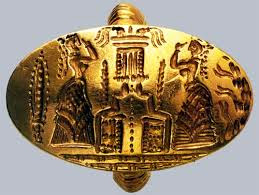
Signet ring dates to around 1500 BCE

UK gardeners land gold hoard

A family weeding their garden in New Forest in 2020 discovered a hoard of gold coins that may have been hidden during the dissolution of the monasteries there. The find of 63 gold coins and one silver coin, mostly date from the reigns of kings from Edward IV to Henry VIII. The coins were likely hidden around 1540 and sold for over $20k USD.
Four gold coins depicting Henry VIII have the initials of three of his wives on them. The initials stand for his first three wives Catherine of Aragon, Anne Boleyn and Jane Seymour. Henry VIII put the initials of whoever his wife was at the time on his coins but stopped the practice after Jane. Henry divorced Catherine, beheaded Anne and lost Jane when she died after giving birth.

Wednesday, February 26, 2025

The Salvation of Rome: Gordian III

Rome in the third century was a time of turmoil and encroaching chaos. Gordian III assumed the throne in 238 CE at the age of 13, making him the youngest sole Roman emperor. In 235, following the murder of Severus, Maximinus Thrax was acclaimed emperor by his troops. Born of Thracian origin and given the nickname Thrax "the Thracian", a growing opposition against him followed. The Roman Senate and the population of Rome opposed his rule. In 238, a rebellion broke out in the Africa Province, where Gordian's grandfather and uncle, Gordian I and II, were proclaimed joint emperors. This revolt was suppressed by Cappellianus, a loyal supporter of Maximinus.
Later in 238, a senatorial revolt broke out, leading to the successive proclamations of Gordian I, Gordian II, Pupienus, Balbinus, and Gordian III.
Maximinus advanced on Rome, but was halted at Aquileia, where he was assassinated by elements of the Legio II Parthica.
Gordian III served for almost six years before dying under mysterious circumstances while fighting against the Sassanian Persians. He was succeeded by his praetorian prefect, Philip the Arab. The Latin word “aureus” means “golden”, and derives from the Roman word for gold: aurum. The aureus was first produced in the first century BCE and was still being struck in the fourth century CE. It was initially valued at 25 silver denarii.

Tuesday, February 25, 2025

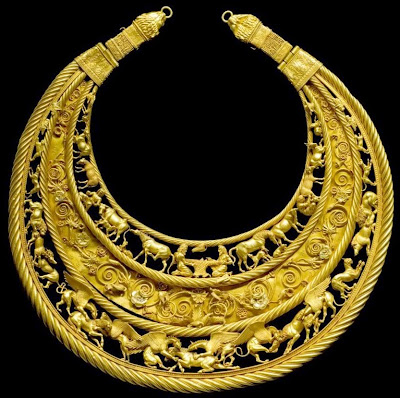
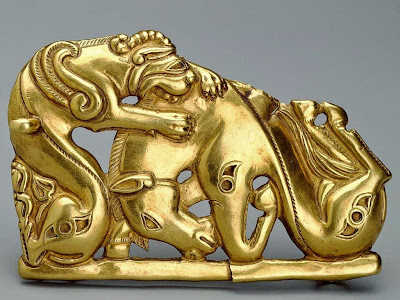
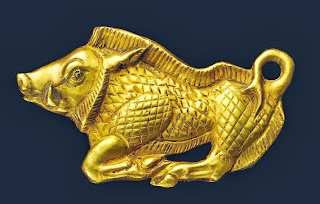
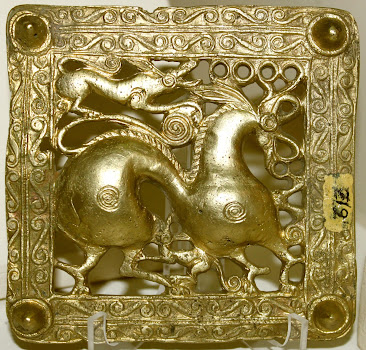
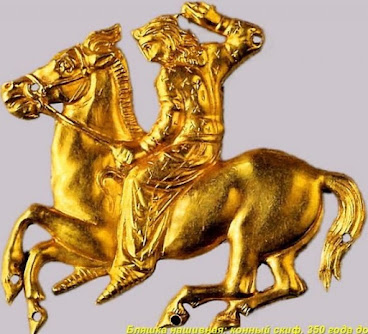
Scythian Gold

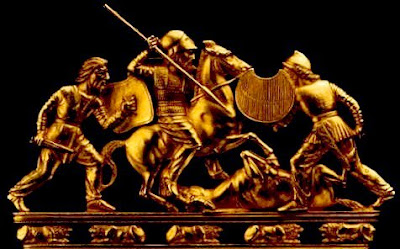
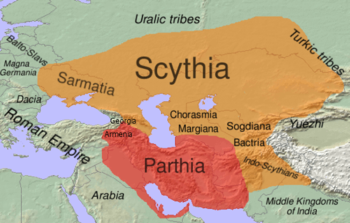
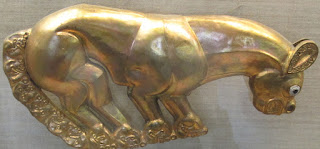
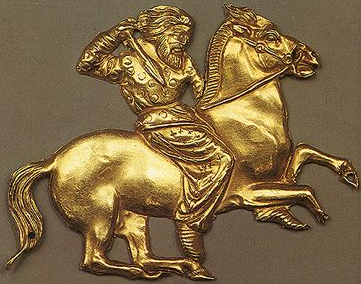
Scythians were Iranian equestrian tribes who inhabited large areas of the central Eurasian steppes from the 7th century BC through the 4th century AD. Ancient Greeks gave the name Scythia to all the lands north-east of Europe and the northern coast of the Black Sea, unknown to them in that era.

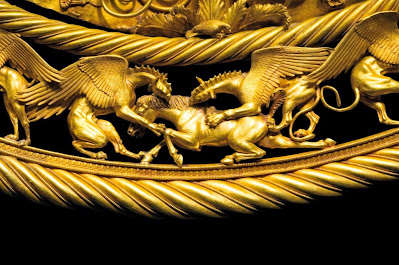
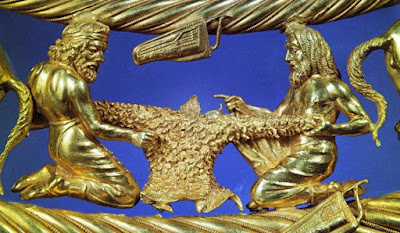
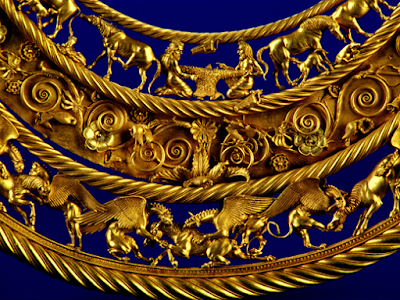
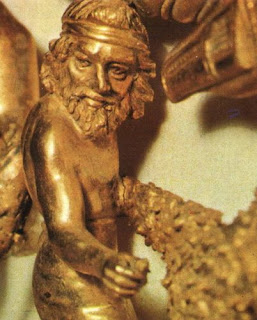
Scythian golden pectoral from the royal grave at Tolstaja Mogila kurgan, 4th century BC. It shows the three tiers of Scythian mythology: the Inner Earth, the Astral-Cosmic sphere and innermost the inhabited world.


Gold comb decorated with scenes of battle with Scythian warriors. From the tumulus of Solokha, Ukraine. 5th-4th century BC.

Royal burial site in Tuva, Late 7th century BC


Scythian golden sword and scabbard.

Gold Scythian belt title, Azerbaijan, 7th century BC.

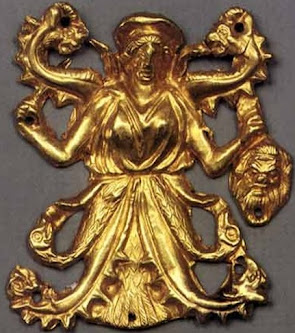
Scythian goddess Apa from the Kul Oba kurgan.

Scythian Gold Stag, 4th-3rd Century BC

The gold fish of Vettersfelde, Scythian, ca 500 BC

Friday, February 21, 2025

Ancient Helmets

The most vulnerable part of the soldier in battle was his head, so the search for protection by some form of helmet goes back to the earliest times. Helmets were purpose-built to protect the wearer against the specific weapons he faced.

Flattened copper helmet and skull found in the Royal Tomb at Ur
At first, ancient helmets seem to have been pointed at the top, to deflect the downward force. When the ax became popular as a weapon, the shape of the helmet was modified to counter the cutting edge of a downward-falling blade.

Stele of Vultures circa 2500 BC. King Eannatum of Lagash leads a phalanx of soldiers with metal helmets, armed with spears and socketed axes. They are trampling over the bodies of their enemies.
The technology of armor was constantly evolving. By 3,000 BC metal workers were making helmets of copper. 500 years later the Sumerians had bronze helmets, spears and axes.


Egyptian soldier in the act of killing a warrior of the 'Sea Peoples' in the Medinet Habu temple relief

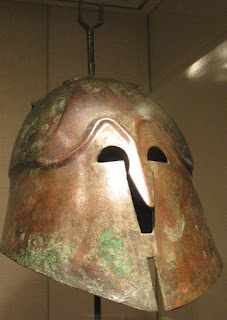
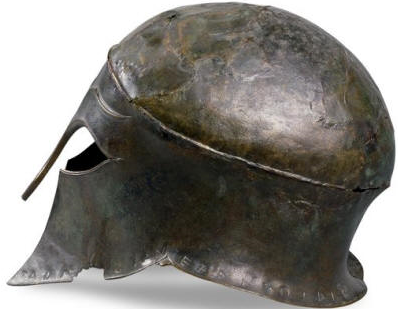
Corinthian helmet

The Helmet of Agighiol is a Geto-Dacian silver helmet dating from the 5th century BC.

Sutton Hoo helmet reconstructed

The Golden Helmet of Coţofeneşti
This 2,600-year-old bronze helmet was discovered in the waters of Haifa Bay, Israel in 2012. When it was made Greek colonies dotted the Mediterranean coast, stretching from the Black Sea to southern France.

This warrior was likely one of Egyptian pharaoh Necho II's mercenaries, which he sent through Israel accompanied by a fleet of ancient ships. The pharaoh was involved in military campaigns in the region for nearly a decade, operations in which this warrior and his group likely were involved.
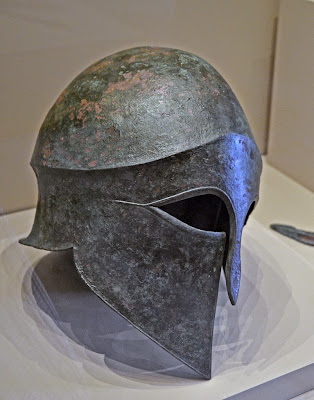
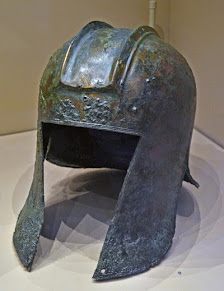
Ancient Greek helmets from the Archaic period (800 BC – 480 BCE). A Corinthian-type. The second is a Illyrian-type. The third is from Agia Paraskevi. All are made of bronze.
The Crosby Garrett Helmet is a copper alloy Roman cavalry helmet dating from the late 2nd or early 3rd century AD. 

Bronze Helmet from Ancient Greece, around 460 BC

Roman horseman's helmet.

Gladiator helmet

Greek Spartan Crest Helmet

Spanish morion (helmet)

Helmet of the Chou Dynasty, Emperor Wu Wang tomb complex at Laoyang, circa 1020 BC.

Japanese helmet, circa 1590–1640.

Helmet of a Yuan Dynasty officer

Chinese chichak-style helmet, Ming Dynasty


Helmet from 7th century Viking boat grave
A myth about Vikings was that they wore horned helmets. There is  no proof that Viking helmets had horns. The reason their helmets didn't have horns was because they would have gotten in the way in battle and would injure the wearer.

Real Viking helmets had protective metal down and around the ears and some helmets found in burial mounts had a metal mask in front.

German helmet by famous armorsmith Jörg Seusenhofer ca. 1540