Saturday, January 31, 2026

Bulgarian Valley of Kings

The Valley of the Thracian Rulers (or Kings) in central Bulgaria, near Kazanlak, represents a major concentration of Thracian elite tombs from the 5th–3rd centuries BC.
A four-wheeled wooden chariot, its intricately carved bronze plating and fittings, plus the skeletal remains of two horses and a dog have been preserved in situ instead of being removed to a museum. Thracian chariots were often buried with up to eight horses and their elaborately decorated bridles. Thracians established a powerful kingdom in the fifth century B.C.

The capital was thought to be Seutopolis, whose ancient ruins lie under a large artificial lake near Shipka, in an area dubbed 'the Bulgarian Valley of Kings' for its many rich tombs. It is believed that there are over 1500 funeral mounds in the region, with only 300 being researched so far.
The Kazanlak Tomb was found accidentally on 19 April 1944 by soldiers who were digging for entrenchment against aircraft. It dates to the first half of 3rd century BC.
The Svetitsa mound revealed a spectacular gold mask, which was laid on the face of the deceased person. It was made of a solid 673-g gold plate with individual features - thick hair, beard and mustache, the eyes half-closed. This is one of the earliest and richest tombs discovered in the Valley.
"To Seuthes," was written in one of the silver vessels and on a bronze helmet. It led some historians to suppose that the tomb belonged to King Seuthes III (ca. 330-300/295 BC). See ---- https://ancientbulgaria.bg/listings/valley-thracian-kings

Friday, January 30, 2026

Roman Chariot and horses, curse tablets, found in Croatia

In 2019 archaeologists discovered the remains of a chariot from ancient Rome along with two horses. Dating to the 3rd century AD, the find, the first of its kind in Croatia, represents an extremely high status burial ritual for a wealthy family.
The discovery stems from an ancient burial tradition under a mound known as a tumuli. Only those with the highest status and with extreme wealth were buried in this manner.
______________________
Archaeologists discovered golden curse tablets in Roman tombs. These contain inscriptions with magical symbols calling upon both gods and demons to unleash ill-health, punishment, and death upon enemies.
The curse tablets were found in Roman tombs at Viminacium, the ancient capital of the former Roman province of Moesia Superior in Serbia. The territory was under Roman (and later Byzantine) rule for about 600 years, from the 1st century BC until the 6th century. Viminacium occupies a total of about 450 hectares (1,100 acres)
“..so long as someone, whether slave or free, whether man or woman, keeps silent or knows anything about it, they may be accursed in blood, and eyes and every limb and even have all intestines quite eaten away if they have stolen the ring or been privy (to the theft).”

Other curses are even more personal ... “May your penis burn away when you make love.”
In Viminacium archaeologists found Christians and pagans buried together, suggesting they lived together in relative harmony and tolerance.

Tuesday, January 27, 2026

Famous Mythological Creatures

The Kraken. In Scandinavian mythology, the Kraken is a giant sea creature that attacks ships and is so huge that its body could be mistaken for an island. Accounts of the Kraken are believed to have originated from sightings of the giant squid, which can reach 18 meters in length.
The Griffin is a legendary creature with the head and wings of an eagle, and the body, tail, and hind legs of a lion.
While griffins are common in the art and mythology of Ancient Greece, representations of griffins in ancient Persia and ancient Egypt date to as early as the 4th millennium BC. On Crete, archaeologists have uncovered depictions of griffins in the Bronze Age Palace of Knossos dating to the 15th century BC.
Medusa was a Greek monster. She had the face of an ugly woman with snakes instead of hair; anyone who looked into her eyes was immediately turned to stone. She was a priestess of Athena, devoted to a life of celibacy; however as punishment for marrying Poseidon she was cursed.

Medusa was beheaded by the hero Perseus, who used her head as a weapon until he gave it to the goddess Athena to place on her shield. In classical antiquity the image of the head of Medusa appeared in the evil-averting device known as the Gorgoneion.
The Banshee is a spirit creature originating in Irish folklore. She is said to scream when someone is about to die. The foretelling of death was seen as both a blessing and a curse.

The Bean Sidhe or Banshee haunts only the families of authentic noble stock and it is with great dread when her piercing "caoine" or keening is heard. The Banshee scream is always a death omen.
Mermaids. In ancient Syrian folklore there was a goddess named Atargatis. She was a fertility goddess whose cult eventually spread to Greece and Rome and was associated with water.
Often depicted in mermaid form, Atargatis is perhaps the “original” mermaid. A Melusine, or siren, has two tails. This creature is from medieval legend. A Melusine was a beautiful woman that transformed into a serpent from the waist down while bathing. This always resulted in calamity.

Monday, January 26, 2026

The Prince of Prittlewell

The Prittlewell Prince refers to a high-status Anglo-Saxon royal burial discovered in 2003 near Southend-on-Sea, Essex. Called "Britain's Tutankhamun" due to its undisturbed state, the chamber yielded over 40 treasures. Radiocarbon dates combined with other dating evidence narrowed the burial to a period of about 30 years (AD 575–605). This date was refined by tiny gold coins from the coffin, called tremissi from Merovingian France.
An extremely high status Anglo-Saxon royal was laid to rest in a lavish tomb. He was buried with amazing treasures. 1,400 years later, the remains of the royal tomb was discovered next to a pub and a grocery store in the Essex town of Prittlewell.

The Museum of London Archaeology (MOLA) published a trove of research into the find, and launched an interactive version of the burial chamber.
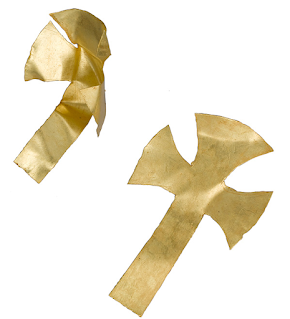
The identity of the Prince of Prittlewell may never be known. One theory suggests the tomb belonged to Sæberht, once King of Essex, who is known to have been an early Anglo-Saxon convert to Christianity. Two gold-foil crosses found at the head of the coffin were placed over the eyes of the deceased.
High status latticed blue glass beakers manufactured in Kent and a pair of drinking bottles

Sunday, January 25, 2026

Viking coin hoard brings jail sentence for thieves

A haul of Viking coins uncovered during a police raid in 2019 could “change British history”, according to a leading historian. The coins were described as a “nationally important hoard”.
44 coins, which were valued at £766,000, were discovered by police after Craig Best, from Bishop Auckland, County Durham, tried to sell some of them in 2018. The coins date back to 879AD under the rule of King Alfred the Great of Wessex and include two extremely rare 'Two Emperor' coins which were issued by King Alfred and Ceolwulf II of Mercia.
Craig Best (left), Roger Pilling (right) were convicted and sentenced to a total of more than 18 years in 2019. It is the legal responsibility of the finder of any precious metal objects that are over 300 years old to report them to the local coroner.
Accounts had suggested Ceolwulf of Mercia as a "puppet" of the Vikings and a minor nobleman rather than a proper King in his own right. However, the 'Two Emperor' coins tell a different story and show two rulers standing side by side as allies and peers. They portray him as a king in his own right and a strong ally to Alfred, rather than a ‘puppet’ for the Vikings as previously thought.

A 'Two Emperor' coin will bring six figures.
Police seized the hoard of coins and a solid silver bar from properties in County Durham and Lancashire during an investigation. The items include coins from the reign of Alfred the Great, King of Wessex, and Ceolwulf II of Mercia. King Alfred inflicted a major defeat on the Vikings in AD 878. Experts believe the coins belong to an undeclared hoard from the Viking army at that time. Alfred the Great created a unified kingdom of England.Alfred the Great

Saturday, January 24, 2026

Lincolnshire Roman coin hoard - 'largest find in Britain'

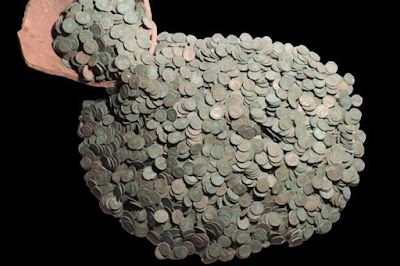
More than 3,000 copper alloy coins were found by two metal detectorists near the village of Rauceby, Lincolnshire, in July 2017.

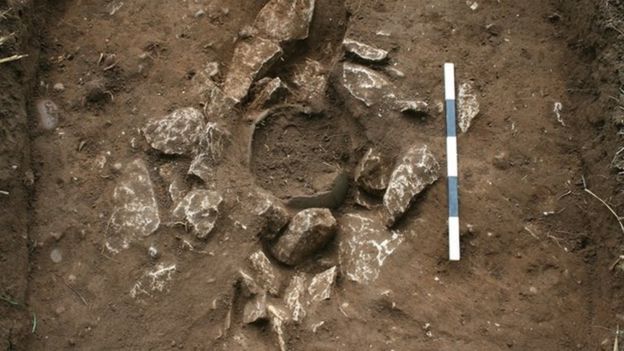
The coins were found in a ceramic pot, buried in an oval pit and may have been buried as part of a ceremony, or votive commemoration.
The coins were declared treasure following an inquest hearing. The coins are thought to date to the time Constantine was declared emperor in York (306 AD) while on a military campaign. York was Rome's northern military command headquarters. Around six years later, back in Italy, Constantine converted from paganism to Christianity. He was baptized on his deathbed in 337.

Friday, January 23, 2026

Sarcophagus dedicated to sky god found

Egypt unveiled the tombs of ancient high priests and a sarcophagus dedicated to the sky god Horus at an archaeological site in Minya in 2020.
The shared tombs were dedicated to high priests of the god Djehuty, from the Late Period around 3,000 years ago. One of the stone sarcophagi was dedicated to the god Horus, the son of Isis and Osiris, and features a depiction of the goddess Nut spreading her wings.
The ministry also unveiled 10,000 blue and green ushabti (funerary figurines), 700 amulets—including some made of pure gold bearing scarab shapes, and one bearing the figure of a winged cobra.

Horus is the name of a sky god in ancient Egyptian mythology which designates primarily two deities: Horus the Elder (Horus the Great), the last born of the first five original gods, and Horus the Younger, the son of Osiris and Isis.

Wednesday, January 21, 2026

Ichthyosaur fossil proves ancient sea monster roamed the world

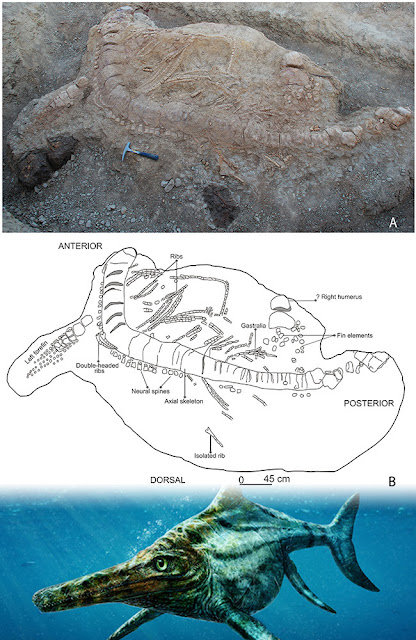
In 2019 a nearly complete fossil of the giant ‘lizard fish’ Ichthyosaur was unearthed in India. It’s the first time the fishlike reptile has been found on the sub continent.
It was found among the remains of its prey. It appears to belong to the Ophthalmosauridae family of Ichthyosaurs, closely related to Northern Hemisphere varieties. It likely lived between 152 and 157 million years ago.

Tuesday, January 20, 2026

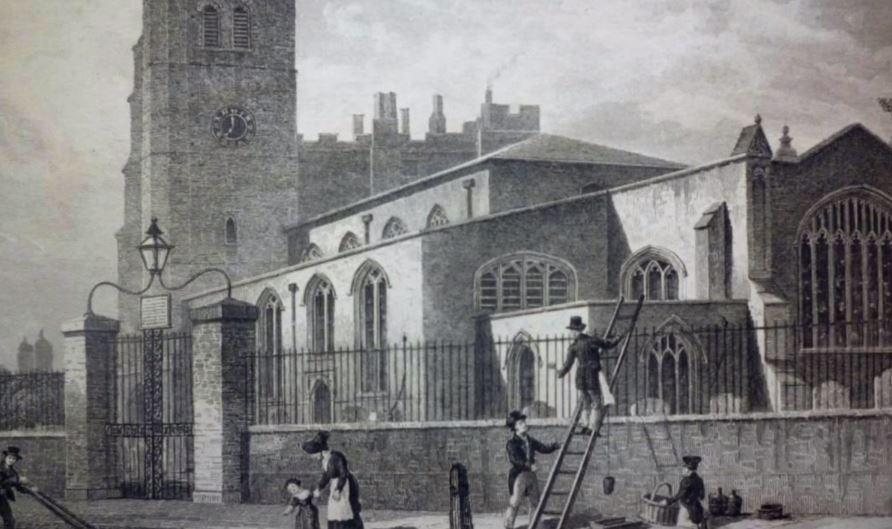
Forgotten Crypt in U.K. - exploding bishops

A forgotten crypt was uncovered in an ancient church in London in 2017. Inside are the remains of some of England’s most influential churchmen. They will remain undisturbed for now — being sealed in a lead coffin can have explosive consequences.

The tomb was accidentally uncovered by workmen refurbishing the Garden Museum in a neighborhood of London. The Garden Museum is located in the deconsecrated St. Mary-at-Lambeth Church, which dates back to 1062
The tomb appears to be 400 or 500 years old. At least five of the 30 coffins contain the remains of former archbishops of Canterbury — the most senior clergyman in the Episcopal Church of England.
Clergymen have been identified by plates affixed to the coffins. They include Richard Bancroft, who was England’s No. 1 churchman from 1604 to 1610. He played a major role in producing the King James Bible.
A corpse in a coffin that’s undisturbed for 400 or so years would turn most of us into dust. But some turn into so-called ‘coffin liquor.’
When the tightly sealed coffin lets the anaerobic bacteria win the day, some coffins will be one third full of a viscous black liquid. These contents can burst out violently when the seal is broken.

Monday, January 19, 2026

Roman coin hoard found in France

Tens of thousands of Roman coins have been unearthed in Senon, northeastern France. Some of the coins bear images of rulers of the Gallic Empire that controlled the region from A.D. 260 to 274.

The coins were collected over time in three amphoras, which were carefully buried in a dwelling so that the openings of the jars were level with the floor. The first jar held about 83 pounds of coins, and the second jar contained about 110 pounds of coins. Only three coins were found in a pit where a third jar had once been buried and later retrieved in antiquity.
This region of France was once populated by a Celtic tribe known as the Mediomatrici, who were eventually conquered by the Romans. It’s believed that these hoards were a type of long-term deposit rather than hastily buried treasure. The building they were found in was destroyed by fire. The three hoards in total contain at least 40,000 ancient Roman coins.
Between A.D. 260 and 274, during the height of the Crisis of the Third Century and the existence of the breakaway Gallic Empire, Roman coinage, specifically the antoninianus (double denarius), underwent severe debasement, reaching its lowest point in silver content. By roughly 260, the coins were only about 2% silver, often applied as a thin silver wash or plating over a copper core.