Tuesday, March 31, 2026

The Jersey Hoard (Grouville Hoard)

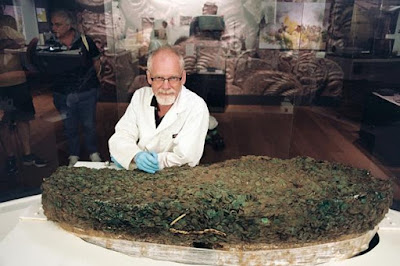
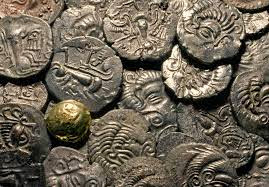
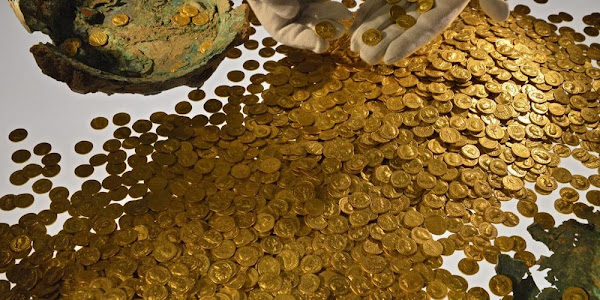
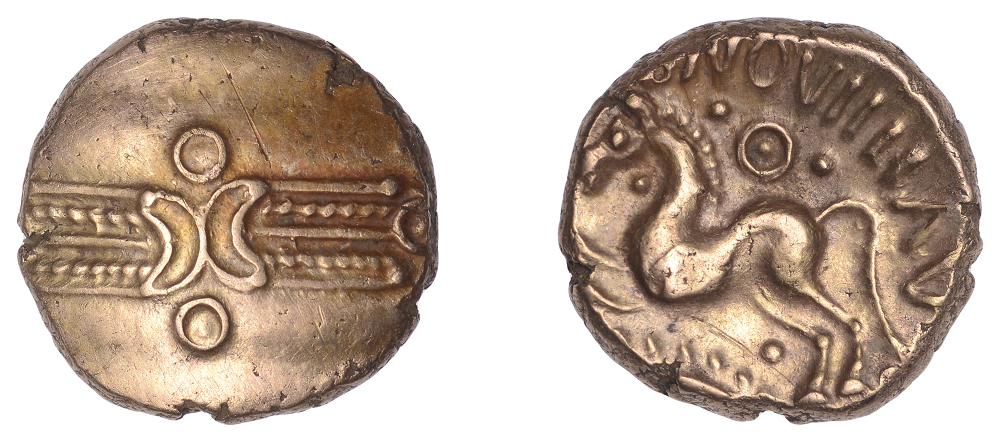
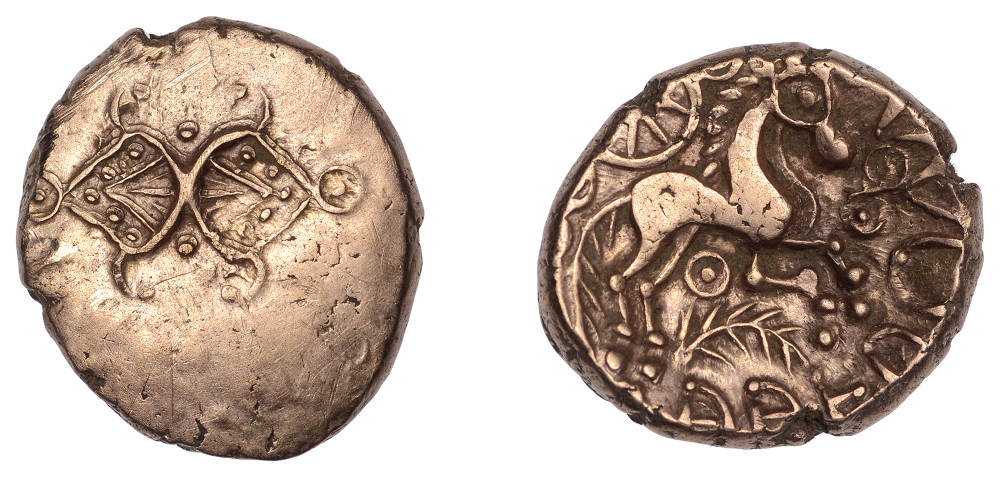
The last coins from an ancient Celtic hoard discovered in a field in Jersey were removed from the conglomerate they were buried in in 2020. Dating from around 30-50 BC, the collection of 69,347 coins was six times larger than any other similar Celtic artifacts and also included jewellery, beads and fabric. The hoard was probably buried by a tribe of Curiosilitae Celts. Historians believe they were fleeing Gaul to avoid Julius Caesar's armies around 50 to 60 BC.
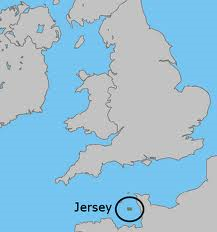
The Jersey Hoard (Grouville Hoard) is a hoard of late Iron Age and Roman coins discovered in June 2012. It was discovered in a field in the parish of Grouville on the east side of Jersey in the Channel Islands.

Jersey Heritage's conservation team have been excavating an area known to contain gold jewelery. One end of a solid gold torc was uncovered. The find follows the discovery of two other solid gold torcs - one gold-plated and one of an unknown alloy - along with a silver brooch and a crushed sheet gold tube.
__________________________________________________________
At least 50,000 coins dating back to the time of Julius Caesar were found in a field in Jersey. The Roman and Celtic coins, which date from the 1st Century BC, were found by two metal detector enthusiasts. Archaeologists said the hoard weighed about three quarters of a tonne.
It is the first hoard of coins found in the island for more than 60 years. Several hoards of Celtic coins have been found in Jersey before but the largest was in 1935 at La Marquanderie when more than 11,000 were discovered.
This is the world's biggest Celtic coin hoard ever, and was a significant part of a tribe's wealth. It is also one of the world's biggest coin hoards and certainly the biggest coin hoard found in Britain. The value of the hoard was estimated at up to £10m when it was first removed from the ground.

Trajan - alimenta

Circa A.D. 103 to 111 gold aureus of Trajan. The coin was struck at Rome and depicts a laureate and draped bust of Trajan on its obverse. Trajan also appears on the reverse, where he is standing facing left, a scroll in his left hand, extending his right hand to two children standing with their arms raised toward him. The inscription below, ALIM ITAL, is a reference to the alimenta. Graded Very Fine the coin made $2,000 in 2020.

TRAJAN AR silver denarius. Annona standing, child at her feet. ALIM ITAL, Alimenta Italia.
Alimentary grants (alimenta) were a form of state support in Italy for citizen children, initiated by Emperor Nerva and expanded under Trajan. Unlike previous grain doles, which were privately funded and limited to Rome, the new initiative was a state-funded subsidy at regular intervals for children all across Italy. Trajan’s pride in the alimenta led to a series of coins in gold, silver and bronze to commemorate it. This program continued under his successor and lasted into the mid-third century.

Aquila - SPQR


Jaws flapped about Trump's use of the Nazi eagle.
The Nazi eagle (Parteiadler - Imperial Eagle) was stolen from the Romans. The Nazi swastika was also hijacked from ancient sources.
The word swastika comes from the Sanskrit svastika, which means “good fortune” or “well-being."
An aquila, or eagle, was a prominent symbol used in ancient Rome, especially as the standard of a Roman legion. A legionary known as an aquilifer, or eagle-bearer, carried this standard. Each legion carried one eagle.
The eagle was very important to the Roman military, beyond merely being a symbol of a legion. A lost standard was considered an extremely grave event. The Roman military often went to great lengths to protect a standard and to recover it if lost. In the aftermath of the Battle of the Teutoburg Forest the Romans spent decades trying to recover the lost standards of the three destroyed legions. No legionary eagles are known to have survived. SPQR stood for Senatus Populusque Romanus. The meaning was "The Senate and People of Rome". S · Senatus = 'The Senate', P · Populus = 'The People', Q · Que = 'And', R · Romanus = 'Roman'.

Monday, March 30, 2026

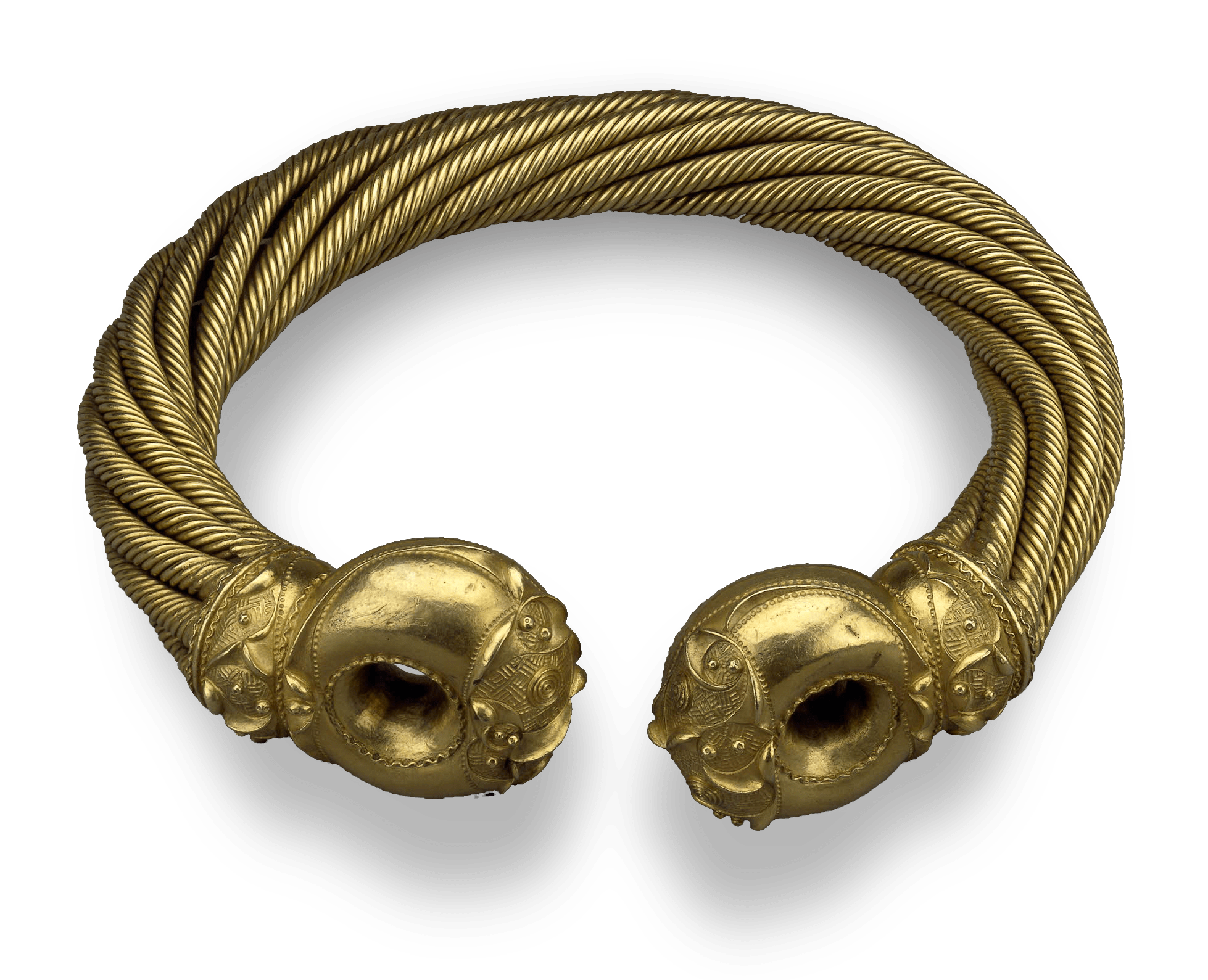
Great torc from Snettisham

The Great Torc from Snettisham or Snettisham Great Torc is a large Iron Age torc or neck ring in electrum, from the 1st century BC.
It is one of the finest pieces of early Celtic art known. It was the most spectacular object in the Snettisham Hoard, found in 1950 near the village of Snettisham in Norfolk, East Anglia. The perfectly intact torc is noted for its high level of craftsmanship and artistry. Soon after its discovery it was acquired by the British Museum.
It had been buried with a bracelet and a French coin, which helped date the torc to around 75 BC.
The hoard consists of metal, jet and more than 150 gold/silver/copper alloy torc fragments, more than 70 of which form complete torcs. The Great Torc weighs slightly more than 1 kg and is mostly made of gold alloyed with a small fraction of silver. The torc was made in two ways: complex threads of metal were grouped into ropes and twisted around each other to create the crescent shaped necklace; the ends of the torc were cast in moulds with La Tène designs and welded onto the metal ropes to create the whole composition. It has been conjectured that the area around Snettisham may have been connected with royalty from the Iceni tribe. The Great torc from Snettisham could belong to no one else.
Research by the British Museum reveals the wear patterns in the torcs, the chemical composition of the metal and the cut marks that reduced many of them to fragments. One hypothesis suggests the deliberate destruction of valuable items was a form of votive offering.

Chemical warfare is ancient history - Dura-Europos

Researchers claimed in 2009 to have found the first evidence of chemical weapons, dating from a battle fought at the ancient Roman fortress of Dura-Europos. 20 Roman soldiers unearthed beneath the town's ramparts didn't die of war wounds, but from poison gas.
War in antiquity rarely matched the heroism of myth. To stave off a Roman siege in A.D. 189, the defenders of the Greek city of Ambracia built a flamethrower that coughed out smoking chicken feathers.
At Themiscrya, another Greek outpost, Romans tunneling beneath the city contended with not only a charge of wild beasts but also a barrage of hives swarming with bees. Roman armies routinely poisoned the wells of cities they besieged.
Roman general Sertorius in 80 B.C. had his troops pile mounds of gypsum powder by the hillside hideouts of Spanish rebels. When kicked up by wind, the dust became an irritant, smoking the insurgents out.

In 332 B.C., the citizens of the doomed port of Tyre catapulted basins of burning sand at Alexander the Great's advancing army.
Poisoned arrows appear in classical literature. The epics of Homer, the Iliad and the Odyssey both insinuate the use of the poisoned arrows in the Trojan War. The myths of Hercules also allude to the use of poisoned arrows; after he slew the Hydra he dipped his arrowheads in the venom.

Scythians were famed for their poisoned arrows; the poison was a concoction of decomposed poisonous snakes and human blood incubated in a manure heap. One of the terms that the Greeks used to describe this poison was toxikon, which stemmed from toxon meaning a bow. Our modern word toxicology derives from this.

Greek fire was an incendiary weapon developed c. 672 and used by the Eastern Roman (Byzantine) Empire. The Byzantine formula was a closely guarded state secret. The composition of Greek fire remains a matter of speculation with proposals including combinations of pine resin, naphtha, quicklime, calcium phosphide, and sulfur. Byzantine use of incendiary mixtures used pressurized nozzles or siphōn to project the liquid onto the enemy.

Even in antiquity, some feared the lurking consequences of unleashing what we call chemical weapons. The ancient Greek tale of Pandora's box offers a metaphor for their use. Pandora's box is an artifact in Greek mythology which contained all the evils of the world. The phrase "to open Pandora's box" means to perform an action that may seem small, but that turns out to have severely detrimental and far-reaching consequences.

The Dura-Europos shield is the only surviving fully intact rectangular "long shield" (scutum) from the Roman Empire. It was discovered in the 1930s in the ancient Roman city of Dura-Europos in modern-day Syria. The artifact dates to the mid-3rd century CE (about 250–256 CE)
The rectangular arched shield is mainly made of wood. It was found broken up into thirteen parts. It is made from strips of wood that are 30 to 80 mm wide and 1.5 to 2 mm thick. They are put together in three layers, so that the total thickness of the wood layer is 4.5 to 6 mm.

In the center of the shield is a hole that was cut into the wood after the board was made, the umbo (central boss) is missing.

Sunday, March 29, 2026

The Coggalbeg hoard

The Coggalbeg hoard is an Early Bronze Age hoard of three pieces of Irish gold jewellery dating to 2300–2000 BC. It was found in a bog at Coggalbeg, County Roscommon in 1945, and consists of a gold lunula and two small gold discs. It's thought that the objects were ritually deposited as an offering to gods. The lunula is of the "Classical" type, considered the earliest and finest of three types of lunula. Of the estimated 100 lunula known in Western Europe, some 80 originate in Ireland.
The priceless gold was first discovered by farmer Hubert Lannon. He found it in a bog while cutting turf and kept it at home. In March 2010, two men pleaded guilty to burglary and were given three-year suspended sentences. Working with police, curators from the National Museum’s Irish Antiquities Division found out that the jewelry had been left in a dumpster in Dublin. The police had hours to locate the dumpster before the trash would be collected. The detectives waded through a dumpster and found the treasures. The necklace and two discs are among the most important archaeological discoveries in Ireland for many years.

The Roman gold ring that inspired J.R.R Tolkien

In 2016 the UK National Trust and the Tolkien Society put an artifact on display for fans of "The Lord of the Rings" to decide for themselves whether this was Tolkien's precious ring of power. The Vyne Ring or the Ring of Silvianus is a gold ring, dating to the 4th century, discovered in a field in Hampshire, England, in 1785.
Weighing 12g and featuring a ten-faceted design with a Venus-inscribed bezel, it's linked to a curse tablet. It was originally the property of a wealthy British Roman called Silvianus.
The large gold ring is inscribed in Latin, "Senicianus live well in God," and inset with an image of the goddess Venus. The ring is believed to be linked to a curse tablet found separately at the site of a Roman temple dedicated to a god named Nodens in Gloucestershire.
The tablet says a man called Silvianus had lost a ring, and it asks Nodens to place a curse of ill health on Senicianus until he returns it. An archeologist who looked into the connection between the ring and the curse tablet asked Tolkien, who was an Anglo-Saxon professor at Oxford University, to work on the etymology of the name Nodens in 1929.