Tuesday, April 29, 2025

'Gifts of gold, frankincense and myrrh'

The gifts of gold, frankincense, and myrrh, brought by the Magi to the newborn Jesus, were symbolic of his role as a king, a priest, and a human who would suffer and die. Gold as a symbol of a king, frankincense (an incense traditionally burned in the temple) as a symbol of deity, and myrrh (an embalming oil) as a symbol of death.
In the Bible, the wise men “saw the child with his mother Mary, and they bowed down and worshipped him. Then they opened their treasures and presented him with gifts of gold, frankincense and myrrh.” Frankincense and myrrh had been in use for thousands of years and were extremely expensive in ancients times - as much or more than gold. Frankincense was mixed with various spices to form incense, and myrrh was used by the ancient Egyptians as an embalming agent. Both substances are produced from the resin of trees in the Burseraceae family. An incision is made in the trunk of the tree and the resin is drained and dried.
Frankincense comes from Boswellia trees, myrrh from Commiphora trees.
The frankincense-producing Boswellia sacra is native to Oman, Yemen and Somalia. As the source of high quality frankincense, it has been widely over harvested into modern times. Myrrh is collected from Comiphora wightii, which is native to parts of Pakistan and India. It is critically endangered due to over-harvesting.

Saturday, April 26, 2025

Rare ancient gold brings top dollar

A rare Gaius (Caligula) (AD 37-41), with Agrippina Senior. AV aureus NGC AU 4/5 – 4/5 soared to a record $216k. Another ancient that reached six figures was an unpublished Stater of Menelaus, King of Cyprus that closed at $114k. Exceedingly rare with no examples in sales archives, and apparently unknown as a full stater.
A Star Mint State Julius Caesar Aureus that ended at $78k. Mint State ancient coins with a star designation for superior eye appeal are strong performers. An Otho (15 January-16 April AD 69). AV aureus NGC Choice VF 4/5 – 3/5 made $72k. Gold aurei like this example are rare and coveted as the "key" coin in any set of the '12 Caesars'.
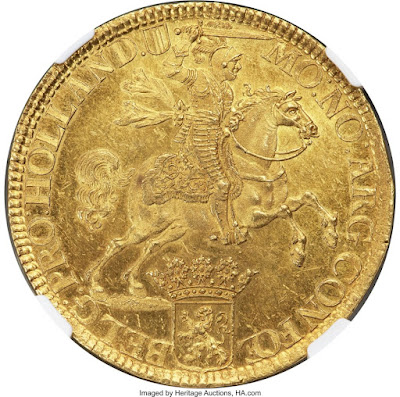
A Michael III "the Drunkard" (AD 842-867), with Theodora and Thecla. AV solidus (19mm, 4.42 gm, 7h). NGC MS★ 5/5 – 5/5 reached $66k. A Provincial gold Proof Pattern Ducaton (Silver Rider) 1672 PR63 NGC closed well above estimates at $180k. This coin is the only certified example known.

Wednesday, April 23, 2025

Expensive ancient coins

The record holder for an ancient Greek coin is the facing portrait gold stater of Pantikapaion, which brought $3.2m in a 2012 New York auction. Pantikapaion on the Black Sea coast of Crimea grew wealthy shipping grain from Ukraine’s fields to feed Greek cities. Weighing 9.12 grams, the coin was struck between 350 and 300 BCE. On the reverse a griffin stands over an ear of wheat, surrounded by the first three letters of the town’s name. The obverse shows the bearded head of a satyr.
Syracuse Tetradrachm of Kimon. Greek cities of Sicily during the fifth century BCE brought the art of coin die engraving to levels that would not be seen again for 1300 years. Cities like Syracuse, Akragas, Leontinoi and Naxos competed to celebrate their deities on large silver ancient coins. $3m a record for a Greek silver coin.
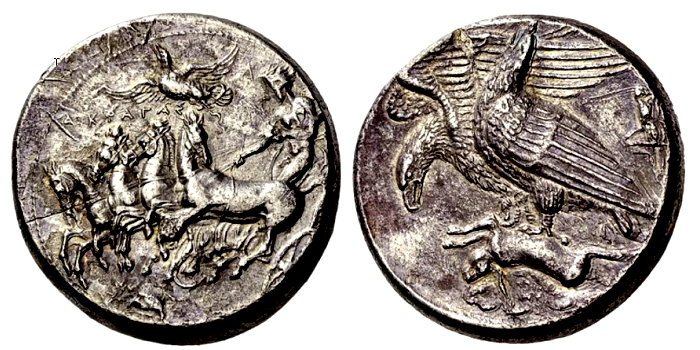
Akragas Dekadrachm. Until it was sacked by the Carthaginians in 406 BCE, Akragas (now Agrigento) was one of the largest and wealthiest cities in the Greek world. $2.4m
Dekadrachm of Athens. With only around 40 genuine examples known (and many convincing fakes), the silver dekadrachm of Athens struck c. 467-465 BCE is one of the most desired ancient coins. The obverse depicts the helmeted head of the goddess Athena. The reverse shows an owl, wings outspread. At 42.5 grams, the coin is so large that it pushed the limits of hand-hammered minting. $ 850,000
Gold Stater of Athens. A handful of gold staters and fractions were struck as an emergency wartime issue in 406-407 BCE. Four examples of the 8.6 gram gold stater are known, three of them in museums. The fourth brought $783k in 2008.

Tuesday, April 22, 2025

Evolution of Gold Coins

Gold has been used as a medium of exchange and a store of wealth for millennia due to its rarity, desirability, and high value. Ancient gold coins were first introduced in commerce in the kingdom of Lydia (modern Turkey) during the reign of King Croesus in the 6th century BC. The earliest coins were made from electrum, a naturally occurring alloy of gold and silver. Electrum wasn't always desirable. When coinage gained popularity a way to standardize the purity of the gold and silver was needed.
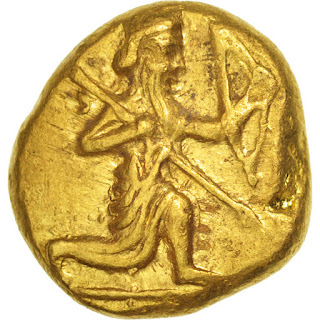
The first technique of gold parting was invented by Croesus: salt cementation. King Cyrus and the Persians defeated the Lydians in 546 B.C., and the region became part of the Achaemenid Persian Empire. Through trade and conquest, the Persians spread the use of gold coinage throughout the Mediterranean. The most popular gold coin of the empire was the Persian daric, introduced by Darius the Great sometime around 500 B.C. Production of darics continued for nearly two hundred years, until the Persians were defeated by Alexander the Great.
Alexander and his armies looted some 700,000 troy ounces of gold coins from the Persians. These ‘spoils of war’ were subsequently melted and used to mint coins in his name.

In Britain and elsewhere, a number of Celtic tribes issues coins in gold. The early Roman Republic issued few coins in gold, their main coinage being in silver, with bronze or copper for smaller denominations. From the death of Julius Caesar, gold coinage became an important part of the Roman financial system.

See ----->Gold of Croesus

Sunday, April 20, 2025

Vapheio Gold Cups

The pair of cups, which were created over 3,400 years ago, were the product of advanced Creto-Mycenaean metalwork. Called the “Vapheio Cups,” they are considered masterpieces of ancient Greek art.
Vapheio is an ancient site in Laconia, Greece, on the right bank of the Eurotas, some five miles south of Sparta. It is famous for its tholos or "beehive" tomb, excavated in 1889 by Christos Tsountas. The pottery in the tomb dates to around 1500 to 1450 BC, but the gold and carved gem seals might have been old when buried. Grave goods include a large number of carved gem seals and amethyst beads, together with articles in gold, silver, bronze, iron, lead, amber and crystal. Many of the seals and rings found in the tholos have strong affinities in style and subject matter with Minoan seals.
The finest of the grave goods are a pair of golden cups decorated with scenes in relief, showing two different methods of capturing bulls.
Some believe that the first cup is Minoan, while the other is Mycenaean.

Saturday, April 19, 2025

Eureka

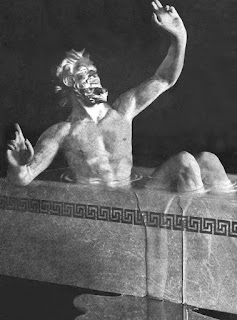
"Eureka" comes from the Ancient Greek word εὕρηκα heúrēka, meaning "I have found (it)" It is an interjection used to celebrate a discovery or invention. It is a transliteration of an exclamation attributed to Ancient Greek mathematician and inventor Archimedes. He reportedly proclaimed "Eureka! Eureka!" after he had stepped into a bath and noticed that the water level rose. He suddenly understood that the volume of water displaced must be equal to the volume of the part of his body he had submerged. The volume of irregular objects could be measured with precision, a previously intractable problem. He is said to have leapt out of his bathtub and run through the streets of Syracuse naked.
Archimedes' insight led to the solution of the problem of measuring gold's purity. Hiero of Syracuse suspected, correctly, he had been cheated by a goldsmith removing gold and adding the same weight of silver to a crown he commissioned. Equipment for weighing objects with good precision already existed, and now that Archimedes could also measure volume, their ratio would give the object's density, an important indicator of purity. The answer was now a simple one ... balance the crown against pure gold in air, and then submerge the scale with crown and gold in water to see if they still balance.

Friday, April 18, 2025

Gold leaf from Napoleon's crown makes €625,000

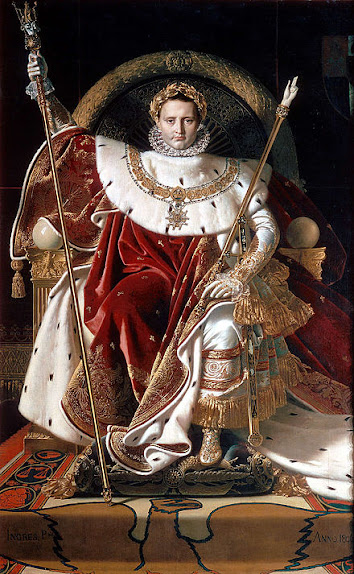
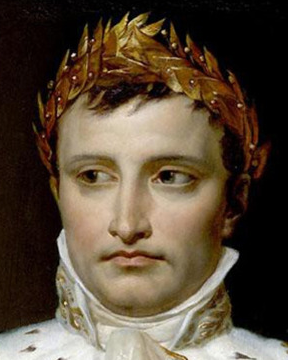
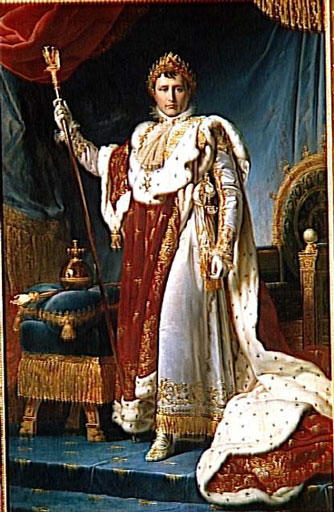
A golden laurel leaf from Napoleon's crown went under the hammer in 2017. Napoleon crowned himself emperor at the Notre Dame cathedral in Paris in 1804.
He famously took the Roman-style laurel wreath and put it on his own head, instead of letting Pope Pius VII do the honors. At a fitting for the crown leading up to the spectacular event, Napoleon had complained that it was too heavy. So goldsmith Martin-Guillaume Biennais took six leaves out of the crown, later giving one to each of his six daughters. The original wreath was melted down after Napoleon's fall in the wake of the Battle of Waterloo. The crown, modelled on the one worn by Roman caesars, is the centerpiece of Jacques-Louis David's monumental painting, "The Coronation of Napoleon" at the Louvre.
The crown Napoleon wore at his coronation had 44 large gold laurel leaves and 12 smaller ones.
Napoleon's crown cost 8,000 francs, with the box it was stored in a further 1,300 francs.

Thursday, April 17, 2025

Alexander the Great tetradrachms

When Philip II rose to power in 359 BCE, he recognized the importance of coinage. Philip’s coins became very popular throughout the ancient world. His son, Alexander the Great refocused the silver mintage on a tetradrachm based on the Athenian weight standard that could be used throughout Greece. For more than two hundred years, Alexander the Great tetradrachms would be minted at a prolific rate, sourced from mines in Thrace and Macedonia as well as the new bullion from the Persians.
Primary design elements remained consistent. The obverse depicts Herakles (Hercules to the Romans). Herakles was Zeus’ son and was able to attain divine status through 12 labors. The coin represents the first of those labors, the slaying of the Nemean Lion. The reverse shows Zeus wearing a crown.
A single coin represented about four day’s pay for a laborer, so Alexander also minted bronze coinage for smaller transactions.

Europe's most ancient battlefield - Tollense Valley

The Gross Raden Archaeological Open Air Museum is presenting an exhibition featuring artifacts, many of them found on the site of a battle which took place in the Tollense Valley, in the northeast of Germany.
The discovery of the battlefield in the Tollense Valley provides much to consider. Since 2007, over 10,000 human bones have been found. A series of bronze weapons, such as lances, arrowheads and knives were found. A few wooden clubs which were used for battle as well as the remains of horses have been found.
The violence wasn't random. The Tollense battle demonstrates a clearly organized form of violence. It was required to be able to assemble such a large group of young men and issue orders. It demonstrates that power was conditional for such a large, violent conflict.

This man did not see death coming his way 3300 years ago. A bronze arrow tip pierced the back of his head. The bronze arrow tip is still stuck in the skull.
The warriors were exclusively men, mostly between the ages of 20 and 25. The bodies on the battle site that were accessible were looted. They had no metal left on them – although they must have been wearing metal, since bronze was part of men's dress during the period. The remains of those who fell in the river are different, as metal objects have been found on them. Less than 10% of the site has been excavated.

Wednesday, April 16, 2025

Getty Museum told to hand over 'Victorious Youth' by Italians, again

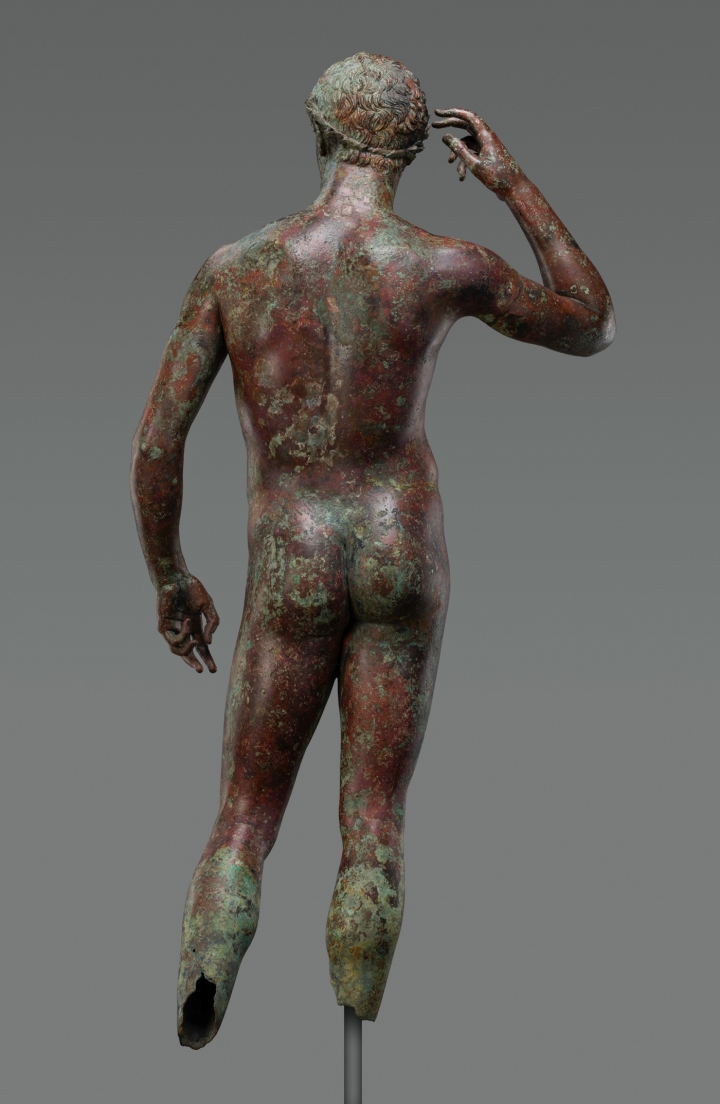
A naked youth stands with his weight on his right leg, crowning himself with a wreath, probably olive. The olive wreath was the prize for a victor in the Olympic Games and identifies this youth as a victorious athlete. Found in the sea in international waters, the statue is one of the very few life-size Greek bronzes to have survived. The statue, believed to have been recovered from the Adriatic Sea in 1964, has long been at the center of a legal and cultural battle between Italy and the Getty Trust, with Italy demanding its return under claims of illegal export. In 2021 the Italian senate approved a resolution that could pave the way to restitutions as politicians call for return of the ancient Greek bronze also known as Atleta di Fano.
Italy’s highest court ordered the Getty Museum in Los Angeles in 2018 to return an ancient Greek bronze statue. The ruling by the Court of Cassation in Rome was the latest round in a decade-long, acrimonious dispute over the ownership of the exquisite bronze figure, known as Victorious Youth or the Getty Bronze. The Getty Museum immediately rejected the judgment, saying it had no intention of giving up the fourth century BC statue. The museum bought it in 1977 for $3.95 million from a German art dealer. Italian authorities maintain that the statue was illegally taken out of the country.
A fresh dispute has erupted over the origins of the ancient Greek bronze statue known as Victorious Youth, currently housed at the Getty Villa Museum in Los Angeles, with Italian cultural authorities now questioning whether the statue was created by the famed Greek sculptor Lysippos. Lysippos of the 4th century BC together with Scopas and Praxiteles, is considered one of the three greatest sculptors of the Classical Greek era. Experts suggest the famed statue is a copy of Lysippos's work.