Sunday, November 30, 2025

The Galloway Viking Hoard

The Galloway Hoard is a hoard of gold and silver objects from the Viking age discovered in Dumfries and Galloway in south-west Scotland in September 2014.
The hoard has been described by experts as one of the most significant Viking hoards ever found in Scotland.
It was discovered by a metal detectorist who reported the find to the authorities. The hoard was valued in 2017 by experts at £2 million.
A county archaeologist carried out an excavation which revealed the presence of a variety of jewellery from various parts of the Viking world. It is thought that the hoard was buried some time in the mid-ninth or tenth century. The hoard consists of a variety of gold and silver objects including armbands, a Christian cross, brooches, ingots, and what is possibly the largest silver Carolingian pot ever discovered. The items among the treasure originated across a wide geographic area that includes Ireland, Scandinavia, and central Europe.
Medieval texts date the arrival of the Vikings in the British Isles to the 790s A.D., when fierce raiders appeared along the coasts, plundering rich monasteries and terrorizing local communities. During the three centuries that followed, ambitious Viking chiefs and their followers arrived to conquer and colonize territories in England, Ireland, Wales, and Scotland, until they and their descendants were finally defeated or assimilated.

Around the early 10th century Viking forces had suffered a serious setback in Ireland, and local Galloway folklore “referred to a Viking army being defeated by a Scots army” at Galloway.
In the upper layer, the team excavated a gold, bird-shaped pin as well as 67 silver ingots and arm rings, many produced by metalworkers in Ireland. This portable silver served as ready cash in the Viking world: the elite hacked off pieces to buy cattle or other commodities, reward loyal followers, or “pay off the troops” in Viking mercenary armies.
Three inches below that trove, researchers found the Carolingian pot, a lidded metal vessel buried upside down, perhaps to keep out ground water. It turned out to be packed with treasures, many carefully swathed in leather and fine textiles. Only six of these Carolingian vessels have ever been found. Scholars believe they were used during important ceremonies in the Catholic Church.

The hoard's mixture of gold, silver, glass, enamel, and textiles is unique

An ancient Anglo-Saxon silver cross buried for more than a millennium has been revealed for the first time. The cross was found as part of the Galloway Hoard, a trove of treasures discovered by a metal detectorist in a field in western Scotland in 2014. The cross, decorated using black niello and gold-leaf, features engravings depicting each of the writers of the Gospels. The Galloway Hoard is regarded as one of the richest and most significant finds of Viking objects ever found in the UK. The cross was made in Northumbria -- what is now northern England and southern Scotland -- in the 9th century for a high-ranking cleric.
Research into the Galloway Hoard has uncovered the name of one of its original owners on a silver arm ring. An expert examining Anglo-Saxon runic inscriptions on arm rings in the hoard found the name “Ecgbeorht”, which would be Egbert in its modern form.

A World of Emotions: Ancient Greece, 700 BC – 200 AD


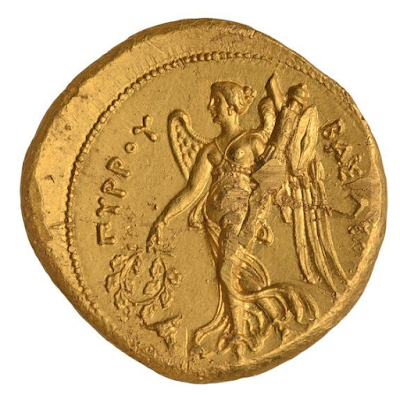
Stater Of Pyrrhos I Nike Holding A Trophy 278 BC
Bringing to life the people of ancient Greece, the Onassis Cultural Center New York presented the exhibition "A World of Emotions: Ancient Greece, 700 BC – 200 AD" in 2019.
Cup with Achilles Slaying Penthesileia, ca. 470–460 BC

Bronze vessel was made in Pharsalos about 370 BC.
The exhibition brought together more than 130 ancient masterpieces.

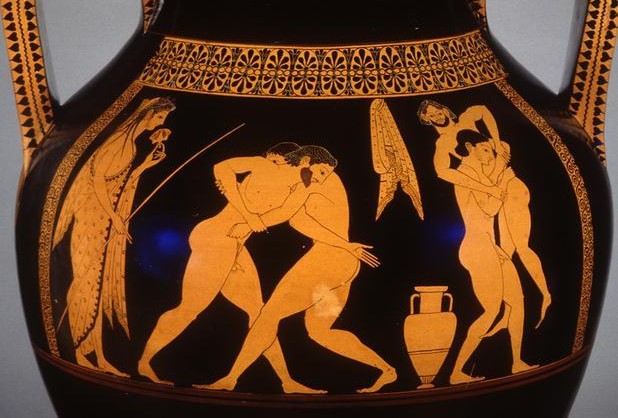
Amphora with Scene of Achilles and Ajax Playing a Board Game 540 BC

Saturday, November 29, 2025

Artifacts and Mummies Discovered in Ancient Egyptian Tomb

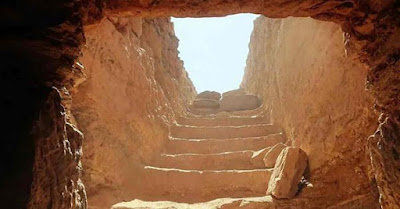
In 2019 Egypt confirmed an ancient tomb had been found carved in stone from the Greco-Roman period in Aswan, 539 miles south of Cairo.
The Greco-Roman Period (332 B.C.-395 A.D.) saw the rise of Alexander the Great who conquered the Persians who ruled over Egypt at the time, and founded Alexandria, the second largest city in Egypt.

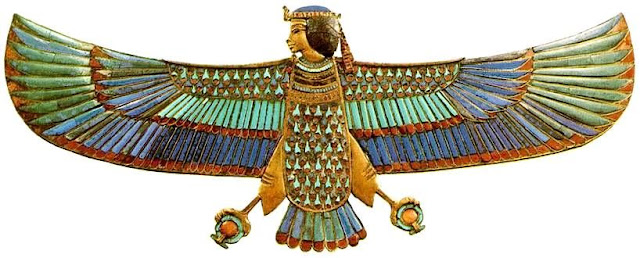
Small Ba bird statues were recovered which, according to ancient Egyptian mythology, was believed to fly out of the person’s tomb to join their vital essence in the afterlife.
The tomb contained about 30 mummies, including young children. There were also gold-painted funeral masks, statuettes, amphora-shaped jugs, ritual offering vases, vessels still containing food, coffin fragments, a lamp, and white cartonnages. One of the coffins presented a complete text, detailing the name of the tomb’s owner, Tjt.

Friday, November 28, 2025

$20 gold coin from 'Ship of Gold' makes $282k

The spectacular 1857-S Double Eagle, recovered in 2014 from the SS Central America set a record price for any 1857 San Francisco Mint $20 gold coin in a public auction conducted by Legend Rare Coin Auctions on May 16, 2019. The sunken treasure Double Eagle, graded PCGS MS67, sold for $282,000.

Gallic treasure - Treasure of Tavers


It was feared that the treasure would be sold at a price that could not be matched by museums and it would leave the country.
The 'Treasure of Tavers' hoard was declared a national treasure of France and purchased for €50.000 in 2019. It comprises 58 copper alloy and seven iron and lead pieces, including five full torque necklaces, eighteen bracelets (including six whole), four rings of pegs, three weapons and fragments of crockery. The rare metalwork would have sold for much, much more at auction.
65 pieces of metal, buried 2600 years ago by Gauls, is exceptionally rare. It dates to the protohistoric period, several centuries before the roman conquest.

Monday, November 24, 2025

Captain Black Sam Bellamy - The Whydah Galley

In February 1717 Captain Black Sam Bellamy captured the Whydah and made it his flagship. It's said that when the Whydah was wrecked off Cape Cod in a storm on 26 April 1717, Bellamy, 28, had been heading for Boston with a vast fortune on board. Bellamy, the “Robin Hood of the sea” was the highest-earning pirate of all time. Bellamy’s fleet captured over fifty vessels. The site on the shores of Cape Cod may contain the bones of as many as 102 men whose corpses remained after the Whydah sank. The Whydah was found buried beneath 18 feet of sand in 25 feet of water 1,500 feet from the shore in 1984.
The shipwreck has yielded over 200,000 artifacts, including treasure and the ship's bell. Coins recovered from the site represent a cross-section of global commerce in the early 18th century, spanning multiple mints, dates, and origins. Investigators discovered what they think are the remains of Bellamy himself.
A leg bone was found among sand and debris, next to a pistol said by the researchers to have unique features and symbols that prove it was one of Bellamy’s flintlocks.

Sunday, November 23, 2025

Rare Judaean and Roman coins

The First Jewish Revolt was 66-70 CE.
An extremely rare shekel produced in Year 4 plus the ultimate rarity–a Year 5 shekel. The Second Revolt was circa 132-135 CE.
Very rare Judaea Capta type gold aureus features a Roman trophy with the inscription DE IVDAEIS
Extremely rare hybrid features the strange legend IVDAEA AUGUST.
Titus, AD 79-81. Gold Aureus. A true rarity, the date is early in AD 70, which places it before or during the siege of Jerusalem (May-September 70).
Roman Emperor Galba ruled for eight months from AD 68 to 69