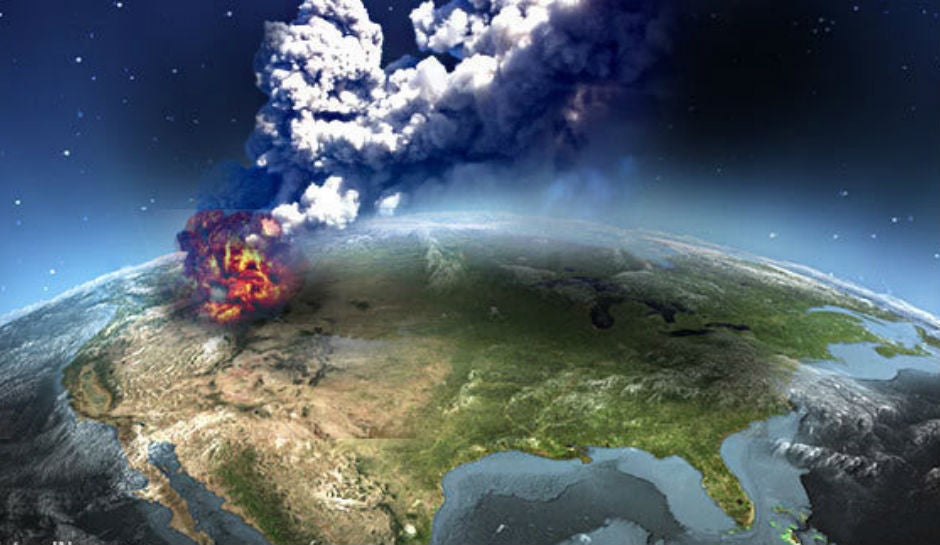
![]() | There are five tremors a day on average. Monitoring records from the US Geological Survey shows that all of the earthquakes have been relatively small, with the largest being a 3.5. Some geologists argue that when it comes to forecasting a volcano eruption, it's not the size of the seismic activity, but more the quantity. | A spate of small earthquakes around a volcano usually signifies that magma and gasses beneath the surface are beginning to navigate their exit. |
Thursday, August 22, 2019
Yellowstone volcano: 133 earthquakes registered in one month
Monday, August 19, 2019
Sekhmet 'The Powerful One'
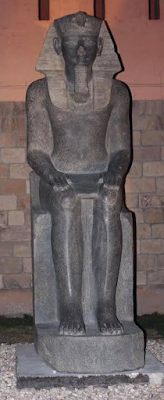
![]() | In 2017 archaeologists discovered 66 fragments and statues of Sekhmet believed to have been warding off evil from Amenhotep III’s temple. Amenhotep III’s reign, between 1386 to 1349 BC, is regarded as the peak of Egypt’s prosperity and power. | ![]() A toppled black granite statue of Amenhotep III was also found at the site. |
![]() | The statue of Amenhotep shows the king as a young man and is thought to have been commissioned during his reign. Pharoah Amenhotep III became a king at the age of 12, when he inherited an empire spanning from the Euphrates to Sudan. His temple is being preserved and rebuilt as part of a government approved renovation project. ![]() | ![]() |
![]() | Sekhmet, often called “the powerful one” is the daughter of Egyptian sun god Ra and was believed to ward off evil and ill health. Her influence was powerful on the Egyptians. Some statues depict her standing and holding the symbol of life – a sceptre made of papyrus.![]() | ![]() |
Saturday, August 17, 2019
Discovery attests to Babylonian conquest of Jerusalem
![]() | Archaeologists have uncovered evidence of the bloody Babylonian conquest of Jerusalem in the sixth century B.C. The Babylonians, under King Nebuchadnezzar, besieged Jerusalem and then conquered the city, razing it and burning it to the ground. Experts digging in an excavation site at Jerusalem’s Mount Zion found layers of ash and arrowheads, as well as lamps, a gold and silver tassel or earring and pieces of ceramics from the Iron Age. | ![]() |
![]() | The arrowheads are known as 'Scythian arrowheads' and have been found at other battle sites from the 7th and 6th centuries BCE. They were fairly common. The Babylonian conquest of Jerusalem took place in 587 and 586 B.C. The nature of the artifacts and the layer of ash point to a bloody chapter in the city’s long history. |
Sunday, August 11, 2019
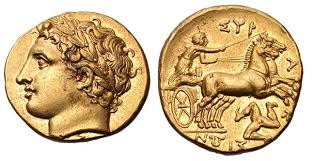
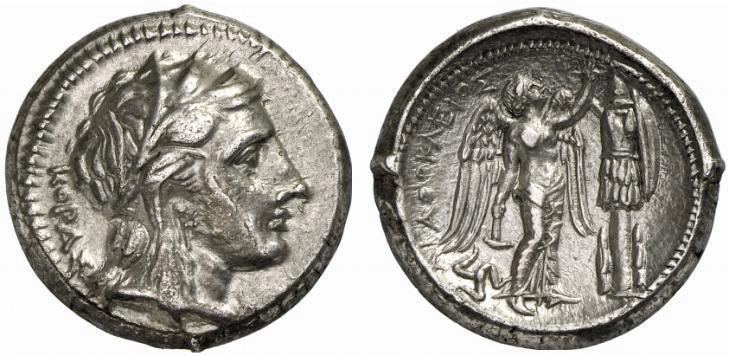
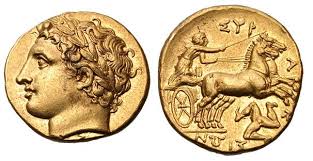
Agathocles of Syracuse
Friday, August 9, 2019
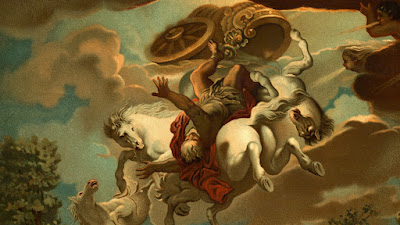
Phaethon
![]() | Phaethon was the son of the Oceanid Clymene and the solar deity Helios in Greek mythology. He asked his father for proof of his relationship with the sun. When the god promised to grant him whatever he wanted, he insisted on being allowed to drive the sun chariot for a day. | ![]() Placed in charge of the chariot, Phaethon was unable to control the horses. |
![]() | In some versions, the Earth first froze when the horses climbed too high, but when the chariot then scorched the Earth by swinging too near, Zeus decided to prevent disaster by striking it down with a thunderbolt. Phaethon fell to earth and was killed. | Phaeton became symbolic of heroic aspiration. |

Wednesday, August 7, 2019
Pax Romana Gallery and Auction
![]() | Pax Romana are London dealers and auctioneers of Ancient Art and Numismatics. Their gallery is opposite the British Museum. ![]() | ![]() Greek Corinthian bronze helmet belonging to Spartan warrior. Circa 600 BC. Est £30k-£50k. |
Tuesday, August 6, 2019
Roman Emperor Galba
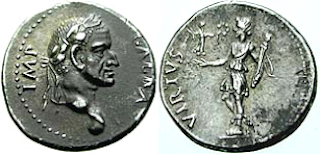
![]() | Surviving under tyrants like Caligula or Nero was a difficult task if you belonged to the Roman upper class. They tended to consider prominent members of the Senate their rivals, and thus found need to dispose of them. Anyone who did not master the art of survival didn't last long. Galba mastered it, for a while. Galba was 73 when the governor of the province of Gallia Lugdunensis contacted him in the winter of 67/68. Gaius Iulius Vindex put himself at the forefront of those who no longer wanted to fund Nero’s massive extravagances. | ![]() Galba, 68-69. Denarius April to late 68. ![]() Galba Sestertius, Rome 68-69 |
![]() | When Nero learned about the rebellion of Vindex, he immediately assumed that Galba could become a threat. The murder attempt failed. It made clear to Galba that his tactics would not protect him from another assassination attempt by Nero. On April 2, 68, he stepped in front of the army on the forum of Cartagena. The army did what it was expected to do: it proclaimed Galba emperor. The Senate dismissed Nero on June 9, 68, and sentenced him to death. Galba was appointed his successor. |
![]() Galba, Aureus July 68-January 69 | Instead of concentrating on his army, Galba focused on the seriously depleted state coffers. He tried to recover the 2.2 billion sestertii Nero had given away as gifts. The tide was turning for Galba on January 1, 69, when all the legions were requested to renew the oath on the emperor. The Roman army on the Rhine refused. The legionaries were upset that Galba had not rewarded them for their support during the rebellion. Galba vainly tried to take up the fight. A bad decision. Galba was killed and more conflict followed. The eventful year 69 AD went down in Roman history as the 'Year of the Four Emperors'. |
See ----->https://psjfactoids.blogspot.com/2019/04/worst-roman-emperors.html
Monday, August 5, 2019
McDonald's banned from site near Caracalla Baths
![]() | McDonald's fast food outlets are ubiquitous, but Italy's culture ministry has banned the chain from building another restaurant near the Caracalla Baths. The baths date from the 3rd century and sit near the center of the city, close to the Coliseum and other famous sites. Despite the decision, visitors to Rome will not have to travel far to get their Big Mac. The Italian capital already has 40 McDonald's restaurants. |
Sunday, August 4, 2019
Caracalla
![]() | Caracalla, known as Antoninus, was Roman emperor from 198 to 217 AD. He was a member of the Severan dynasty, the eldest son of Septimius Severus and Julia Domna. Co-ruler with his father from 198, he continued to rule with his brother Geta after their father's death in 211. He had his brother killed later that year. | ![]() |
![]() | Ancient sources portray Caracalla as a tyrant and as a cruel leader. Caracalla became known for the construction of the Baths of Caracalla, and for the massacres he ordered against the people of Rome and elsewhere in the empire. In 216, Caracalla began a war against the Parthian Empire. He did not see this campaign through due to his assassination by a soldier in 217. | The aureus shown carries an estimate of $25k to $30k![]() Macrinus succeeded him as emperor three days later. |
Thursday, August 1, 2019
'Footprints of Buddha' returned to Pakistan
![]() | In late April 2016 the US returned an ancient Buddhist stone sculpture to Pakistan, from where it was stolen in the 1980s. The 2nd Century piece was taken from the Swat Valley and eventually smuggled into the US. A Japanese antiquities dealer was arrested for smuggling the $1.1 million sculpture into the US. Tatsuzo Kaku, whose company — Tokyo-based Taiyo Ltd. — deals in ancient artifacts, was busted March 14, 2016 after he agreed to ship the 440-pound relic to New York. The rare Buddhapada sculpture was stolen in 1982 from an archaeological site in the Swat Region of Pakistan. |
![]() | In e-mails, Kaku admitted that he had purchased the Buddhapada in Pakistan in 1982 after the artifact had been illegally excavated and stolen. Kaku admitted to investigators that he knew it was illegal to buy or possess such material. The footprint of the Buddha is an imprint of Gautama Buddha's one or both feet. There are two forms: natural, as found in stone or rock, and those made artificially. The footprints of the Buddha (Buddhapada) are one of the early representations of the Buddha in the anticonic (no statues) stage of Buddhist art. The Buddhapada are highly revered in all Buddhist countries. They symbolize the grounding of the transcendent. According to Buddhist legend, after the Buddha attained enlightenment, his feet made an imprint in the stone where he stepped. | ![]() |
Subscribe to:
Comments (Atom)

A spate of small earthquakes around a volcano usually signifies that magma and gasses beneath the surface are beginning to navigate their exit.






Phaeton became symbolic of heroic aspiration.