Sunday, June 29, 2025

The Berthouville Treasure

The Berthouville treasure is a hoard of Roman silver uncovered by ploughing in March 1830 at the hamlet of Villeret in Berthouville, Normandy, northern France. The treasure belonged to a sanctuary of Mercury Canetonensis. In the mid-1st century BCE, Julius Caesar had identified Mercury as one of the main deities of Gaul.
A cache of pearl and emerald-encrusted rings, bracelets, gold necklaces and other opulent objects from the Roman Empire were displayed at the Getty Villa in Pacific Palisades in 2015. The assortment of precious jewelry accompanies the 90-piece gilt-silver Berthouville Treasure of statuettes and ornamental vessels. The treasure consists of silver and other metalwork and dates to the 1st to late 2nd centuries
The restored treasure was exhibited at the Getty Villa from November 2014 to August 2015, then went on tour in the US and Europe before being returned to Paris.


Cameo of Emperor Trajan, Roman, about A.D. 100; sardonyx set in a seventeeth-century gold, enamel, and ruby mount

Pitcher with Scenes from the Trojan War, Roman, A.D. 1-100; silver and gold. Achilles dragging the body of Hector around the walls of Troy

Pitcher with Scenes from the Trojan War (detail), Roman, A.D. 1-100; silver and gold. The death of Achilles

Offering Bowl with a Medallion of Mercury in a Rural Shrine (detail), Roman, A.D. 175-225; silver and gold

Lampsakos

Lampsakos (Lampsacus) was an ancient Greek city located in modern day Turkey, strategically situated on the eastern side of the Hellespont.
Lampsakos was founded by Greek colonists in the 6th century B.C. It became main competitor of Miletus, controlling the trade routes in the Dardanelles. During the 6th and 5th centuries B.C., Lampsacus was successively dominated by Lydia, Persia, Athens, and Sparta.

LAMPSAKOS, Stater c. 360–340, Persic standard, AV 8.47 g. Obv. Laureate and head of Zeus left, lotus-tipped sceptre on right shoulder. Rev. Pegasus flying right
Lampsakos was the first ancient Greek city state to see its gold coinage reach broad acceptance for international trade, a testament to its prosperity and influence. The stater of Lampsakos became very popular, circulating from Sicily to the Black Sea.
In 196 BC, the Romans defended the town against Antiochus the Great, and it became an ally of Rome. Lampsacus was notable for its worship of Dionysus/Priapus, who was said to have been born there.

Saturday, June 28, 2025

The 'Dolphin Rider' coinage of Tarentum

Tarentum, the city upon which modern Taranto, Italy was built, was founded in the eighth century BCE. Some attributed the civic beginnings to Taras, the legendary son of Poseidon and Satyria, a local nymph. In his myth, Taras falls from his ship during a storm, and is miraculously rescued and brought to shore by a dolphin. Starting in the very late sixth century BCE, Tarentum began issuing coinage paying tribute to the dolphin.
Though many denominations were struck over the ensuing three centuries, the most iconic was that of the nomos, a silver coin equivalent to two drachmai. Corresponding in size to U.S. nickel, these coins were a staple in regional trade.

A vast quantity were struck owing to the fact that Tarentum was one of the most populous cities in the world around 500 BCE.

Friday, June 27, 2025

Burgess Shale

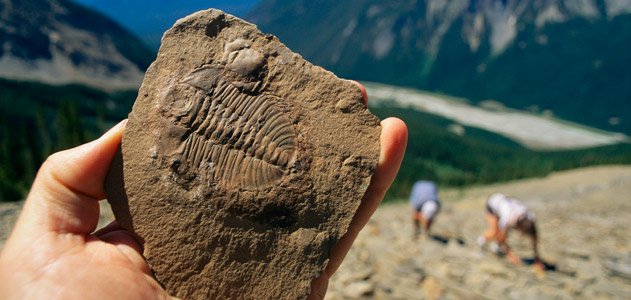
In 2021 a tourist from Belgium paid a price for trying to steal a fossil by putting it into a sock and stuffing it into his backpack. An alert guide at the Burgess Shale Formation in Canada’s Yoho National Park spotted him in a restricted area and alerted wardens.

The tourist was collecting fossils illegally near the Walcott Quarry of the Burgess Shale, a fossil field with some artifacts more than 500 million years old. Wardens dug through the tourist’s backpack and discovered the trilobite fossil.

The Walcott Quarry of the Burgess Shale.
He was charged with removing a fossil with the intention of selling or trafficking the ancient artifact. A British Columbia provincial court fined him $4,000.

Authorities say an active black market exists for fossils from the Burgess Shale with values ranging from $300 or $400 for common trilobite fossils. Larger and rarer fossils can sell for $10,000 or more.
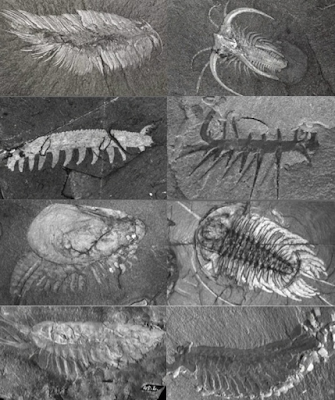
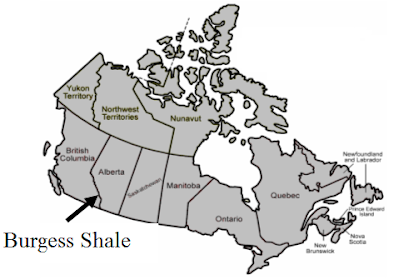
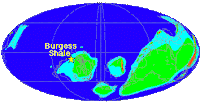
The Burgess Shale Formation is located in the Canadian Rockies of British Columbia. It is one of the world's most celebrated fossil fields and is listed as a UNESCO world heritage site. It is famous for the exceptional preservation of the soft parts of its fossils. At 508 million years (Middle Cambrian) old, it is one of the earliest fossil beds containing soft-part imprints.
Burgess Shale contains the best record we have of Cambrian animal fossils. It reveals creatures originating from the Cambrian explosion, an evolutionary burst of animal origins dating 545 to 525 million years ago.
During this period, life was restricted to the world's oceans. The land was barren, uninhabited, and subject to mudslides which periodically rolled into the seas and buried marine organisms.
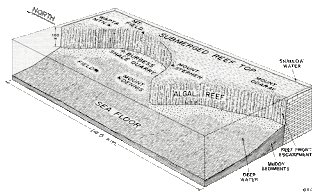
At Burgess, sediment was deposited in a deep-water basin adjacent to a huge algal reef with a vertical escarpment several hundred meters high.
The Burgess Shale fossils have been called the world’s most significant fossil discovery because of their great age, diversity, and detail of preservation.


Gold found on Minoan island dedicated to purple

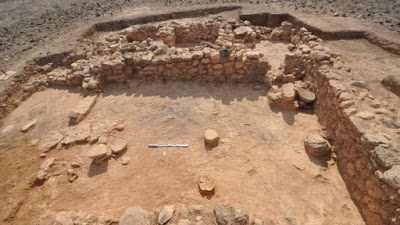
Ancient objects, including precious jewels and gold beads, were uncovered on an island near Crete in 2019. Chrysi, now uninhabited, was once devoted to making a precious purple dye from sea snails.
The huge value placed on the rare purple dye supported a flourishing settlement between 3,800 and 3,500 years ago, during the Minoan civilization on Crete. The prosperity of the island settlement is not seen by the remains of its simple buildings, but by the high quality of the artifacts found.
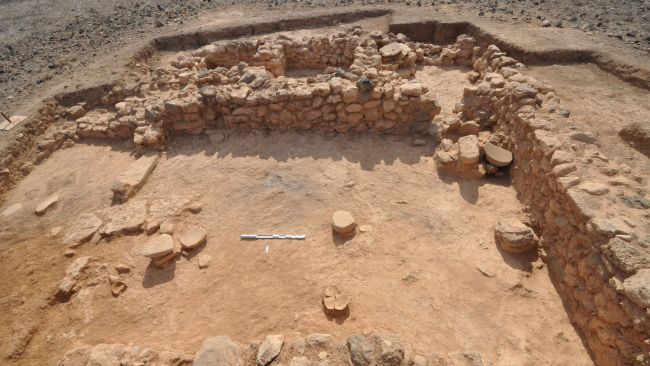
Archaeologists have investigated the settlement on Chrysi since 2008, revealing various discoveries, including the remains of large carved stone tanks near the waterline on the beach. Researchers believe the tanks were used to farm the shellfish — a species of Murex called Hexaplex trunculus.
The difficulty of making the dye led to it only being used by the elite, and it became known as "Royal purple." It was also known as "Tyrian purple," after the ancient Phoenican coastal city of Tyre which also produced it.
See ----->Tyrian Purple
Wednesday, June 25, 2025

The Rosetta Stone

The Rosetta Stone is a granodiorite stele inscribed with three versions of a decree issued in ancient Egypt, dating to 196 BC. It's famous for containing the same text in three scripts: hieroglyphic, demotic, and ancient Greek.
The Rosetta Stone was the key to deciphering Egyptian hieroglyphics. The inscribed black granodiorite stone was the first ancient Egyptian bilingual text to be discovered in modern times. The stone was unearthed in 1799 during Napoleon's campaign in Fort Saint Julien, El-Rashid in Egypt and has been housed in the British Museum since 1802.

Tuesday, June 24, 2025

The Bactrian Treasure - Hill of Gold - Tillya Tepe


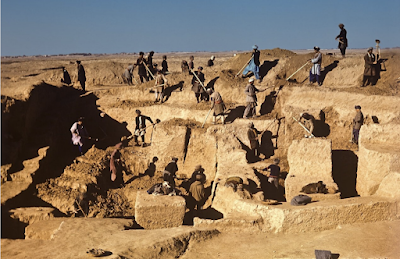
Excavation at Tillya Tepe in Sheberghan, Afghanistan in 1978.
In 2021 the Taliban were looking for the Bactrian treasure. They never found it. The treasure was brought to the presidential palace by the former government in February 2021 and put on display for public viewing. The priceless hoard then vanished. “The issue is under investigation, and we will collect information to know what the reality is,” said Ahmadullah Wasiq, the Taliban’s mouthpiece.
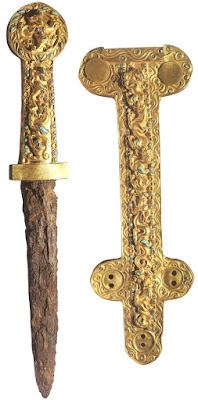
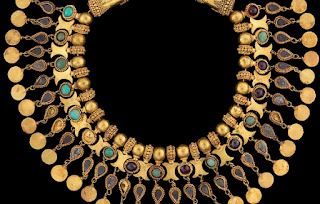
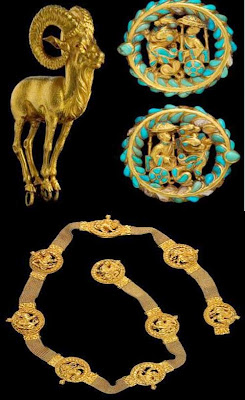
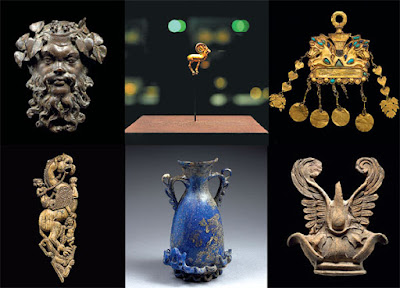
The Bactrian Treasure is a gold hoard that lay under the 'Hill of Gold' in Afghanistan, known as Bactria when Alexander the Great conquered the country. This is the treasure of Tillya Tepe, the Hill of Gold.
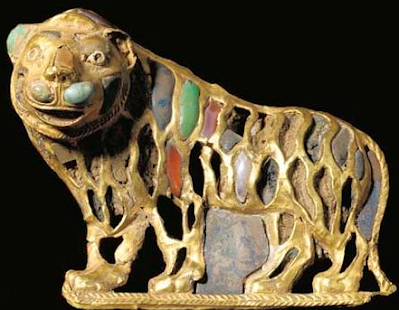
The hoard is a spectacular collection of 20,600 gold ornaments found in six burial mounds just beyond the oasis town of Sheberghan in northern Afghanistan. The treasure lay undisturbed until Soviet archeologists exposed it shortly before the 1979 invasion. Soon after the discovery, a guerrilla war against the Soviet occupation began, followed by civil war.

Gold and turquoise crown from tomb six at Tillya Tepe, dating to 25-50 CE. During those years the treasure was kept in the Kabul Museum, which has since been looted. The day before the Russians fled Kabul in February 1989, the treasure was moved to the presidential compound, the safest place in the capital.


Gold stater of the Greco-Bactrian king Eucratides, Weight: 169.2 gm., Diam: 58 mm., the largest gold coin of antiquity.
The treasure remained safe due to the efforts of one man: Mr. Ameruddin Askarzai, a security guard of the central bank who has been guardian of the vaults for 30 years. He is one of the few people to have seen the entire collection. "It's the best heritage of our country," he said.


Mr Askerzai helped to seal the treasure in seven trunks and guarded it along with the assets of the central bank - gold bars the "size of your arm" worth about £50 million - also kept in the presidential palace. The real threat to the treasure came when the Taliban captured Kabul in 1996. A delegation of 10 mullahs arrived with a jeweller to inspect the vaults. A pistol held against his head, he opened the combination lock so they could inspect the gold bars.
They had found the second prize, but did not realize the real treasure was in a vault above their heads. The Taliban asked if there was any other gold, but Mr Askerzai remained silent. He was imprisoned for three months and 17 days, during which he was beaten and tortured, but he did not reveal anything. "I wasn't scared," he said. "I didn't care for my life. They were foreigners. They were not Afghans."

On the Taliban's last night in power, as coalition forces pounded the country with bombs, the Taliban stuffed the central bank's cash reserves into tin trunks and arrived at the vault for the gold bars. They spent four hours trying to open the vault. Mr Askerzai watched. Unknown to them, five years earlier he had broken the key and left it in the lock. The Taliban gave up and fled Kabul as Northern Alliance forces edged closer. That saved the treasure.
In 2003 the vault was opened. The National Geographic Society catalogued the collection, which appeared to be complete. Also witnessing the re-opening was the archaeologist who originally found the hoard, Viktor Sarianidi.