Sunday, July 26, 2020

Yamashita's Gold - Imelda Marcos’ jewelry

In the closing months of World War II General Yamashita Tomoyuki was in charge of hiding tons of Japan's looted gold and treasure.

Expert teams accompanying Japan's armed forces systematically striped anything of value from conquered territories. An effective US blockade prevented shipment and at one time there were more than 175 Imperial treasure sites hidden in caves and tunnels throughout the Philippines.

With US forces closing in, the chief engineers of all the vaults were called together with General Yamashita 67 meters underground in Tunnel 8 in the mountains of Luzon. They became drunk on sake and sang patriotic songs.

At midnight, General Yamashita Tomoyuki and his aids slipped out. Dynamite charges were set off in the access tunnels, entombing the engineers.

The General escaped to Tokyo by submarine and three months later surrendered to American troops.
Yamashita's driver led the Americans to more than a dozen treasure vaults in the rugged country north of Manila. What they found astounded everyone.

In November 1945, General MacArthur strolled down row after row of gold bars stacked two metres tall during a tour. In another 500 meter tunnel west of Mindanao, 12.5kg Gold bars were stacked 1 meter high.
After discussions with his cabinet, President Harry Truman kept the recovery efforts a state secret.
After surrendering on September 2, 1945, General Yamashita was charged with war crimes. During his trial there was no mention made of plundered treasure or of Japanese looting during the war.

On 23 February 1946, at Los Baños, Laguna Prison Camp, 30 miles (48 km) south of Manila, Yamashita was hanged.

In 1992, Imelda Marcos claimed that Yamashita's gold accounted for the bulk of the wealth of her husband, Ferdinand Marcos. Despite the best efforts of treasure hunters, no gold hoards have ever (officially) been found.
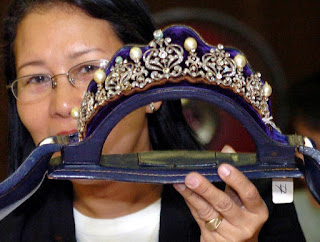
Former First Lady Imelda Marcos’ jewelry and real estate are among the P18.2 billion worth of recovered ill-gotten assets of the late dictator Ferdinand Marcos.

The Hawaii collection comprises jewels seized by the United States Bureau of Customs from the Marcoses when they fled to Honolulu during the 1986 People Power revolt.
The government still holds about 760 pieces of Mrs. Marcos’ jewelry in three collections, valued at a total of $6 million. That includes 300 pieces of jewelry retrieved from the Malacanang Palace right after People’s Power Revolution, 400 items confiscated in Hawaii, and 60 items seized by the Philippines’ Bureau of Customs from a Greek national accused of smuggling the jewels out of the country.

Sunday, July 19, 2020

The Malagana Treasure

In 1992 a sugarcane farm employee was working the fields at the Hacienda Malagana located in Colombia‘s Cauca Valley. The ground gave way, and both man and machine tumbled into the hole. The worker noticed shiny, golden objects in the dirt. Upon closer inspection he realized he’d found treasure, ancient gold. The artifacts were grave goods from burial tombs of a previously-unknown indigenous culture of Colombia.

His secret didn’t last long. Word spread like wildfire, and a looting frenzy began. Between October and December 1992, thousands descended upon Hacienda Malagana in what was called the “Malagana Gold Rush”.
Almost four tons of priceless pre-Columbian artifacts were removed from the site to be melted down or sold to collectors in what was described as the “grandest haul since the Conquistadores.”

By 1994 the treasure hunters had given up as the cemetery site had been destroyed, and archaeologists were finally able to learn more about the mysterious culture. Researchers found that the habitation site dated to between 300 BC and 300 AD.

Jaguar lime flask, Calima Malagana, 200 BC.
Colombia's Museo del Oro, 'Museum of Gold' launched a campaign to locate and recover as many artifacts as possible that were stolen from the tombs of the main cemetery at Hacienda Malagana. Over 150 often stunning objects were eventually acquired.

Saturday, July 18, 2020

Angkorian gold

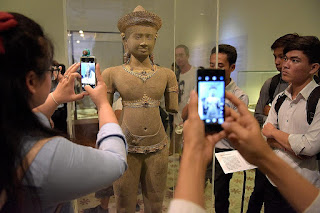
Angkorian gold jewelry that found its way to London in 2017 was returned to Cambodia after the government intervened to stop a planned sale. Cambodia’s Ministry of Culture and Fine Arts petitioned to return the Angkorian artifacts.
They originated from the Khmer empire, a power in Southeast Asia from A.D. 802 to A.D. 1431. It once included much of today’s Cambodia, Thailand, Laos and southern Vietnam. After decades of war, Cambodia lost countless priceless historical artifacts to looters and smugglers who targeted ancient sites. The Khmer Rouge and other military groups often controlled looters in their areas.

Looting artifacts has a history almost as old as the items themselves. The earliest known trial of looters in Egypt took place in Thebes in 1113 B.C.

Friday, July 17, 2020

Rome - cruel and unusual punishment

Roman history is full of stories about the fates of those who broke the law. When Tarpeia let the enemy Sabines into Rome, she was thrown from a precipice above the Roman forum. It then became established practice to throw traitors from the “Tarpeian Rock”. Such tales served as a warning for future generations.

Roman society was patriarchal. The family’s oldest living male had, in theory, the power to kill anyone within his household with impunity. This included not only those living under his roof, but the wider family as well.
Parricides were commonly punished by being 'condemned to the beasts', which was very popular in the Roman world.Anyone who killed his father, mother, or another relative (parricide) was subjected to the “punishment of the sack” (poena cullei). This allegedly involved the criminal being sewn into a leather sack together with four animals – a snake, a monkey, a rooster, and a dog – then being thrown into a river. Was anyone ever actually punished this way? It seems unlikely. The emperor Constantine’s penalty for parricide only specified that snakes should be used.
Taking part in the Roman census was compulsory as the state needed a complete record of citizens’ property for taxation. According to Dionysius of Halicarnassus, the sixth king of Rome Servius Tullius decreed that anyone who did not participate in the census would lose their property and be sold into slavery.

The collage of sources from many different periods creates Roman punishment that sometimes seems unlikely at best.

Thursday, July 16, 2020

Kerala’s Sree Padmanabhaswamy temple

The Sree Padmanabhaswamy temple has great religious significance to Hindus. The temple is known for its six subterranean “kallara” or vaults. In 2011 five of the temple’s six vaults, designated A, B, C, D, E and F, were opened. In them lay around 3,000 tonnes of gold, coins, sacks of diamonds and jewellery.

Treasures include gold in the form of pots and jars, crowns, religious iconography, as well as gold coins from civilizations around the world including the Romans, French, Dutch, Venetians and the Mughals. Some of the items in the vaults date back to 200 BC. All this does not include what is thought to be stored inside vault B. Ancient legend said if the vault were ever opened it would bring devastation to the world.
Vault B has indeed been opened several times in recent history as is evident from the many missing items, according to inspectors.

Wednesday, July 15, 2020

Ancient Gold returned to Romania

The first of what archaeologists called the 'most sensational finds of the last century' surfaced not in a museum but at Christie's New York.
Among pieces of ancient jewelry for sale on Dec 8, 1999, was Lot 26, a spiraling, snake-shaped gold bracelet that the auction house identified as a "massive Greek or Thracian gold armband."

Christie's estimated it would sell for as much as $100k. When the bidding stalled at $65k, the sale was called off—and the bracelet and its owner disappeared back into the underworld of ancient artifacts.

Lot 26, "a massive Greek or Thracian gold arm band" circa 2nd-1st BCE.
Lot 26 set off an international search to recover the lost heirlooms of Dacia, an empire that was once a mighty rival to ancient Rome. After nearly a decade of sleuthing by everyone from FBI agents to Interpol investigators and Romanian prosecutors, more than a dozen similar bracelets have been found, along with hundreds of gold and silver coins. Their discovery has led to new insights into Dacian society.

Sarmizegetusa was once the capital and sacred center of the Dacians, a civilization crushed by Trajan in two bloody wars more than 1,900 years ago. The victory yielded one of the largest treasures the ancient world had ever seen: half a million pounds of gold and a million pounds of silver.

After his victory, Trajan took the spoils to Rome, where they paid for his famous forum. In that same complex, the Roman Senate erected a column dedicated to Trajan and illustrating the story of the wars. Sarmizegetusa was leveled and forgotten for centuries. But stories of Dacia's gold lived on, inspiring generations of peasants who lived nearby to dig in the steep valleys.

It wasn't until Romania's communist dictatorship collapsed in 1989 that dreams of striking it rich came true. Groups of local treasure hunters started using metal detectors (unavailable in communist times) to hunt for artifacts in the thick forests at the rugged site. Treasure hunters hit the mother lode in May 2000, according to Romanian police.
Their metal detector pinged over a stone slab about two feet wide, embedded in a steep hillside. Underneath, in a small chamber made of flat stones propped against each other, they found ten spiraling, elaborately decorated Dacian bracelets—all solid gold. One weighed 1.2kg. Over the next two years looters found at least 14 more bracelets at Sarmizegetusa.

The recovered bracelets are now on display in Bucharest are the only ones of their kind found in Romania. At least another dozen, including the one still known as Lot 26, remain missing.
Sarmizegetusa's stolen gold was nearly lost. Recovering it involved authorities in Europe and the US and a decade of dogged sleuthing.

Romanian authorities recovered 13 hammered gold bracelets and more than 27.5 pounds (12.5kg) of gold.