Thursday, January 30, 2020
Sunday, January 26, 2020
Florida treasure hunters find $4.5m in lost gold
![]() | A team of treasure hunters scouring the waters off Florida in 2017 recovered a $4.5m bounty of gold coins – including several made for the king of Spain, Philip V, in the early 1700s. The find was made off the coast of Vero Beach, Florida. Bret Brisben, captain of the S/V Capitana and his crew reportedly found 350 gold coins, nine of which are known as Royals and valued at $300k each. | ![]() |
![]() | Brisben’s find comes a month after one of his subcontractors, Eric Schmitt, found 52 gold coins worth more than $1 million. Schmitt found the gold while diving about 150 feet off the coast of Fort Pierce in Florida during his yearly treasure-hunting trip with his wife, his sister and his parents. | ![]() |
![]() | "It resonates with everybody -- every demographic, young and old, rich and poor," Brisben told the newspaper. "People freak out that we're literally 10-15 feet off the beach in 2-3 feet of water." | ![]() |
Saturday, January 25, 2020
Ephesus
![]() | The Romans made Ephesus the capital of the Asian State, and the city became one of the biggest settlements in Anatolia. Today Ephesus is one of Turkey’s leading tourist attractions. | ![]() |
![]() | A extremely rare ancient Ephesus coin (625-600 B.C.) crossed the block in New York. The electrum coin is related to the god of light, Phanes. There are only two other known examples. It made $300k. | ![]() |
Friday, January 24, 2020
Submerged ancient Egyptian treasures
![]() | More than 200 objects were showcased in 2016 at an exhibition of Egyptian artifacts discovered in a sunken ancient city. Dating back some 2,300 years they were found over a decade ago near what is now the city of Alexandria. In ancient times, the port city of Thonis-Heracleion was the main port of entry to Egypt for all ships coming from the Greek world. | ![]() |
![]() | The city was founded around the 8th century BC, underwent natural catastrophes, and eventually sunk entirely into the depths of the Mediterranean in the 8th century CE. | ![]() |
![]() | ![]() |
![]() | ![]() | ![]() |
![]() | | ![]() |
![]() | ![]() | ![]() |
![]() | ![]() |
Thursday, January 23, 2020
Ancient Bat Guano reveals secrets
![]() | Ancient bat guano like sediment cores, ice samples and tree rings, can be used to study the climate of the past. Artibeus jamaicensis is one of the species that contributed to the guano researchers used to study the climates of the past. Deep in the forests of northwestern Jamaica, a secluded cave has sheltered an unabridged account of the environment since the early Bronze Age. The cave’s inhabitants live in near-total darkness, swarming out to feed at night through a mist of their own urine and retreating back inside to roost. The colony of bats then add to the archived climate record much as their ancestors did before them: by swooping down from the walls and defecating on the cave floor. With its high levels of nitrogen, guano from bats and birds has been harvested as a natural fertilizer. |
![]() | Wars have even been fought over the treasure: In 1864 a naval conflict broke out between Spain and Peru over the Chincha Islands, covered in guano deposits said to be over thirty meters, or 100 feet, tall. Radiocarbon dating put the base of the core at around 4,300 years old, long before the first humans arrived. | The lead levels in the guano core experienced a sharp uptick after 1760, the fingerprint of coal combustion that propelled the Industrial Revolution. |
Tuesday, January 21, 2020
Yarrabubba crater 2.229 billion years old
![]() | More than two billion years ago, an asteroid slammed into Earth and created a 43-mile wide crater in Western Australia's outback. Researchers believe it is the oldest known impact crater, predating others by 200 million years. The new age of the Yarrabubba crater, created by dating the minerals, is 2.229 billion years old. |
![]() | An impact into an ice-covered continent could have sent half a trillion tons of water vapor, an important greenhouse gas, into the atmosphere. Water vapor is an effective, and the most abundant, greenhouse gas that can absorb radiation and send it back to Earth's surface. The asteroid strike that led to the extinction of the dinosaurs 66 million years ago led to global ocean cooling and widespread acid rain. |
Monday, January 20, 2020
Basilosaurus cetoides
![]() | An ancient whale twice the length of today's orcas once chowed down on other whales in the Eocene epoch's seas 40 to 35 mya. Measuring 15–18 m (49–59 ft), Basilosaurus cetoides is one of the largest-known animals to exist from the KT extinction event 66 mya to around 15 mya when modern cetaceans began to reach huge sizes. |
Basilosaurus was top marine predator of it's time. | A 2010 discovery of a Basilosaurus fossil in Egypt's Wadi Al-Hitan (Valley of Whales) is the first-ever with its last meal inside it. The valley, about 87 miles (140 km) southwest of Cairo, is a hot spot for whale fossils, with hundreds found there. | ![]() |
![]() | Among the jumble of bones found mixed with the whale's skeleton were teeth, skull fragments, vertebrae and ribs of D. atrox, an ancient species of whale that grew to about 16 feet (5 m) long. A modern equivalent to Basilosaurus would be orcas, which are about half the size.![]() |
Sunday, January 19, 2020
1937 Edward VIII sovereign makes $1.3m
Saturday, January 18, 2020
Mummies of Museo Leymebamba
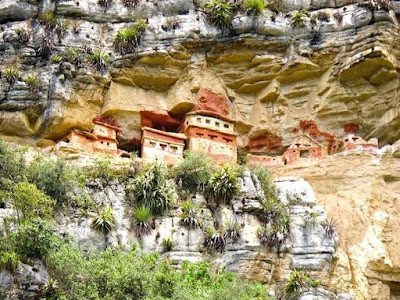
![]() | The Leymebamba Museum in Peru was inaugurated in 2000, specifically to house 200 mummies and their burial offerings. The mummies were recovered during a 1997 excavation on the banks of Laguna de los Cóndores, a lake about 50 miles south of Chachapoyas. The mummies are from the Chachapoyas culture from about 800 AD. Nestled into the limestone cliffs around the lake were a series of chullpas, or tombs. The stone burial structures had been untouched for 500 years, until local farmers started to rummage through the funerary site. |
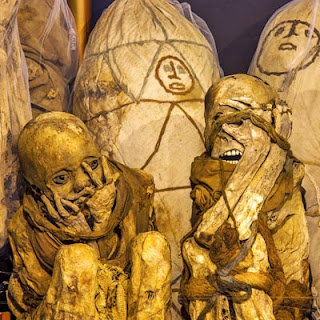
| The Chachapoya were skilled embalmers. They treated the skin and vacated bodily cavities. Then they left much of the remaining mummification process to the cold, dry, sheltered lakeside ledges. | ![]() |
![]() | It’s an unnerving sight for some. A few of the mummies stare back with pained expressions, an occasional face so well-preserved that it looks like it would blink. A few bundled babies also sit on the shelves, their tiny bodies carefully wrapped in cloth. Now in the controlled climate of the museum the mummies found a new resting place. Here they sit huddled together like a lost tribe, eternally silent. | ![]() |
![]() | They are exhibited in semi-darkness, at the same temperature and moisture as the mausoleum where they were deposited. | ![]() |
Subscribe to:
Comments (Atom)


The lead levels in the guano core experienced a sharp uptick after 1760, the fingerprint of coal combustion that propelled the Industrial Revolution.
More than two billion years ago, an asteroid slammed into Earth and created a 43-mile wide crater in Western Australia's outback. Researchers believe it is the oldest known impact crater, predating others by 200 million years. The new age of the Yarrabubba crater, created by dating the minerals, is 2.229 billion years old.

Basilosaurus was top marine predator of it's time.


They are exhibited in semi-darkness, at the same temperature and moisture as the mausoleum where they were deposited.