
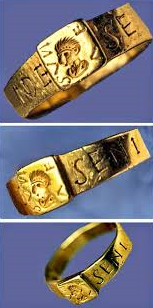
 | The Vyne Ring or the Ring of Silvianus is a gold ring, dating to the 4th century, discovered in a field in Hampshire, England, in 1785. Weighing 12g with a ten-faceted design with a Venus-inscribed bezel, it's linked to a curse tablet. It was originally owned by a wealthy British Roman called Silvianus. |  |
 | The large gold ring is inscribed in Latin, "Senicianus live well in God," and inset with an image of the goddess Venus. The ring is believed to be linked to a curse tablet (defixio) discovered 100 km away in Gloucestershire at Lydney Park. That site was a Roman temple dedicated to a god named Nodens. |   |
 | An archeologist who looked into the connection between the ring and the curse tablet asked Tolkien, who was an Anglo-Saxon professor at Oxford University, to work on the etymology of the name Nodens in 1929.  |  |
 | Parallels are drawn between Silvianus losing his ring to Senicianus (and naming the thief in a curse) and Gollum losing his precious ring to Bilbo Baggins. Made of lead, Silvianus's defixio was inscribed with a curse: DEVO NODENTI SILVIANVS ANILVM PERDEDIT DEMEDIAM PARTEM DONAVIT NODENTI INTER QVIBVS NOMEN SENICIANI NOLLIS PETMITTAS SANITATEM DONEC PERFERAT VSQVE TEMPLVM NODENTIS Translation: 'To the god Nodens. Silvianus has lost a ring; he hereby gives half of it (i.e. half of its value) to Nodens. Among those who are called Senicianius, do not allow health until he brings it to the temple of Nodens.' |

No comments:
Post a Comment