Sunday, March 29, 2020

Secret Crypt found in U.K. - Exploding Bishops

A forgotten crypt was uncovered in an ancient church in London in 2017. Inside are the remains of some of England’s most influential churchmen. They will remain undisturbed for now — being sealed in a lead coffin can have explosive consequences.

The tomb was accidentally uncovered by workmen refurbishing the Garden Museum in a neighborhood of London. The Garden Museum is located in the deconsecrated St. Mary-at-Lambeth Church, which dates back to 1062
The tomb appears to be 400 or 500 years old. At least five of the 30 coffins contain the remains of former archbishops of Canterbury — the most senior clergyman in the Episcopal Church of England.
Clergymen have been identified by plates affixed to the coffins. They include Richard Bancroft, who was England’s No. 1 churchman from 1604 to 1610. He played a major role in producing the King James Bible.

A corpse in a coffin that’s undisturbed for 400 or so years would turn most of us into dust. But some turn into so-called ‘coffin liquor.’

When the tightly sealed coffin lets the anaerobic bacteria win the day, some coffins will be one third full of a viscous black liquid. These contents can burst out violently when the seal is broken.

Friday, March 27, 2020

Medusa

Medusa was a monster to the ancient Greeks, one of the Gorgon sisters and daughter of Phorkys and Keto, the children of Gaea (Earth) and Oceanus (Ocean). She had the face of an ugly woman with snakes instead of hair; anyone who looked into her eyes was turned to stone.

She was once a fair maiden, a priestess of Athena, and devoted to a life of celibacy; however, after being wooed by Poseidon she forgot her vows and married him. For this offence she was punished by the goddess. Each wavy lock of the beautiful hair that had charmed her husband was changed into a venomous snake; her love-inspiring eyes turned into bloodshot, furious orbs, which excited fear and disgust in the onlooker; whilst her milk-white skin turned a loathsome green.

After a life of misery deliverance came at the hands of Perseus. Medusa was beheaded by the hero Perseus, who used her head as a weapon until he gave it to Athena to place on her shield. In classical antiquity the image of the head of Medusa appeared in an evil-averting device known as the Gorgoneion.
Medusa's frightening appearance on coins served a propaganda purpose. Warfare was endemic in the classical world, a way of life, and death, as it has been throughout history.

Medusa served to both protect and terrify.

Tuesday, March 24, 2020

Bulgarian Valley of Kings

A four-wheeled wooden chariot, its intricately carved bronze plating and fittings, plus the skeletal remains of two horses and a dog have been preserved in situ instead of being removed to a museum. Thracian chariots were often buried with up to eight horses and their elaborately decorated bridles. Thracians established a powerful kingdom in the fifth century B.C.

The capital was thought to be Seutopolis, whose ancient ruins lie under a large artificial lake near Shipka, in an area dubbed 'the Bulgarian Valley of Kings' for its many rich tombs. It is believed that there are over 1500 funeral mounds in the region, with only 300 being researched so far.
The Kazanlak Tomb was found accidentally on 19 April 1944 by soldiers who were digging for entrenchment against aircraft. It dates to the first half of 3rd century BC.
The Svetitsa mound revealed a spectacular gold mask, which was laid on the face of the deceased person. It was made of a solid 673-g gold plate with individual features - thick hair, beard and mustache, the eyes half-closed. This is one of the earliest and richest tombs discovered in the Valley.

Monday, March 23, 2020

Ancient mosaics of Lod

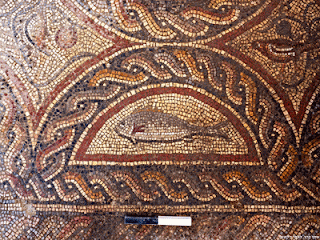
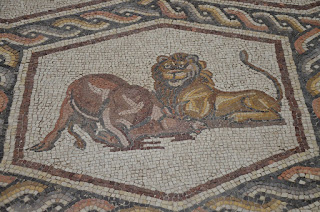
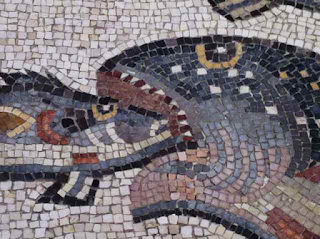
An ancient mosaic that once belonged to a Roman villa in the city of Lod was discovered in 2018 by archaeological excavations at the site.

The mosaic-decorated reception and courtyard, as well as a water system were found as the Israel Antiquities Authority dug in preparation for the construction of a visitors’ center in Lod.
A 1,700-year-old mosaic discovered in Lod, Israel, was revealed to the public for the first time in November, 2015.

Measuring 36 by 42 feet, the impressive artwork covered in depictions of nature. It was found near another artwork found two decades ago in that same area.

Tuesday, March 17, 2020

Celtic coins - Geoff Cottam collection

Spink London sold the Celtic coin collection of Geoff Cottam on December 2, 2015. One of the most stunning rarities is one of the finest known gold quarter staters of the Atrebates and Regni peoples, minted under Tincomarus, (c.20 BC-AD 10). It is a 'Medusa' type.

Celtic, Trinovantes and Catuvellauni, uninscribed coinage, (c.60-20 BC), gold Quarter Stater, 1.25g,

Addedomaros Crescent Cross. c.45-25 BC.
The Celtic tribes left little archaeological evidence  to understand their culture, and almost all written description of them comes from others.

All that remains are a few artifacts; of which this collection was an incredible treasure trove.

Monday, March 16, 2020

Stolen Roman ballista stone returned


The thief cited the current coronavirus outbreak as the reason for returning the artifact.
A man has returned an ancient Roman projectile that he took from an ancient site in Jerusalem 15 years ago.  The man took the ballista stone from the City of David in the Jerusalem Walls National Park.
The ballista stones at the City of David likely date to the Roman siege of Jerusalem and the destruction of the Second Temple in 70 CE.

Saturday, March 14, 2020

Black Death

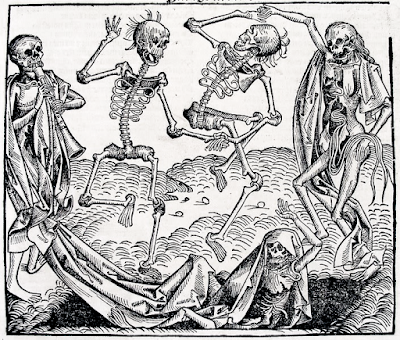
The Black Death plague arrived in western Europe in 1347 and in England in 1348. It faded away in the early 1350s. The Black Death, or ‘pestilencia’ was the worst catastrophe in recorded history. It destroyed a higher proportion of the population than any other single known event. One observer noted ‘the living were scarcely sufficient to bury the dead.’ Old and young, men and women: all of society – royalty, peasants, archbishops, monks, nuns and parish clergy. None were immune to the Black Death.

In Europe it is thought that some 50 million people died.

In a study published in January 2017, researchers simulated Black Death outbreaks. The model that focused on fleas and ticks on humans was the most accurate for explaining the spread of the disease.
In Medieval times people believed that the Black Death came from God, and responded with prayers.

Rats have long been blamed for spreading the Black Death. A study suggests that rats weren’t the main carriers of fleas and lice that spread the plague ... it was humans.

Wednesday, March 11, 2020

Hummingbird sized dinosaur - Oculudentavis khaungraae

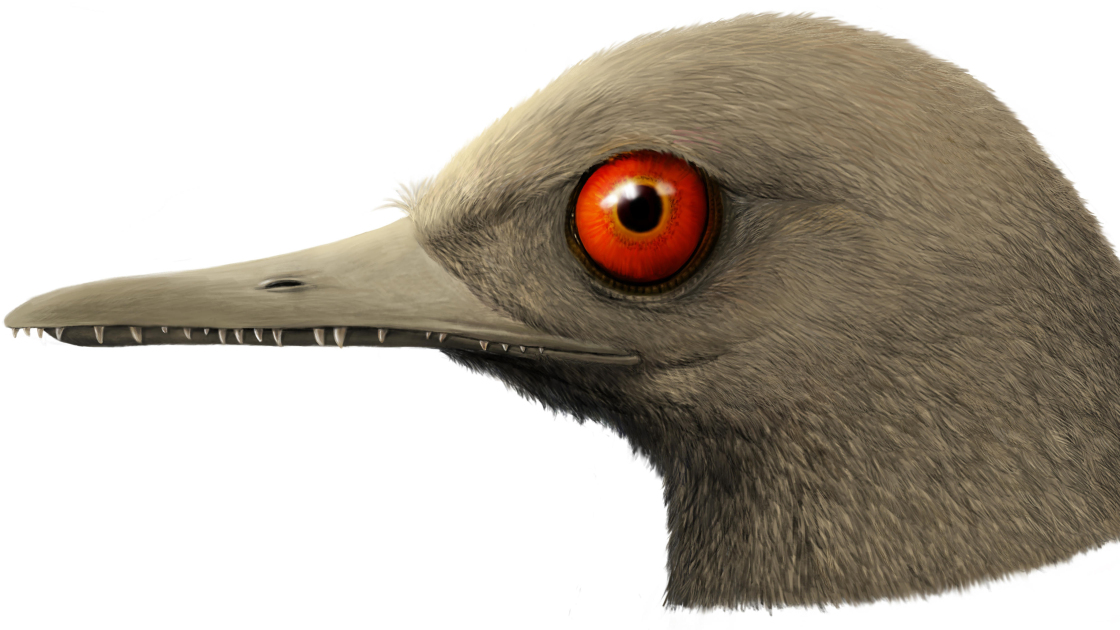
A hummingbird-sized predatory bird is the smallest known dinosaur to live during the Mesozoic Era, between 252 million and 66 million years ago. Of modern birds the bee hummingbird is the smallest. The new species, dubbed Oculudentavis khaungraae, was similar in size.

The earliest birds, such as Archaeopteryx, arose around 150 million years ago, and this find suggests that bird body sizes were reaching their lower limit by 99 million years ago.
Tomography scans reveal a 3-D image of the bird’s skull, preserved in amber. They show the deep eye sockets and sharp teeth of a predator. Researchers need to figure out where the new species belongs on the tree of life.

Tuesday, March 10, 2020

SS Central America - Territorial Gold Coins


Second finest known 1854 Kellogg $20 Territorial gold coin, graded PCGS MS62+
Coins from the SS Central America include rare Territorial Gold Coins. "Territorial" is a term that encompasses a wide range of coins issued by private minters, semi-official entities, entrepreneurs, and opportunists.
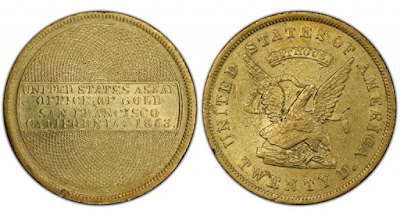
Rare 884 THOUS variety 1853 U.S. Assay Office $20, graded PCGS AU55+

Small Head variety 1852 Wass Molitor $5 gold coin, with a counterstamp advertising Sacramento dentist W.W. Light
The coins arose out of necessity and were created to fill a void that government would not fill. Until they intervened, these issues flourished; once the government entered the market, they were made illegal.
One of the finest known 1855 Wass Molitor Small Head variety $20 gold coins, PCGS AU58
See ----->https://psjfactoids.blogspot.com/2018/07/superb-california-fractional-gold-coins.html

Monday, March 9, 2020

Iron Age and the Bones of the Dead


A macabre discovery rewrites what we knew about the rituals and beliefs of Iron Age man.
In 2012 ancient remains were discovered in a bog in Denmark. Archaeologists are piecing together what happened to the dozens of dead warriors found at Alken Enge. Researchers were startled by what appeared to be desecration of the skeletal remains.

Protohistoric cultures had many traditions of ensuring the respect of their ancestors, and protection from their dead enemies.
At least six months after the warriors died, their bones were collected, scraped of remaining flesh, sorted and dumped in a lake. Some were handled in a bizarre manner; four pelvises were found strung on a stick. Researchers guess that the desecration of the body parts was an ancient ritual.

Were these grisly desecrations a barbaric ritual of triumph over defeated enemies, as Roman records suggest? There have been Iron Age rites of warding, ensuring the ghosts of a fallen enemy wouldn’t return from the grave to wreak revenge.
Norse folktales included the mythology of the draugr, an undead creature, literally meaning “again-walker”. The draugr was a corpse risen from the grave, a decomposed body. It would seek out and attack those who had wronged it in life.
So horrifying was the prospect of creating a draugr that special care was taken to ensure a proper burial of the dead.