Monday, July 27, 2020

Grand Manan - Captain Kidd's Money Cove

Grand Manan Island is the largest of the Fundy Islands in the Bay of Fundy. It is also the primary island in the Grand Manan Archipelago, sitting at the boundary between the Bay of Fundy and the Gulf of Maine on the Atlantic coast. As early as 1875 searches were made on the west side of the island for treasure buried by Captain William Kidd.
For nearly 200 years, this remote area of the island has been called the "Money Cove".The tale goes a widow had a dream. A headless Negro appeared and said, "In a certain spot on Grand Manan there lies, in a hogshead, the buried treasure of Captain Kidd. I was killed by Captain Kidd's pirates that I might guard the buried treasure. I am weary of my task. I wish to tell you where this treasure is, and then rest in peace. I will show you the place."
Captain William Kidd (c. 22 January 1645 – 23 May 1701) was a Scottish sailor who was tried and executed for piracy after returning from a voyage to the Indian Ocean. He was hanged on 23 May 1701, at 'Execution Dock', Wapping, in London. During the execution, the hangman's rope broke and Kidd was hanged on the second attempt. His body was gibbeted over the River Thames at Tilbury Point—as a warning to future would-be pirates—for three years.

The belief that Kidd had left buried treasure contributed to the growth of his legend.
Just before his death on the gallows, Captain Kidd said, "After my death, you may find treasure I have buried in a place where two tides meet."

Some point to the Bay of Fundy, where two tides meet and the place where Captain Kidd hid his treasure.

Indian Beach
In 2007 a wreck of a treasure ship captured by William Kidd was found in the Caribbean. Lying in just 10ft of water, the Quedah Merchant is on the seabed off the island of Hispaniola, which is split between Haiti and the Dominican Republic.

Marine archaeologists were amazed that the wreck, which was scuttled in 1699, had lain undiscovered for so long.

The Quedah Merchant was perhaps Kidd's greatest prize. A 400-ton Moorish trader from Armenia, it was loaded with gold, silver and fine silks.

Herring "elevator" to lift fish up from the weirs


Sunday, July 26, 2020

Yamashita's Gold - Imelda Marcos’ jewelry

In the closing months of World War II General Yamashita Tomoyuki was in charge of hiding tons of Japan's looted gold and treasure.

Expert teams accompanying Japan's armed forces systematically striped anything of value from conquered territories. An effective US blockade prevented shipment and at one time there were more than 175 Imperial treasure sites hidden in caves and tunnels throughout the Philippines.

With US forces closing in, the chief engineers of all the vaults were called together with General Yamashita 67 meters underground in Tunnel 8 in the mountains of Luzon. They became drunk on sake and sang patriotic songs.

At midnight, General Yamashita Tomoyuki and his aids slipped out. Dynamite charges were set off in the access tunnels, entombing the engineers.

The General escaped to Tokyo by submarine and three months later surrendered to American troops.
Yamashita's driver led the Americans to more than a dozen treasure vaults in the rugged country north of Manila. What they found astounded everyone.

In November 1945, General MacArthur strolled down row after row of gold bars stacked two metres tall during a tour. In another 500 meter tunnel west of Mindanao, 12.5kg Gold bars were stacked 1 meter high.
After discussions with his cabinet, President Harry Truman kept the recovery efforts a state secret.
After surrendering on September 2, 1945, General Yamashita was charged with war crimes. During his trial there was no mention made of plundered treasure or of Japanese looting during the war.

On 23 February 1946, at Los BaƱos, Laguna Prison Camp, 30 miles (48 km) south of Manila, Yamashita was hanged.

In 1992, Imelda Marcos claimed that Yamashita's gold accounted for the bulk of the wealth of her husband, Ferdinand Marcos. Despite the best efforts of treasure hunters, no gold hoards have ever (officially) been found.
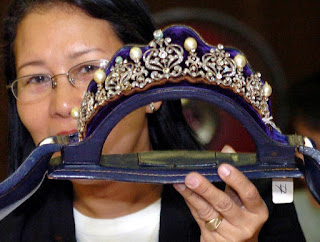
Former First Lady Imelda Marcos’ jewelry and real estate are among the P18.2 billion worth of recovered ill-gotten assets of the late dictator Ferdinand Marcos.

The Hawaii collection comprises jewels seized by the United States Bureau of Customs from the Marcoses when they fled to Honolulu during the 1986 People Power revolt.
The government still holds about 760 pieces of Mrs. Marcos’ jewelry in three collections, valued at a total of $6 million. That includes 300 pieces of jewelry retrieved from the Malacanang Palace right after People’s Power Revolution, 400 items confiscated in Hawaii, and 60 items seized by the Philippines’ Bureau of Customs from a Greek national accused of smuggling the jewels out of the country.

Wednesday, July 22, 2020

Grave of ‘Griffin Warrior’ at Pylos

The grave of a Mycenaean warrior was uncovered in 2016 in Pylos in the southwest of Greece was that of a warrior in his mid-30s who died around 1500 B.C. Buried with him thousands of objects, including silver cups, beads made of precious stones, ivory combs, a sword and four intricately decorated solid gold rings.

The discovery of the “Griffin Warrior” offers evidence that Mycenaean culture recognized and appreciated Minoan culture. The man's rings are made of multiple sheets of gold and depict very detailed scenes and iconography straight out of Minoan mythology. The rings probably come from Crete where they were used to place seals on documents or objects.
All the cups, pitchers and basins found were made of metal – bronze, silver and gold. The man was hugely rich.

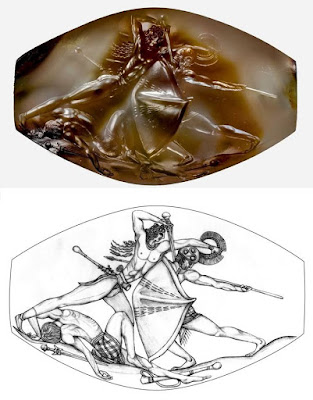
Since discovery the number of artifacts recovered from the grave has reached over 3,500, including a significant Minoan stone called the Pylos Combat Agate and four signet gold rings with detailed images from Minoan mythology.

A bronze mirror with an ivory handle.
Archaeologists digging at Pylos, an ancient city on the southwest coast of Greece, discovered the rich grave of a warrior who was buried at the dawn of European civilization.

Archaeologists expressed astonishment at the richness of the find and its potential for shedding light on the emergence of the Mycenaean civilization, the lost world of Agamemnon, Nestor, Odysseus and other heroes described in the epics of Homer.
The tomb is said to be the the most complete Greek find of its kind since the 1950s. The find includes gold, silver, ivory, and bronze artifacts, as well as engraved gemstones and an ornate ivory-and gilt-hilted sword.

The warrior was buried around 1500 B.C., next to the site on Pylos on which, many years later, arose the palace of Nestor, a large administrative center that was destroyed in 1180 B.C., about the same time as Homer’s Troy.

The palace was part of the Mycenaean civilization; from its ashes, classical Greek culture arose several centuries later.

Tuesday, July 21, 2020

The Griffin

The griffin, griffon, or gryphon is a legendary creature with the body, tail, and back legs of a lion; the head and wings of an eagle; and an eagle's talons as its front feet.

The lion was considered the king of the beasts and the eagle the king of birds, so the griffin was thought of as king of all creatures. Griffins are known for guarding treasure. There is evidence of representations of griffins in ancient Iranian and ancient Egyptian art dating to before 3000 BC.
Romans often associated the mythical creatures with the sun god Apollo, giving the Griffin an air of power and dominance. A Griffin is 'as fiery as the Sun,' and was a creature to be feared and given respect. In Medieval Europe, the Griffin became a Christian symbol for the Church's ideals on marriage. According to legend, Griffins mated for life and in the event of the death of a partner, the surviving griffin would never seek another mate. The creature was also used to symbolize Jesus.

The creature's association with Christianity and the Divinity meant they became protectors of the dead.
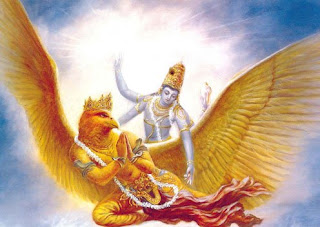
In the eastern world, a part-man, part-bird creature, the Garuda, served as a mount for the Hindu god Vishnu.

The griffin has been part of human culture since ancient times and persists today, as seen in various school emblems, mascots, and popular literature and movies.

Sunday, July 19, 2020

The Malagana Treasure

In 1992 a sugarcane farm employee was working the fields at the Hacienda Malagana located in Colombia‘s Cauca Valley. The ground gave way, and both man and machine tumbled into the hole. The worker noticed shiny, golden objects in the dirt. Upon closer inspection he realized he’d found treasure, ancient gold. The artifacts were grave goods from burial tombs of a previously-unknown indigenous culture of Colombia.

His secret didn’t last long. Word spread like wildfire, and a looting frenzy began. Between October and December 1992, thousands descended upon Hacienda Malagana in what was called the “Malagana Gold Rush”.
Almost four tons of priceless pre-Columbian artifacts were removed from the site to be melted down or sold to collectors in what was described as the “grandest haul since the Conquistadores.”

By 1994 the treasure hunters had given up as the cemetery site had been destroyed, and archaeologists were finally able to learn more about the mysterious culture. Researchers found that the habitation site dated to between 300 BC and 300 AD.

Jaguar lime flask, Calima Malagana, 200 BC.
Colombia's Museo del Oro, 'Museum of Gold' launched a campaign to locate and recover as many artifacts as possible that were stolen from the tombs of the main cemetery at Hacienda Malagana. Over 150 often stunning objects were eventually acquired.