 | The chance discovery of ancient bones under an Irish pub in the mid-2000s has cast doubt over whether Irish people are actually related to the ancient Celts at all. The police arrived on the scene and discovered that it was not a crime scene but an ancient burial site. After DNA analysis it is turning out to be a hugely significant ancient burial. The three skeletons are the ancestors of modern Irish people and they predate the Celts' arrival on Irish shores by around 1,000 years. Radiocarbon dating found that the ancient bones date back to at least 2,000 BC. Irish DNA existed in Ireland before the Celts ever set foot on the island. |

Monday, August 31, 2020
Ancient bones reveal Irish aren't Celts

Friday, August 28, 2020
2600 yo mummy Takabuti reveals secrets
 | Mummy Takabuti was acquired in Thebes by a wealthy man named Thomas Greg from County Down in Northern Ireland in 1834. Greg donated Takabui to the Belfast Natural History Museum. Now, 185 years after she was first unwrapped, a team of experts have gone public with their revelations. |  |
 | CT analysis on Takabuti reveals that the 20 something sustained a severe wound to the back of her upper chest wall. This likely caused her quick death. The mysterious object in her body cavity was a resin-soaked linen, believed to have been used to pack the wound. |
Thursday, August 27, 2020
Supernova fingered in Devian mass extinction
 | 359 million years ago Earth suffered one of its worst extinction events. The boundary of the Permian and Triassic geological periods marked the demise of around 90% of marine species and 70% of land species. A team of researchers at the University of Illinois think that it might have been caused by a series of supernova explosions no more than 35 light years away. The last mass extinction event happened about 65 million years ago. It finished the dinosaurs and began the rule of mammals. The smoking gun for researchers is the fact that fossils of plants from the K/T extinction event show signs of excess UV exposure. The intense radiation from a close enough supernova blast is capable of stripping away the ozone layer. Plutonium-244 is an element that isn’t naturally produced on Earth, so the only way for it to exist in a layer of sediment is for it to have been put there as the shock-wave of a supernova. |
Sunday, August 23, 2020
Ichthyosaur's 250m year old meal it's last
 | In 2010 paleontologists digging in a quarry in southwestern China made a rare discovery. The ichthyosaur's stomach they found contained the undigested remains of a thalattosaur. Researchers speculate that a violent confrontation took place, one which caused the ichthyosaur to fracture it's neck, killing it as it consumed it's prey. These events took place sometime after the end of the Permian era, some 250 million years ago, when land vertebrates started moving back to the sea following a mass extinction event. |

Friday, August 21, 2020
Ancient coins on a budget
 | Lockdales’ auction in Ipswich on July 5 sold a silver denarius of Septimius Severus. It was minted in Rome in AD 210. It changed hands for just £140. Severus was Roman emperor from 193 to 211. Arriving in Britain in 208, he invaded Caledonia (modern Scotland) with an army of 50,000 men, strengthening Hadrian’s Wall and reoccupying the Antonine Wall. His ambitions were cut short when he fell ill in late 210. He died in early 211 at Eboracum (York), and was succeeded by his sons. |
 | There is a vast range of Roman coins at all price levels. If you want to collect examples that circulated from the first century to the second century AD, you will need to find two gold coins, an aureus and a quinarius aureus, two silver coins, the denarius and the quinarius argenteus, and five bronze coins: the sestertius, the dupondius, the as, the semis and the quadrans. Naturally rare gold coins will be the most expensive. Bronze coins far less so. |  |
Thursday, August 20, 2020
Thracian tomb reveals Gold treasure
 | In late 2012 Bulgarian archaeologists found golden treasures in an ancient Thracian tomb near a Unesco world heritage site about 250 miles north-east of the capital Sofia. Items included gold bracelets with snake heads, a tiara with animal motifs and a horse-head piece along with a hoard of other ancient golden artefacts. The items date to the end of the fourth or the beginning of the third century BC. They were found in the biggest of 150 ancient tombs of the Getae, a Thracian tribe. |  |
 | Among the objects found were a golden laurel and ring, rhytons - silver drinking vessels shaped like horns, Greek pottery and military items including weapons and armour. The tomb in Zlatinitsa is extremely rare in that it has remained unopened since the 4th century BC. Most Thracians tombs were looted in antiquity. |  |
 | The tomb was that of a high status leader. Used weapons and the arrow wounds in the bones of his horse indicate that he was a warrior. He was buried in the biggest burial mound in the region.  |  |
 |  |  |
 |  |  |
Saturday, August 15, 2020
Chew Valley Hoard
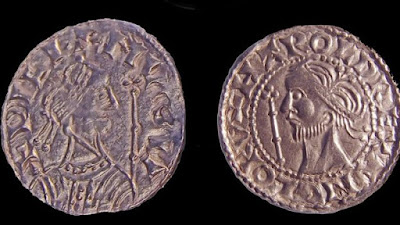 | The 'Chew Valley hoard' contains 1,236 coins of Harold II, the last crowned Anglo-Saxon king of England, and 1,310 coins of William I. Experts say the hoard is "hugely significant" as it doubles the number of Harold coins than all previous known finds combined. It also includes fine examples of coins issued by William I after his coronation on Christmas Day in 1066. | 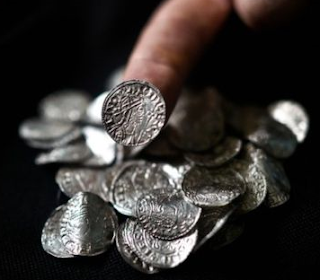 |
 | Adam Staples and Lisa Grace made a once in a lifetime discovery while out metal detecting together. They discovered 2,571 silver coins that date back to the time of King Harold II, aka Harold Godwinson. He was the last crowned Anglo-Saxon king of England who died in the Battle of Hastings by an arrow through the eye in 1066. The couple found the coins while searching an unploughed field in north east Somerset. | 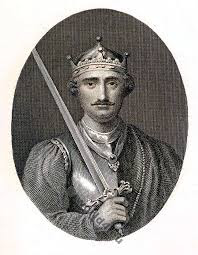 |
 | Harold Godwinson was king for seven months and coins from his reign are rare. Experts believe the coins were buried within two or three years after 1066 and probably before 1072. The Battle of Hastings was fought on 14 October 1066 between the Norman-French army of William, the Duke of Normandy, and an English army under King Harold Godwinson. It marked the beginning of the Norman conquest of England. |  The battle of Hastings was a decisive Norman victory. |
Friday, August 14, 2020
Roman sarcophagi
 | In 2017 two Roman sarcophagi were unearthed close to Rome’s stadium. The marble coffins boast elaborate bas-reliefs and were probably the final resting place of children of a wealthy Roman family. Discovered by chance when an energy company started digging in the area, they date from the third or fourth century AD. |  |
 The Ludovisi sarcophagus | Artifacts are routinely found beneath the streets of Rome during construction. In 2015, an operation to repair gas pipes revealed the remains of a 2,000-year-old villa, complete with frescoed walls. |  A priceless Roman sarcopagus was identified outside Blenheim Palace. |
Thursday, August 13, 2020
Argentine police arrest meteorite thieves - Campo del Cielo
 | In 2015 police in Argentina arrested four men who tried to steal more than a tonne of meteorites in the northern province of Chaco. Highway police say they found more than 200 large pieces of meteorites hidden under the seats of a truck which they had stopped in a random check. Three Argentines and a Paraguayan were arrested. The province of Chaco is world famous for it's meteorites, which are protected under Argentine law. A 37-ton space rock crashed to Earth as part of a meteor shower between 4,000 and 5,000 years ago. It formed a 1,300 sq km (500 sq miles) kilometer crater field known as Campo del Cielo, or Field of the Sky. |  |
 | El Chaco was discovered with a metal detector in 1967. It is the third-biggest meteorite ever found. Named after the province it fell into, the meteorite is central to the native Moqoit people. |  |
 | In 1990 an Argentine highway police officer foiled a plot to steal it for sale to a private US collector. Campo del Cielo meteorite is classified in Group I, 6.68% Ni, 0.43% Co, 0.25% P, 87 ppm Ga, 407 ppm Ge, 3.6 ppm Ir. |  |
 | Almost all of the remaining portion of the meteorite is iron.  |  |
 "Las Víboras" fragment found in Campo del Cielo |  Campo del Cielo meteorite, El Chaco fragment |  :Campo del Cielo meteorite, El Chaco fragment |
Wednesday, August 12, 2020
Emperors from the Principate
 | Toronto based designer Daniel Voshart made colorized, photorealistic portraits of 54 emperors from the Principate.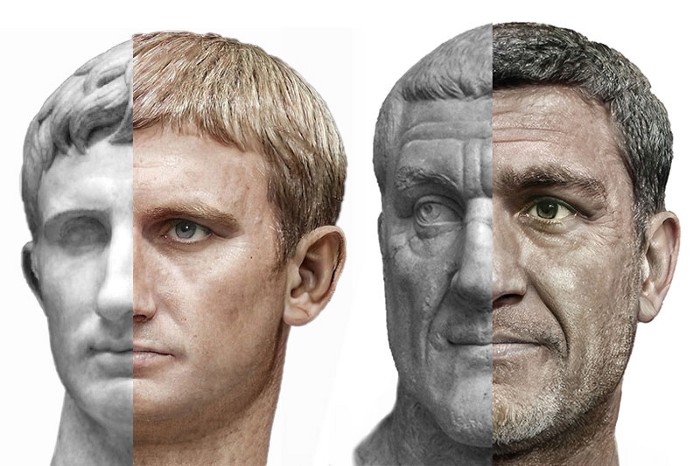 Roman emperors Augustus and Maximinus Thrax. Roman emperors Augustus and Maximinus Thrax. |
Tuesday, August 11, 2020
Roman ‘hand of god’ found near Hadrian’s Wall
 | The hand is made of 2.3 kilos of solid bronze – and was almost certainly an offering to a military deity for giving the Romans victory in the largest military combat operation ever carried out in Britain, before or since. The Roman invasion of Caledonia was launched in 208 by Roman emperor Septimius Severus. The invasion lasted until late 210 when the emperor became ill and died. Some 50,000 Romans were in the invasion force. Found in 2018, it's likely the bronze hand was ritually buried after the conflict. The hand is associated with a Roman god called Jupiter Dolichenus.  |  |
Subscribe to:
Comments (Atom)