 | Palaeontologists have discovered a new species of dinosaur estimated to be up to 125 myo. The fossils were found in the Lujiatun Beds, in north-eastern China, after being buried by a volcanic eruption. Scientists believe the eruption would have trapped the creatures at the bottom of their burrows. About 1.2 metres long, it is thought the dinosaur’s powerful hind legs and stiff tail would have made it a fast runner. The skeleton suggests that creature could dig burrows, much like rabbits do today. |

Monday, September 21, 2020
New dinosaur discovered in China - Changmiania liaoningensis

Monday, September 14, 2020
The Empusa
 | The Empusa is a shape-shifting monster in Greek myth who was often depicted as a beautiful woman, who transforms into a creature with sharp teeth, flaming hair, and (in some tales) bat wings.  |  |
 | Empusa was said to be a demigoddess under the control of the goddess Hecate who hungers for male human flesh. The Empusa would often seduce young men traveling alone. Having taken the form of a woman, they would sleep with the man, sapping their strength. Once the unsuspecting youth was fast asleep, the creature would shift into her hideous form and devour his flesh and drink the blood for sustenance. The Empusa is probably best known for terrifying the god Dionysus as he travels to the underworld. |  |
Friday, September 11, 2020
Silver and gold coins at Bulgaria’s Kaliakra Fortress
 | Researchers working at the site of the Kaliakra Fortress on Bulgaria’s northern Black Sea coast in 2018 found a small clay pot containing close to 1000 objects, including silver and gold coins and jewellery. The items in the clay pot included 873 silver and 28 gold coins, 11 appliqués and buckles, 28 silver and bronze buttons, 11 gold earrings, two rings, one of them gold, and four beads made of precious stones and gold. The discovery was beneath the floor of a room that was burnt in the 14th century. |
  | Kaliakra is a long and narrow headland in the Southern Dobruja region of the northern Bulgarian Black Sea Coast. Ottoman coins make up about 60 per cent of the hoard. They are from the time of Sultan Bayazid Yildirum (1389-1402), and his predecessor, Murad I.  |  |
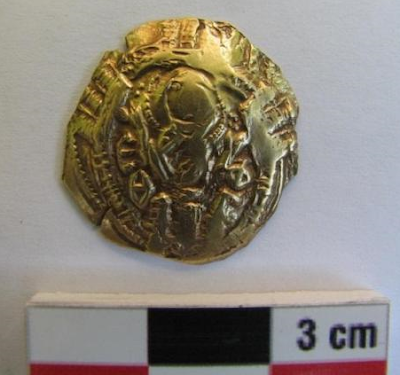 | This is the third treasure to be found at the site, following two finds in earlier years, one of 60 coins, and another of 80 coins. In 2014, three gold coins, dating from the Nicene dynasty in the 13th century were found. |  |
Thursday, September 10, 2020
Painted coffins found at Saqqara
 The 2,500-year-old wooden coffins are so well preserved that the intricate designs on them, painted in blue, gold, white, black and red, are still visible. The 2,500-year-old wooden coffins are so well preserved that the intricate designs on them, painted in blue, gold, white, black and red, are still visible. | Archaeologists have discovered more than 13 ancient Egyptian coffins piled one on top of the other within a burial well at the desert necropolis of Saqqara. |
 | Researchers have yet to look inside the sealed coffins, which haven't been opened since the bodies were interred within. Located 20 miles (30km) south of Cairo, Saqqara was the final resting place of the kings who ruled during the first and second dynasties, including Djoser, the first king of the third dynasty, who had the famous step pyramid at Saqqara constructed. |
Wednesday, September 9, 2020
Evidence of Viking Sunstone found
 | Lore suggested Vikings used special crystals to find their way under cloudy skies. The crystal of legend was locked in the verses of Norse myth with no evidence that it was real. Now scientists believe that the 'Viking Sunstone' or 'Viking Compass' did exist. Though none have ever been found at Viking archaeological sites, a crystal uncovered in a British shipwreck proves they did exist. |
 | A chemical analysis confirmed that the stone was Icelandic Spar, or calcite crystal, believed to be the Vikings' mineral of choice for their sunstones, first mentioned in the 13th-century Viking saga of Saint Olaf. Today, the crystal would be useless for navigation, because it has been abraded by sand and clouded by magnesium salts. But in better days, such a stone would have bent light in a helpful way. |  |
 | Because of the rhombohedral shape of calcite crystals, they refract or polarize light in such a way to create a double image. This means that if you were to look at someone's face through a clear chunk of Icelandic spar, you would see two faces. But if the crystal is held in just the right position, the double image becomes a single image and you know the crystal is pointing east-west. The study’s authors say the crystal could be used to determine the sun's location with an accuracy of one degree, even when it was invisible to the naked eye. It has been suggested that sunstones helped Norse mariners navigate their way to Iceland and onwards as far as North America. |
Ancient Miocene infant ape skull
 | The complete cranium of a Miocene ape from Africa was found in 2017. It lived before the human lineage split off from the common ancestors we share with chimpanzees some 7 million years ago. Scientists in Kenya found the prize: an almost perfectly preserved skull roughly the size of a baseball from an infant. The remarkably complete skull was discovered in the Turkana Basin of northern Kenya. |  Researchers measured argon isotopes—which decay at a fixed, predictable rate—within the fossil’s rock layer, revealing that it was about 13 million years old. Researchers measured argon isotopes—which decay at a fixed, predictable rate—within the fossil’s rock layer, revealing that it was about 13 million years old. |
3D animation of the Alesi skull computed from the European Synchrotron Radiation Facility (ESRF) microtomographic data. It shows the skull in solid 3D rendering | X-rays fired at the skull turned up such high-res images of its teeth that the infant's age could be determined to within a matter of months. But the scientists were most excited about its ears. The inner ear structure suggests that it would not have had the balance to perform treetop aerial antics. |
Tuesday, September 8, 2020
Viking gold hoard in Denmark
 | In 2017 three metal detectorists found the largest Viking gold hoard ever discovered in Denmark. At 900 grams, the hoard consists of seven beautifully worked bracelets, six of gold and one of silver. The silver piece weighs about 90 grams. Gold is extremely rare in the Viking record. The group found the pieces in a field in Vejen, which is in Jutland. There’s no doubt the treasure belonged to Viking elite, and the bracelets may have been used by a chief as alliance gifts, or as rewards or oath rings for his men. |
 | A gold chain of 67 grams was found in the area in 1911. The latest find is almost certainly connected to the chain. |  Viking Gold arm ring |
Wednesday, September 2, 2020
1,000yo Christian cemetery in Poland yields mystery
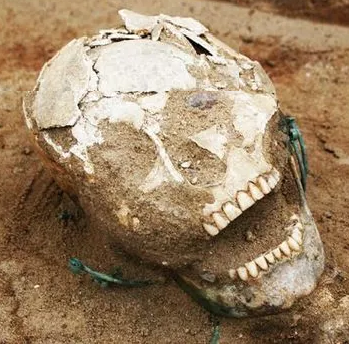 | A 1,000-year-old Christian cemetery in Northern Poland yielded a number of discoveries, including the body of a woman buried with a boulder on her chest. Most of the bodies uncovered at the site were children. One of the burials appears to have been a premature birth. A necklace was found in that burial. |  The corpses all featured grounded down teeth, a sign of a diet heavy in poorly refined flour. The corpses all featured grounded down teeth, a sign of a diet heavy in poorly refined flour. |
Subscribe to:
Comments (Atom)