Tuesday, June 29, 2021

Pandora's box

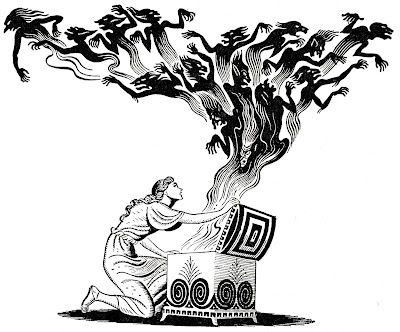
Pandora's box is connected with the myth of Pandora in Hesiod's 'Works and Days'. The container in the original story was a large storage jar but the word was later mistranslated as "box". When Prometheus stole fire from heaven, Zeus took vengeance by presenting Pandora to Prometheus' brother Epimetheus. Pandora opened a jar left in his care containing sickness, death and other evils which were released into the world.
Though Pandora tried to close the jar, only one thing was left behind – usually translated as Hope.

From this story has grown the idiom "to open a Pandora's box", meaning to do some small act that will cause great and unforeseen harm.

Sunday, June 27, 2021

Legio IX Hispana - 9th Legion

Legio IX Hispana ("9th Legion – Spanish") was a legion of the Imperial Roman army that existed from the 1st century BC until at least AD 120. The legion fought in various provinces of the late Roman Republic and early Roman Empire. It was stationed in Britain following the Roman invasion in 43 AD. The Caesarian Ninth Legion fought in the battles of Dyrrhachium and Pharsalus (48 BC) and in the African campaign of 46 BC. After his final victory, Caesar disbanded the legion.Octavian (Augustus) later recalled the veterans of the Ninth to fight against the rebellion of Sextus Pompeius. The Ninth remained with Octavian in his war of 31 BC against Mark Antony and fought by his side in the Battle of Actium.
The legion was sent to Hispania to take part in the campaign against the Cantabrians (25–13 BC). The Ninth participated in the invasion of Caledonia (modern Scotland) in 82–83. The legion narrowly escaped destruction after a surprise attack at night on their fort. The last attested activity of the Ninth in Britain is during the rebuilding in stone of the legionary fortress at York (Eboracum) in 108.

The last records came from Nijmegen and date 120. These are the latest records of Legion IX. It's fate remains speculation to this day.

Wednesday, June 23, 2021

"Painters of Pompeii" opens

"The Painters of Pompeii" opens in Oklahoma City and highlights Roman wall painting, which was common in ancient Rome. The interiors of Roman buildings were decorated with bold colors and designs that ranged from mythology to landscapes to still lifes to architecture.

Often paintings covered the entire wall, from floor to ceiling.

Tuesday, June 22, 2021

17 decapitated skeletons found at ancient Roman cemetery in UK

Seventeen decapitated skeletons dating back about 1,700 years have been discovered in three Roman cemeteries at Knobb's Farm in Cambridgeshire, in the U.K. Archaeologists who excavated the site think that the people were executed for violating Roman laws. The cemeteries hold the burials of 52 people, and the 17 decapitated bodies include those of nine men and eight women and all over 25 years of age at time of death.
The number of capital crimes in Roman law increased dramatically during the third and fourth centuries, around the time these skeletons were buried. Death offenses grew from 14 at the start of the third century to around 60 by the death of Constantine in A.D. 337. Evidence suggests that the Roman military used Knobb's farm as a supply center, and would have dealt harshly with any infractions.

Monday, June 21, 2021

Kent detectorists strike gold three times

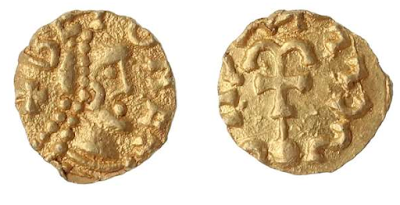
Two rare gold tremissis from the Merovingian dynasty - the ruling family of the Franks from the middle of the 5th century until 751 were found. Only 115 such coins have been recorded in Britain. How the tremissis turned up in the UK will never be known exactly but they originate from a time of social turmoil across Europe, in the wake of the collapse of the Roman Empire. It was a time in Britain when no coins were being minted by the tribes left free of Roman rule.
A Gallo-Belgic gold stater isn't as rare as the tremissis, it's older, from around 150BC - and has its origins in another time of turmoil. They was minted to pay mercenaries fighting in the Gaul war against Julius Caesar. It could have been bought over by a mercenary from the continent. They were only struck on one side and were produced hastily.

Sunday, June 20, 2021

The Jerusalem National Park Hoard - Givati hoard

In January 2009 a hoard of gold coins was found in Jerusalem. The excavations were in the Giv‘ati car park in the City of David, in the walls around Jerusalem National Park. A large building was uncovered that dated to about the seventh century. The hoard of 264 gold coins was discovered among the ruins of the building.
There were 264 gold solidi with the portrait of Heraclius in the Givati hoard. Heraclius ruled the East Roman Empire from 610 to 641 CE. None of the coins are clipped, carry graffiti, or have any other significant signs of use. The coins all appear to be from the early Heraclius solidi series struck from 610 through 613. In fact, however, they are more likely part of an emergency issue struck at a Jerusalem mint as they were all struck from the same die.
Different coins were minted during this emperor’s reign; however, all of the coins that were discovered in the City of David in Jerusalem belong to one well-known type in which the likeness of the emperor wearing military garb and holding a cross in his right hand is depicted on the obverse, while the sign of the cross is on the reverse. The coins were minted shortly before the Persians conquered Byzantine Jerusalem (614 CE).

Tuesday, June 15, 2021

“Echenique Disc” returned to Peru

The Smithsonian’s National Museum of the American Indian returned a pre-Incan gold ornament from its collection to Peru. The repatriated item, an “Echenique Disc,” is recognized as the symbol of the city of Cusco in Peru, once the capital of the Inca Empire. The object is a circular thin sheet of metal measuring 5.3 inches in diameter. It’s made of 90% gold, 5% silver, and 5% copper, and crafted with techniques commonly used in ancient Andean metal work. Experts have dated the item to the pre-Inca Early Horizon Period (800 BCE to 1 CE).

Sunday, June 6, 2021

Spectacular 'Leda and the Swan' found in Pompeii

In 2019 archaeologists found a watercolor fresco depicting 'Leda and the Swan' in Pompeii. Amazingly preserved it has brilliant detail and color despite being buried for nearly 2,000 years.
The Orto dei fuggiaschi (The garden of the Fugitives)
'Leda and the Swan' is a common theme. The swan is an embodiment of the Roman god Zeus, who is impregnating Leda.

Saturday, June 5, 2021

The Pereshchepina Hoard


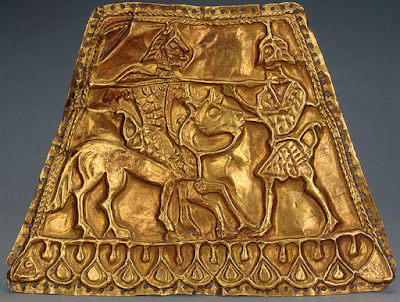
Belt Plaque Gold. Second half of the 7th century BC
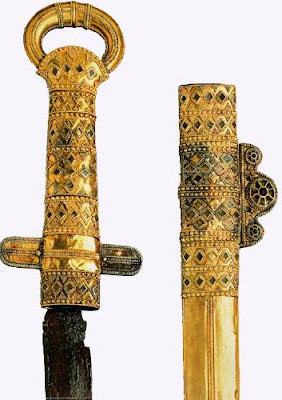
The Pereshchepina Treasure is a major deposit of Bulgarian, Sassanian, Sogdian, Turkic and Avarian objects. The hoard was discovered in 1912 in the village of Mala Pereshchepina (20 km from Poltava, Ukraine) by a boy shepherd who literally stumbled over a golden vessel and fell into what is thought to be the grave of Kuvrat, the founder of Great Bulgaria and father of Asparuh, the founder of the First Bulgarian Empire.

Comb with Scythians in Battle. Gold; cast and chased. Late 5th - early 4th century BC

Plaque in the Form of the Head Gold; stamped. Scythian. 4th century BC

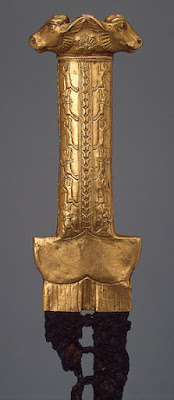
Sword Hilt. Gold and iron; chased. Scythian. 5th century BC
The 800 piece trove contains finely crafted gold artifacts that exceeds 21 kg and 50 kg of silver. (42 pounds, 110 pounds) Items ranged from 500 BC to 670 AD and are of Byzantine, Persian and Barbarian origin. Three gold rings are engraved with the monogram of Kubrat, and his 400gm gold patrician buckle and sword were found.


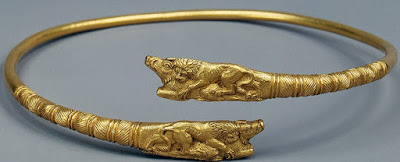
Torque (Grivna) Gold; cast, forged, chased. Meotian Culture. Late 4th century BC

Necklace. Gold; stamped, soldered, filigreed, repousse. Meotian Culture. Late 4th century BC

Plaque with Scythian Warriors. Gold; repousse. Scythian. 4th century BC

Facing for a Horse's Frontlet Gold; stamped. Scythian. 4th century BC

Overlay for a Goryt (Case for a Bow and Arrows) Gold; stamped. Scythian. 4th century BC

Hand-Washing Vessel: Pitcher and Ladle Poltava Region, Ukraine. Silver gilt

Overlay for a Wooden Vessel Gold; stamped. Scythian. First half of the 5th century BC

Pair of Boat-Shaped Earrings Gold; forged, stamped, soldered, filigreed. Scythian. 4th century BC

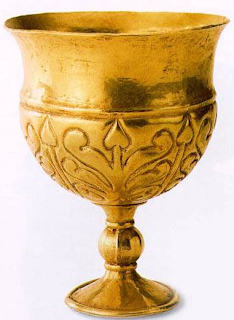
Goblet Poltava Region, Ukraine 7th century

Friday, June 4, 2021

Eleutherna Treasures

Eleutherna, also called Apollonia, was an ancient city-state in Crete, Greece. It is located on a narrow northern spur of Mount Ida, the highest mountain in Crete.

It flourished from the Dark Ages of Greece’s history until Byzantine times.
The Eleutherna museum is in an area where excavations were conducted and is enclosed within the Eleutherna archaeological park's boundaries.
Located in the heart of Crete, near the island's geographical center, the archaeological site is nestled in a slope of Mount Ida overlooking the sea. Time has erased most traces of the ancient city-state from the surface – with a human presence dating back to 3000 BC. But the ground itself has yielded many treasures.
The site of Eleutherna includes an acropolis, a polis, and a necropolis. Excavations over the years have shown that the people who lived here were of the Bronze Age civilizations of both the Minoans and the Mycenaeans, as well as the Dorians, warriors from the Greek mainland.

Plaques with the Life of Achilles, about A.D. 300–350, made in Thessaloniki; found in Eleutherna

Greek Bee Fibula, 4th century BC

Bee Goddess - From Eleutherna on Crete, c. 700 BC.