In 2014 paleontologists in Patagonia, southern Argentina unearthed a 90-million-year-old fossil of what they claim is one of the largest dinosaurs found to date. The dinosaur, Patagotitan mayorum, weighed about 80 tons, the equivalent of 14 grown elephants.
A complete skeleton was found in a field discovered by a farm worker, where up to seven such complete skeletons are believed to exist, in the locality of El Sombrero.
(Click to Enlarge)
Titanosaurs lived at the end of the Cretaceous (145 mya to 66 mya).
The Island of Gold disappeared mysteriously around the 14th century. The site of Srivijaya may have been found by local fishing crews carrying out night-time dives on the Musi River near Palembang on the Indonesian island of Sumatra. Srivijaya was an important centre for the expansion of Buddhism from the 7th to the 12th century AD. Srivijaya was the first unified kingdom to dominate much of the Malay Archipelago. Srivijaya was a waterworld, its people living on the river like modern boat people. As ancient texts recorded: “When the civilization ended, their wooden houses, palaces and temples all sank along with all their goods.” Srivijaya controlled the arteries of the Maritime Silk Road, a huge market in which local, Chinese and Arab goods were traded. For over 300 years the rulers of Srivijaya mastered the trade routes between the Middle East and imperial China.
Srivijaya became the international crossroads and its rulers accumulated legendary wealth. Locals may have found the fabled civilization in the Musi River around Palembang.
A diver prepares to freedive with a hookah breathing system in the Musi River at Palembang.
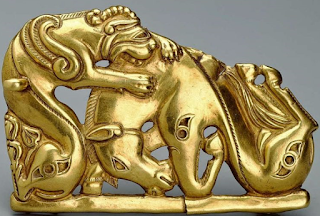
A Dutch court ruled to hand over gold artifacts unearthed in annexed Crimea to Ukraine, dealing a blow to Russia’s claims. Both Moscow and Kiev claimed ownership of the Scythian treasures, which were loaned to Amsterdam’s Allard Pierson Museum. The museum’s “Crimea: Gold and Secrets of the Black Sea” exhibit opened in February 2014, one month before Russia seized the Black Sea peninsula from Ukraine. The treasures remain in "safe storage" in the Allard Pierson museum pending appeal.
The collection dates to the Scythian era in the fourth century B.C.
A Dutch court ruled that Ukraine was the rightful owner of the ancient treasure and it should not be returned to the territory while it is occupied by Russia. Moscow claimed that as Crimea is part of Russia, the artifacts should be returned. Moscow had accused the Netherlands of seizing the gold artifacts illegally, as they were claimed by the Kremlin following Russia's annexation of Crimea.
Pompeii is a buried Roman town near modern Naples. When Mt. Vesuvius erupted in 79 AD, Pompeii was burned and buried in ash, while nearby Herculaneum was destroyed by pyroclastic flow. The area was buried under 4 to 6m (13 to 20 ft) of ash and pumice. Pompeii was lost until its rediscovery in 1599 and broader rediscovery in 1748.
The objects that lay beneath the city have been well preserved.
Marble statue from the Temple of Isis.
Helmet of a Thrax gladiator. Bronze.
Mosaic (detail) from Pompeii.
Apollo as an Archer
Diana as an Archer.
A gold bracelet bears an inscription. On its inside face are the words dominus ancillae suae – from the master (dominus) to his slave-girl (ancilla).
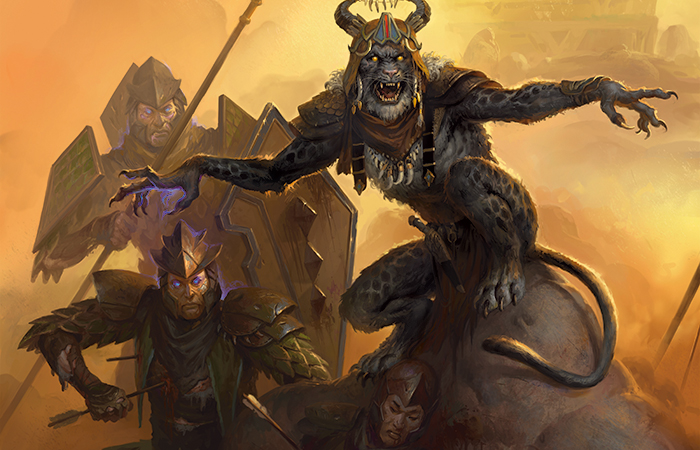
In Hindu mythology, a rakshasa is a malignant demon, especially one of a band of demons at war with Rama and Hanuman. The word rakshasa comes from the Sanskrit rākṣasa, meaning ‘demon’. The rakshasa was later incorporated into Buddhism. Rakshasas are also called 'Maneaters'. A female rakshasa is known as a Rakshasi.
They were insatiable cannibals that could smell the scent of human flesh. Some drank blood with their palms or from a human skull.
Generally they could fly, vanish, and had Maya (magical powers of illusion), which enabled them to change size at will and assume the form of any creature.
The crab fossil record extends to the Early Jurassic epoch, more than 200 million years ago. Fossils of nonmarine crabs are sparse, until now with the discovery of Cretapsara athanata, a previously unknown true crab preserved in Cretaceous amber from Myanmar. The 5-mm-long crab is the oldest and the most complete fossil crab found. Well-developed gills indicate an aquatic to semi-aquatic crab.
Previous fossil records of crabs suggested that crabs ventured onto land and adapted to freshwater about 75 to 50 million years ago. This crab most likely died in brackish or freshwater near the coast or an estuary. This demonstrates that crabs became terrestrial about 100 mya — much earlier than previously thought.
Archaeopteryx (meaning "ancient wing") is a very early prehistoric bird, dating from about 150 million years ago during the Jurassic period. The first, and one of the most complete fossils of archaeopteryx is known as the London specimen. It was discovered in 1861, just two years after Darwin published On the Origin of Species, and made a stir being a transitional form.
Only 12 of these curious creatures have ever been found.
They are going under the glare of a giant X-ray machine - to find out what lies buried beneath the surface. Using a new "camera obscura" technique scientists have captured some of the clearest ever images of Archaeopteryx. For the first time, they can see the complete skeleton in 3D. Not just the surface outlines, but all the hidden bones and feathers. Could Archaeopteryx fly? The answer grows closer as new, microscopic details of its anatomy emerge.
Blood vessels within the bones, for example, can be compared to modern birds.


 The collection dates to the Scythian era in the fourth century B.C.




 Only 12 of these curious creatures have ever been found.


