Friday, October 31, 2025

Ancient Assyrian inscription reveals events in Bible

A tiny fragment told a story of Biblical proportions. Archaeologists in Jerusalem unearthed a 2,700-year-old Assyrian inscription in clay that could shine a light on key events detailed in the Old Testament. The 1-inch pottery fragment is part of a seal that was used to authenticate official documents. It was found in a drainage canal at Temple Mount in Jerusalem’s Old City. This is the first time that evidence of relations between the Assyrian Empire and the Kingdom of Judah had been uncovered in the city.
By analyzing the clay, researchers were able to trace the shard’s origin to the Tigris basin region where several Assyrian hubs were located. It was inscribed with Akkadian cuneiform — the world’s oldest written Semitic language. The ancient text is a complaint by the Assyrians over a delayed tax payment by Judah that had been due on the Av, the 11th month of the Hebrew calendar. It was an ancient tax notice from the Assyrian emperor to a Judean king, which rang similar to a Biblical account.

In II Kings 18 and 19, during the reign of Judah’s King Hezekiah, “King Sennacherib of Assyria marched against all the fortified towns of Judah and seized them.” “King Hezekiah sent this message to the king of Assyria at Lachish: ‘I have done wrong; withdraw from me; and I shall bear whatever you impose on me,'” the excerpt read. “So the king of Assyria imposed upon King Hezekiah of Judah a payment of 300 talents of silver and 30 talents of gold.”
Experts were able to date the artifact to between the end of the 8th century and the middle of the 7th century BCE. The tiny shard is evidence of the Hezekiah revolt against Assyrian King Sennacherib. The fragment’s discovery proves how even the tiniest artifacts can provide essential historical evidence.

UK detectorists pay heavy price for theft

Two metal detectorists who unearthed a hoard of gold jewellery, silver ingots and coins buried more than 1,000 years ago by a Viking warrior in Herefordshire received lengthy jail sentences for theft in late 2019.
George Powell, 38, and Layton Davies, 51, should have legally declared the find, worth millions. They elected to steal it and sell it off. They received 10 years and eight and a half years respectively. The judge said they had cheated not only the landowner, but also the public of “exceptionally rare and significant” coins. “You cheated the farmer, his mother, the landowner and also the public when you committed theft of these items,” he said. “That is because the treasure belongs to the nation. The benefit to the nation is these items can be seen and admired by others."
Jewellery dated from the fifth to ninth centuries.
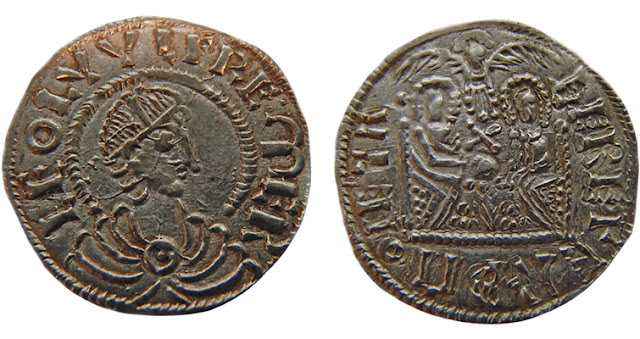
All the jewellery and one ingot was recovered but the majority of the 300 Anglo-Saxon coins are gone forever. One lost coin was “Two Emperors”, believed to depict King Alfred the Great of Wessex and Ceolwulf II of Mercia, revealing a previously unknown pact between the pair. After rumours began to circulate about the find, the gold and one ingot was handed over, but police have recovered only 30 of the 300 coins.

Thursday, October 30, 2025

Royal Germanic grave found

The grave of a Germanic lord who lived 1,500 years ago was unearthed in Saxony-Anhalt, near Brück in 2020.
Remains of 11 animals were found, including cattle, horses and dogs. Builders were clearing land for a new chicken farm and stumbled across a royal cemetery. Ashes may be inside a bronze cauldron in the central tomb, which is around 13 feet by 13 feet in size. The cauldron is the focal point of the mounded tomb, and is surrounded by six women buried in a radial alignment from the pot, like the hands of a clock.
A glass bowl was among the objects found.
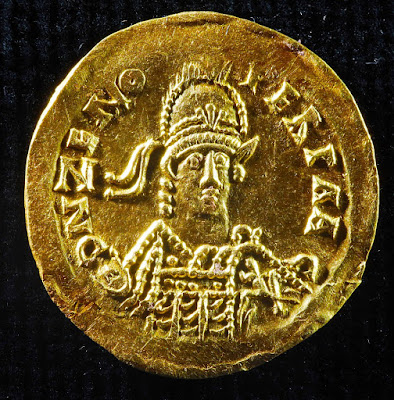
Vestment clasps.The site dates from between AD480 and AD530, a period following the fall of the Roman Empire which saw many Germanic tribes, such as the Huns, invade territories which were no longer under Roman protection. A gold coin found at the site features Eastern Roman emperor Zeno. It dates to around 480.

Wednesday, October 29, 2025

Ancient Jerusalem gold rings mark rite of passage

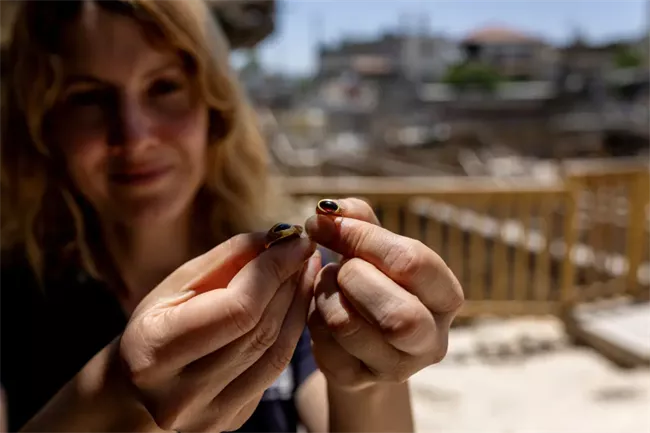
Rings and bronze earrings discovered at the City of David site in the Jerusalem Walls National Park likely come from the early Hellenistic Period in Jerusalem. Reasearchers suggests that two rings may be connected to a coming-of-age ritual for young women before marriage. Found in the building’s foundations, the objects were placed there in the context of executing a well-known Hellenistic period custom in which betrothed women would bury jewellery and other childhood objects in the house foundations as a symbol of the transition from childhood to adulthood.
Jewellery design may have been influenced by trade with the dominant empires at the time. Jewellery that combines gold with bright colour gemstones was a fashion inspired by places such as India and Persia.

Tuesday, October 28, 2025

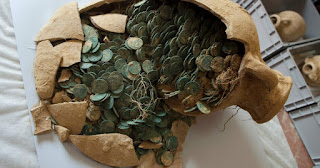
Trove of Roman coins in Spain

In 2016 workers laying pipe in a southern Spanish park unearthed a 600 kilogram (1,300 pounds) trove of Roman coins.
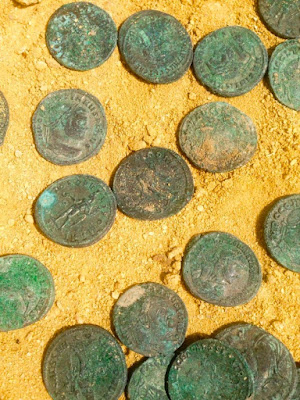
The construction workers came across 19 amphoras containing unused bronze and silver-coated coins dating from the end of the fourth century. The coins are believed to have been recently minted at the time and had probably been stored to pay soldiers or civil servants. The clay pots, 10 of which were said to be intact, were found just over a metre underground. The coins bear images of emperors Constantine and Maximian. The Romans began to conquer Spain in 218 B.C. and ruled until the fifth century.

Hispania was the Roman name for the Iberian Peninsula. Under the Republic, Hispania was divided into two provinces: Hispania Citerior and Hispania Ulterior.

Latin was the official language of Hispania during the Rome's more than 600 years of rule, and by the empire's end in Hispania around 460 AD, all the original Iberian languages, except the ancestor of modern Basque, were extinct. Even after the fall of Rome Latin was spoken by nearly all of the population.

Gorgons

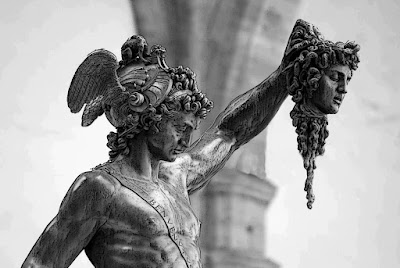
In Greek mythology, a Gorgon is a female creature. The name derives from the ancient Greek word gorgós, which means "dreadful". The term commonly refers to any of three sisters who had hair made of living, venomous snakes. They turned those who beheld them to stone. Traditionally, while two of the Gorgons were immortal, Stheno and Euryale, their sister Medusa was not, and she was slain by Perseus. The concept of the Gorgon is at least as old in classical Greek mythology as Perseus and Zeus. Gorgons were a popular image in Greek mythology, images of the Gorgons were put on objects and buildings for protection.
Representations of full-bodied Gorgons and the Gorgon face, called a gorgoneion, were popular subjects in Ancient Greek, Etruscan and Roman iconography. While ancient Gorgons and gorgoneia were depicted as hideously ugly, over time they came to be portrayed as beautiful young women.
One of the earliest representations on coins is on an electrum stater from Parium.

Going even further back, there is a similar image from the Knossos palace, dating to the fifteenth century BC.

One of two Gorgon Heads from the cuirass (breastplate) of Macedonian King Philip II
Greek Apollonia Pontica Silver Drachm struck 4th century B.C. Perseus and the gorgon.

Monday, October 27, 2025

Gold at Christies - The Ten Thousand

Prices for two ancient plaques exploded past estimates in 2021.
An Achaemenid gold appliqué of a winged bull, reign of Artaxerxes II, 404-359 BC. was estimated £100k-150k. It made £1.4m. A lamassu was estimated the same and made £1.6m. HERE. The spectacular objects were reputedly discovered during an excavation at the city of Hamadan, in northwest Iran, in 1920. Among the trove of 23 gold items were two plaques, coming to auction at Christies.
Artaxerxes II was a powerful leader who defended the largest empire the ancient world had ever seen — stretching from Greece to India — against his brother, Cyrus the Younger, and his army of Greek mercenaries known as ‘The Ten Thousand’. Between 401 and 399 BC, the Ten Thousand marched across Anatolia, fought the Battle of Cunaxa, and then marched back to Greece. Artaxerxes II also waged successful campaigns against the Spartans, Athenians and Egyptians.
Achaemenid gold applique of a winged bull. Iran, reign of Artaxerxes II, 404-359 B.C.

The Gate of All Nations (Gate of Xerxes), in the ruins of the ancient city of Persepolis, Iran, is flanked by a pair of lamassus.

Sunday, October 26, 2025

Gold bedecked 4,500yo Minoan woman's skeleton

A Minoan woman's skeleton was found in 2018 buried in her tomb along with a gold necklace and bronze mirror, 4,500 years after she died. A large dig in the municipality of Sissi, on the north coast of Crete found remnants of an early Minoan settlement dating as far back as 2,600 B.C.

The Minoan civilization arose on Crete about 2600BC and flourished until around 1400BC when it mysteriously disappeared. The origins of the Minoan and their fate has puzzled archaeologists.
The box-shaped stone tomb held a nearly intact female skeleton, as well as jewelry indicating her great wealth. The jewelry included costumes made of bone and bronze, a bronze mirror with an ivory handle, and a beaded gold necklace. The archaeological site at Sissi is 2 miles from the ancient city of Mallia, in Crete.
The Minoans were the first advanced civilization in Europe, leaving behind massive building complexes, tools, stunning artwork, writing systems, and a huge network of trade.

Saturday, October 25, 2025

The Roman gold ring that inspired J.R.R Tolkien

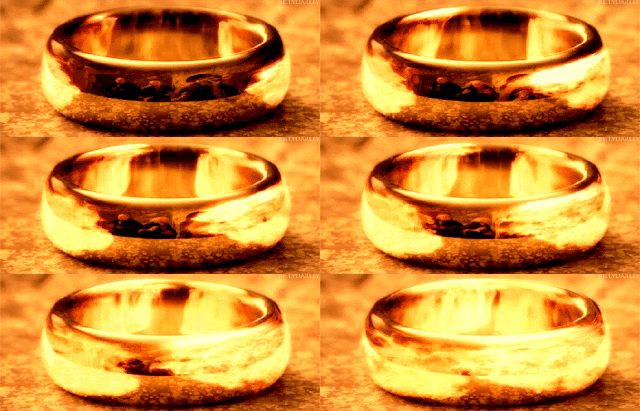
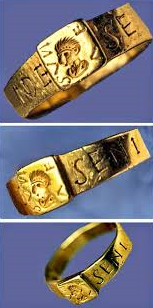
In 2016 the UK National Trust and the Tolkien Society put an artifact on display for fans of "The Lord of the Rings" to decide for themselves whether this was Tolkien's precious ring of power. The Vyne Ring or the Ring of Silvianus is a gold ring, dating to the 4th century, discovered in a field in Hampshire, England, in 1785.
It was originally the property of a British Roman called Silvianus. The gold ring is inscribed in Latin, "Senicianus live well in God," and inset with an image of the goddess Venus. It is larger than average, weighing about 12 grams. The ring is believed to be linked to a curse tablet found separately at the site of a Roman temple dedicated to a god named Nodens in Gloucestershire.
The tablet says a man called Silvianus had lost a ring, and it asks Nodens to place a curse of ill health on Senicianus until he returns it. An archeologist who looked into the connection between the ring and the curse tablet asked Tolkien, who was an Anglo-Saxon professor at Oxford University, to work on the etymology of the name Nodens in 1929.

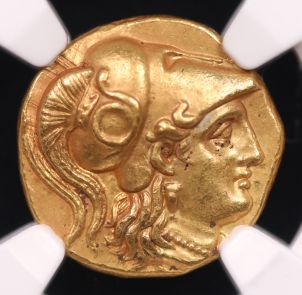
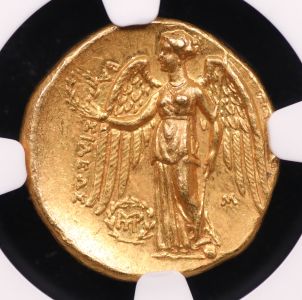
Kingdom of Macedon – Alexander III “the Great” (336–323 BC) Gold Stater

Few ancient coins rival the beauty, power, and enduring legacy of the gold staters issued in the name of Alexander III of Macedon. Alexander the Great. Struck during or shortly after his reign, these coins were a cornerstone of the world’s first truly international currency system. The obverse depicts Athena, goddess of wisdom and war, wearing a crested Corinthian helmet adorned with a coiled serpent—an emblem of divine protection and intellect guiding military might.
On the reverse, Nike, the winged goddess of victory, stands gracefully holding a laurel wreath in her outstretched hand and a stylis (naval staff) in the other, symbolizing triumph both on land and sea. Below her feet appears the mint control monogram, identifying the specific mint—this example attributed to an early Seleucid issue.
Weighing 8.57 grams of nearly pure gold, it earns NGC’s highest surface rating of 5/5. The Fine Style designation underscores exceptional artistry. $33k USD.

Friday, October 24, 2025

Latin teacher's Roman coins bring top dollar

A collection of 130 ancient Roman coins acculmulated by a former Latin teacher from Connecticut sold at auction for over $1m in June 2025.
Carol Ross' interest in ancient Rome led to her collection of over 130 coins. Top lot was an aureus of Marcus Junius Brutus.
Only 17 are known. It was minted in Greece in 42 or 43 B.C. It made over $314,000, far outpacing an estimate of between $100,000 and $150,000.
A rare Augustus aureus was likely minted in Rome in 31 BC and is a symbolic transfer of power back to the Roman Senate after his defeat of Mark Antony. The coin sold for $181,500, obliterating it's $30,000 - $40,000 estimate.