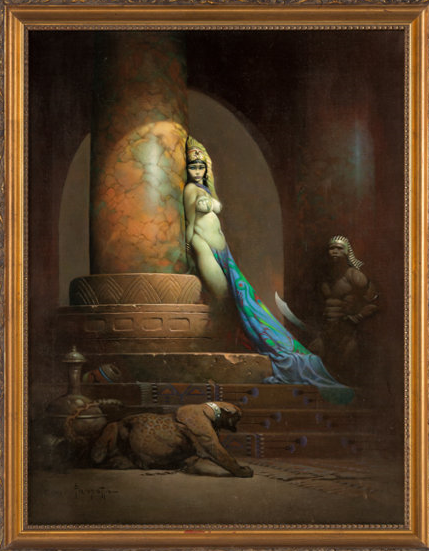
 | Frank Frazetta. Egyptian Queen Painting, Original Art (1969). Frank Frazetta would continue to produce paintings for another 30 years, but this image captured the hearts of legions and remains burned into the minds of generations. The Egyptian Queen first appeared in print as the cover for Eerie magazine #23 in mid-1969, and countless prints and posters were produced over subsequent decades. The masterpiece resided with the Frazetta family since its creation, and it was the first time it has ever been offered for sale. It made $5.4m on 16th May, 2019. |

Tuesday, March 3, 2026
Frank Frazetta - Egyptian Queen - $5.4m

Sunday, March 1, 2026
Worst Roman Emperors
Some Roman emperors reputation for cruelty, excess, and debauchery, enabled by unbridled power at the head of a decadent society, serves as a warning of the pitfalls of absolute power today. Roman emperors had short lifespans after ascending to the throne. Of the 69 emperors from the accession of Augustus to the reign of Theodosius, 43 suffered a violent death.
 | Tiberius ruled AD 14–37. He sank into morbid suspicion of everyone around him. He retreated to the island of Capri and revived the ancient accusation of maiestas (treason) and used it to sentence to death anyone he desired. Tiberius living on Capri is recorded as a depraved sexual predator. Tiberius Gold Aureus. Lugdunum. AU Strike 5/5 - Surface 3/5. US$11,150 |
 | Caligula ruled from 37–41 CE. He became infamous for his extreme feats of carnage. Nero was his nephew. Caligula was cruel, depraved, and insane. In January 41 CE officers of the Praetorian Guard, led by Cassius Chaerea, killed him. Caligula, formally Gaius, Gold Aureus. Rome, A.D. 40. Laureate head of Gaius facing right, Germanicus, Caligula's father who died in A.D. 19, facing right. Au strike 5/5, surface 2/5. US$45,000. |
 | Nero (AD 54 to 68) debased currency and confiscated senators' property and severely taxed to fund his palace, the Domus Aurea. Rome burned for nine days. Its said Nero used the fire to clear space for his palace. Nero blamed the Christians, executing thousands. Nero Gold Aureus. Lugdunum, A.D. 56-8. Nero facing right, VF, Strike 4/5, Surface 2/5. US$10,800. |
 | Domitian (81–96) was fearful and paranoid. Conspiracy theories consumed him, and some were true. He curtailed the Senate and expelled those he deemed unworthy. He executed officials who opposed his policies and confiscated their property. Domitian was assassinated in 96 CE. Domitian Gold Aureus. Rome. Struck AD 90-91. Superb EF. US$29,500. |
 | Commodus (177–192) was cruel, debauched, and a corrupt megalomaniac who viewed himself as reincarnated Greek gods. He too devalued Roman currency mercilessly, instituting the largest drop in value since Nero. Commodus Gold Aureus. Rome mint. Struck AD 183. Superb EF US$24,500 |
 | Elagabalus (218 to 222). Elagabalus's sin was not bloody, but acting unlike any Emperor. Writers told of his sexual perversion, feminity, bisexuality, and transvestism. Elagabalus Gold Aureus. Slow quadriga moving right, on which is set the conical stone of Emesa. Very rare. Graded NGC Ch VF Strike: 5/5 Surface: 2/5. Graffito. Marks. Bent. US$20,000 |
 | Caracalla (AD 211–217) dealt brutally with opponents: he exterminated all of them. Caracalla quickly turned the surplus he inherited from his father into a deficit. He was assassinated by a group of army officers, including Praetorian prefect Opellius Macrinus. Caracalla Gold Aureus. Rome mint. Struck AD 213. Near EF. Extremely rare and important. Caracalla renovated the Circus Maximus in AD 213, and rare aurei and sestertii were issued to celebrate. This aerial view depicts the Circus as it would be seen from the Palatine Hill. US$140,000 |
 | Diocletian (AD 284–305) conducted a ruthless persecution of Christians. Diocletian set about it's total eradication. Churches were destroyed, scriptures burnt, and Christians who refused to give up their faith were tortured and executed. Diocletian Gold Aureus. Grade NGC Ch AU Strike: 5/5 Surface: 4/5, edge marks. US$20,000 |
Nero's bathtub
Nero's bathtub, better described as a porphyry basin, was commissioned by Nero between 54-68 AD for his Domus Aurea (Golden House).
Discovered around 18 AD by the Roman legionary Caius Cominius Leugas, it became the most prestigious stone for the Roman and Byzantine elite.
 |
It was carved from a single, rare slab of Imperial porphyry from Egypt. Imperial Porphyry is a prized, deep purple, volcanic igneous rock with white feldspar crystals, quarried exclusively by the Romans in ancient Egypt at Mons Porphyrites (now Jabal Dokhan). |
 | At the center of the Pantheon in Rome is a large circle of Imperial porphyry on the floor where, for 300 years, new emperors stood to be crowned. Its immense value comes from the rarity of the purple porphyry and its historical connection to Roman imperial power. The quarry is now depleted, making the artifact irreplaceable. It is now located in the Pio Clementino Museum at the Vatican Museums in Rome. |
Subscribe to:
Comments (Atom)