The Prittlewell Prince refers to a high-status Anglo-Saxon royal burial discovered in 2003 near Southend-on-Sea, Essex. Called "Britain's Tutankhamun" due to its undisturbed state, the chamber yielded over 40 treasures. Radiocarbon dates combined with other dating evidence narrowed the burial to a period of about 30 years (AD 575–605). This date was refined by tiny gold coins from the coffin, called tremissi from Merovingian France.
 | An extremely high status Anglo-Saxon royal was laid to rest in a lavish tomb. He was buried with amazing treasures. 1,400 years later, the remains of the royal tomb was discovered next to a pub and a grocery store in the Essex town of Prittlewell.
 | |
The Museum of London Archaeology (MOLA) published a trove of research into the find, and launched an
interactive version of the burial chamber.
 | The identity of the Prince of Prittlewell may never be known. One theory suggests the tomb belonged to Sæberht, once King of Essex, who is known to have been an early Anglo-Saxon convert to Christianity. Two gold-foil crosses found at the head of the coffin were placed over the eyes of the deceased. | 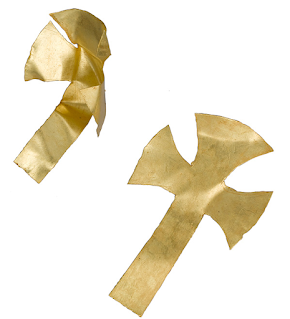
|

High status latticed blue glass beakers manufactured in Kent and a pair of drinking bottles


No comments:
Post a Comment