
 | He played many roles in the myths of ancient people, but as a god of profit and commerce, he was often represented on money. Possibly the earliest coin to depict Hermes is a silver stater of Kaunos dated to c. 490 BCE. |  Populonia, an important center of iron production, was one of the few Etruscan cities that issued silver coinage in the fourth century BCE. A didrachm – one of only three known – depicts Turms. |
 | The facing head of Hermes, dated to c. 402-399 BCE. Perhaps the finest image of Hermes on any ancient coin appears on the reverse of a silver stater of Pheneos, c. 360-350 BCE |  |
 C. Mamilius Limetanus denarius serratus c. 82 BC. Bust of Mercury | One of the last appearances of Mercury on Roman coinage came during the brief reign of the emperor Trajan Decius. (249-251)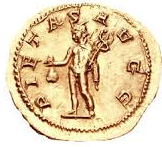 | 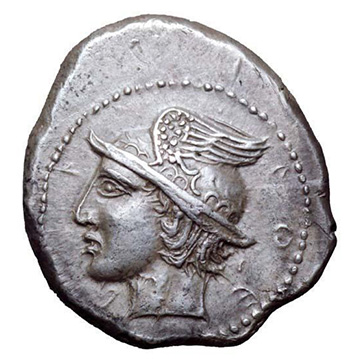 Pheneos produced a small silver obol c. 370-340 BCE |
 | Hermes was often depicted as a young man, wearing traveling clothes, a flat hat known as 'petasus' and winged sandals on his feet. Often, he was depicted having wings attached to his shoulders and hat. He usually held a caduceus, a winged staff with snakes wrapped around it so he could gain access everywhere. This staff helped Hermes to charm the gods. The staff is often mistakenly used as a symbol of medicine. |  |

No comments:
Post a Comment