 Assyrian King Shalmaneser III shaking hands with a Babylonian ruler. Assyrian King Shalmaneser III shaking hands with a Babylonian ruler. | The handshake goes back to the dawning of ancient history but the reason and origin of it are not known. One of the oldest depictions of the handshake is from a ninth-century B.C. relief. A handshake was a symbol of loyalty and friendship in ancient Rome and clasped hands are often found on coins.  |

Wednesday, April 29, 2020
Ancient handshake about to go extinct

Tuesday, April 21, 2020
Gold Treasure of Nagyszentmiklos
 | The Gold Treasure of Nagyszentmiklos is the largest known hoard of early medieval gold vessels. The Treasure of Nagyszentmiklos was discovered accidentally in the Banat region of the Habsburg Empire in 1799. Its total weight is about 10 kg. It is remarkable for its quality and precision of craftsmanship. |
 | Studies over the last few decades have revealed that the treasure was gathered over a long period of time, from the late 7th to the late 8th century AD, and seem to confirm its links to the Avar culture. | 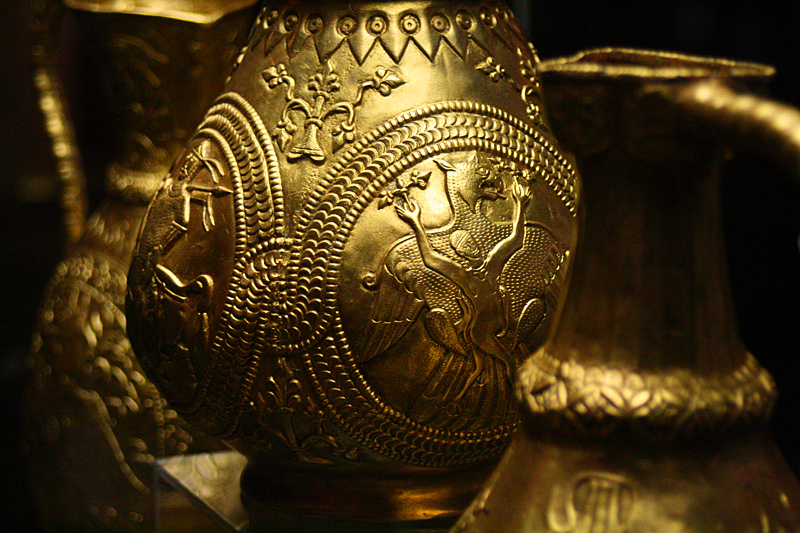 |
Saturday, April 18, 2020
The Staffordshire Hoard
 | With more than 3,500 items, amounting to some 5kg of gold and 1.4kg of silver – plus thousands of garnets – the Staffordshire hoard is the largest cache of Anglo-Saxon metalwork ever found. |
 | Archaeologists believe the treasures were captured over several large mid-seventh century battles. It's likely that they were seized by the English midlands kingdom of Mercia from the kingdoms of Northumbria, East Anglia and possibly Wessex. |
 | The items are almost exclusively military. The hoard was made up of fittings from up to 150 swords, gold and garnet elements of high status seax (fighting knifes), a gilded silver helmet, crosses, and a probable bishop’s headdress. |
 | The ornate bishop’s headdress is the world’s earliest surviving example of high status ecclesiastical headgear. One element bears an inscription – a quotation from the Book of Numbers. It reads “Rise up, LORD, and let thine enemies be scattered; and let them that hate thee flee before thee”. It is possible that the hoard was war booty captured by the pagan Mercian king, Penda, from armies led by Christians. |  |
Thursday, April 16, 2020
Golden Kingdoms: the Ancient Americas
 Octopus Frontlet, 300–600, Moche culture | Golden Kingdoms: Luxury and Legacy in the Ancient Americas, was on view at the Getty Center in 2018. It traced the development of gold working and other luxury arts in the ancient Americas from about 1000 BC to the arrival of Europeans in the early 16th century. The exhibit reveals the ways ancient Americans used not only metals, but also jade, shell, and feathers. |  Ear Ornament Depicting a Warrior, 640–680, Moche. |
 | It was a world where feathers were more valuable than gold. The rarest feathers, including the iridescent green feathers of the quetzal, were reserved for the Aztec emperor himself.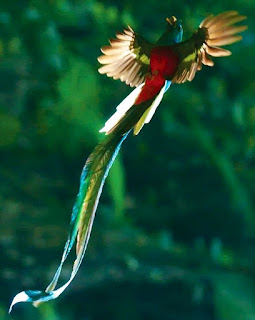 |
 The unprecedented exhibition featured 300 works from 53 lenders in 12 countries. | The MET exhibition traced the development of gold-working in the Americas from its origins in the Andes, to its expansion northward into Central America, and finally to Mexico, where gold-working comes into its own only after 1000 AD. | 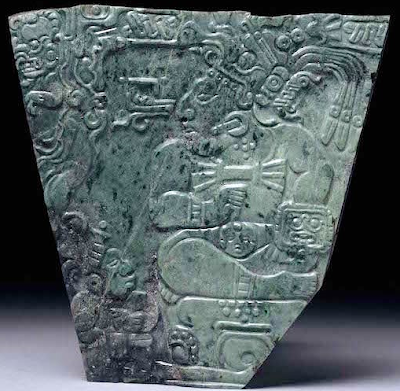 Jade plaque showing a seated king and palace attendant, 600–800 AD |
Wednesday, April 15, 2020
Sword of Damocles
 | Damocles is a character who appears in a anecdote commonly referred to as "the Sword of Damocles." This refers to the imminent peril faced by those in positions of power. Damocles was a courtier in the court of Dionysius II of Syracuse, a 4th-century BC ruler. Damocles was pandering to Dionysius, and exclaimed to him that Dionysius was truly fortunate as a great man of power and authority. In response, Dionysius offered to switch places with Damocles for one day. Damocles eagerly accepted the king's proposal. Dionysius, who had many enemies, had a huge sword above the throne, held at the pommel only by a single hair of a horse's tail. Dionysius did this to evoke the sense of what it's like to be king: though having fortune, always having to watch in fear and anxiety against dangers that might try to take it away. |  |
Tuesday, April 14, 2020
Hawaiian Kona-style statue of the god of war Ku-ka’ili-moku - $7.5m
 | Offered in the 'Collection Vérité' on 21 November 2017 at Christie’s in Paris. Hawaiian figurative sculptures are incredibly rare. Kamehameha I associated himself with the war god Ku-ka’ili-moku — the ‘land snatcher’ or ‘island eater’. This example was made circa 1780-1820 from the Metrosideros, a tree found in the high mountains of Hawaii. The figures that are known are all in museums. The statue made a whooping $7.5m blowing well past it's $3.5m estimate.
|  |

Sunday, April 12, 2020
Teotihuacan: City of Water, City of Fire
 | In 2017 the de Young Museum hosted the exhibit “Teotihuacan: City of Water, City of Fire.” More than 200 artifacts were featured, some never displayed before. Teotihuacan was established in the first century BC. By the fifth century it had evolved into an important urban center and multicultural metropolis, becoming the largest city in the Western Hemisphere. The so-called “City of the Gods” is estimated to contain 100,000 people at it's peak. Around 550 CE, the city was destroyed by fire.  |  |
 | 900 years after its destruction, the Aztecs made their way into a ghost city in the northeastern part of the Valley of Mexico. There, the Aztecs considered Teotihuacan to be the city where the gods brought the world into existence. Teotihuacan means the place where men become gods. |  |
 |
Friday, April 10, 2020
The friezes of Persepolis
 | Persepolis was the ceremonial capital of the Achaemenid Empire (550–330 BC) and is a World Heritage Site. It is situated 60km northeast of the city of Shiraz in Iran. The friezes from Persepolis are of the highest artistic merit. |  |


 |  |  |
Thursday, April 9, 2020
Egyptian Book of the Dead
 A heart being weighed on the scale of Maat against the feather of truth, by Anubis. The ibis-headed Thoth, scribe of the gods, records the result. If his heart equals exactly the weight of the feather, one is allowed to pass into the afterlife. If not, he is eaten by the waiting Ammit. A heart being weighed on the scale of Maat against the feather of truth, by Anubis. The ibis-headed Thoth, scribe of the gods, records the result. If his heart equals exactly the weight of the feather, one is allowed to pass into the afterlife. If not, he is eaten by the waiting Ammit. | The Book of the Dead is an ancient Egyptian funerary text, used from the beginning of the New Kingdom (around 1550 BCE) to around 50 BC. The original Egyptian name for the text is translated as Book of Coming Forth by Day. The loose collection of texts consist of a number of magic spells intended to assist a dead person's journey through the Duat, or underworld, and into the afterlife. It was written by many priests over a period of about 1000 years. The Book of the Dead first developed in Thebes towards the beginning of the Second Intermediate Period, around 1700 BCE and were exclusively for the use of the Pharaoh. |
 | The Book of the Dead is made up of a number of individual texts and their illustrations. Some 192 spells are known, though no single manuscript contains them all. They served a range of purposes. Some are intended to give the deceased mystical knowledge in the afterlife, or perhaps to identify them with the gods. Others are incantations to ensure the different elements of the dead person's being were preserved and reunited, and to give the deceased control over the world around him. Still others protect the deceased from hostile forces, or guide him through the underworld past obstacles. Two spells also deal with the judgement of the deceased in the Weighing of the Heart ritual. |
 | The texts and images of the Book of the Dead were magical as well as religious. Mummification served to preserve and transform the physical body into sah, an idealized form with divine aspects. The heart was regarded as the aspect of being which included intelligence and memory. |  The ka, or life-force, remained in the tomb with the dead body, and required sustenance from offerings of food, water and incense. |
 | The path to the afterlife as laid out in the Book of the Dead was difficult. The deceased was required to pass a series of gates, caverns and mounds guarded by supernatural creatures. These creatures had to be pacified by reciting the appropriate spells. If all the obstacles of the Duat could be negotiated, the deceased would be judged in the 'Weighing of the Heart' ritual. |  |
Tuesday, April 7, 2020
The Carambolo Treasure
 While archaeologists believe the horde was deliberately buried in the sixth century B.C., most of the jewelry was likely made two centuries earlier. While archaeologists believe the horde was deliberately buried in the sixth century B.C., most of the jewelry was likely made two centuries earlier. | The Carambolo Treasure is a hoard of ancient gold discovered by construction workers near Seville in 1958. It is a collection of 21 pieces of goldwork, including a necklace, several chest decorations shaped like ox skins, and lavish bracelets. |  |
 | Analysis revealed that the gold likely came from the same mines associated with underground tombs at Valencina de la Concepcion, which date to the third millennium B.C. |  |
Monday, April 6, 2020
Ancient looted Chinese bronze makes $580k
 | A 3,000-year-old bronze vessel looted by a British soldier from an imperial palace in Beijing has fetched £410,000 (US$581k) in 2018. The water vessel, which dates back to the Western Zhou dynasty (1047-772BC), is believed to be one of only seven similar archaic vessels to exist, five of which are held in museums. The vessel was looted from the Summer Palace in Beijing by Harry Lewis Evans, a Royal Marines captain who fought in the Second Opium War (1856-60). China’s State Administration of Cultural Heritage denounced the auction of "looted cultural relics." |  |
Friday, April 3, 2020
Badge of Cyzicus
 Coin features two dolphins encircling a Cyzicus’ tuna. The dolphins symbolize Poseidon, the god of the sea. Coin features two dolphins encircling a Cyzicus’ tuna. The dolphins symbolize Poseidon, the god of the sea. | Cyzicus was one of the great trade cities of the ancient world. It was located on the Sea of Marmara and ruled by the Persian Empire until its capture by Alexander the Great in 334 BCE. Tuna fishing was the cornerstone of the economy of Cyzicus, becoming the defining feature of the coinage from the city. | 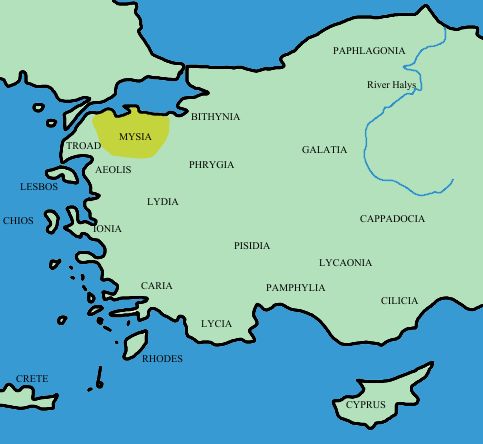 |
 The myth of Perseus & Medusa. An electrum stater struck around 400 BC from Cyzicus | In the first half of the sixth century BCE, the electrum staters of Cyzicus became one of the most widely recognized coins of their time. For decades, the entire trade in grain in the Black Sea Region was transacted with Cyzicus coins. Gold staters of Cyzicus were a staple currency in the ancient world until they were overtaken by those of Philip of Macedon. | 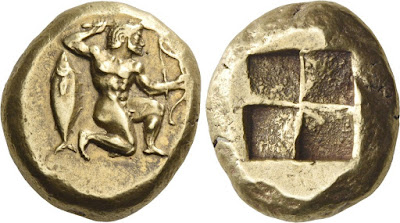  |
 Rare Sphinx of Cyzicus. Six are known. |   |
Subscribe to:
Comments (Atom)