 | Baiae was a mineral springs and coastal resort on the northwest shore of the Gulf of Naples in ancient Italy. The city was named after Baius, Ulysses’ helmsman. It was fashionable for centuries during antiquity for the super-rich. The ancient Roman 'Sin City' was famed for its natural volcanic hot springs. It housed some of the empire's most luxurious baths and private saunas. (laconica) Baiae was built on the Cumaean Peninsula in the Phlegraean Fields, an active volcanic area. Baiae was notorious for its hedonism, corruption and scandal. Roman poet Sextus Propertius once described Baiae as a “vortex of luxury” and a “harbor of vice.” |
 | The bathhouses of Baiae were filled with warm mineral water directed to its pools from underground sulfur springs. Roman engineers constructed a complex system of chambers that channeled underground heat into facilities that acted as saunas. Baiae later formed part of Port Julius, the base of the western fleet of the Imperial Roman Navy. Portus Julius was built in 37 B.C. by Agrippa as Rome's first purpose-built naval base in the Campi Flegrei. Ruins were submerged by volcanic activity by the time of the Renaissance. | 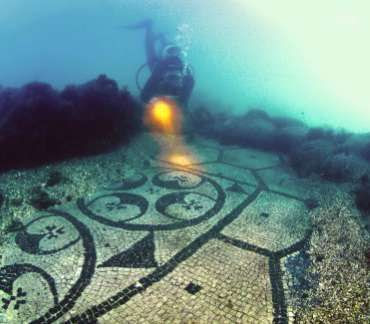 |
 | A volcanic phenomenon known as bradysism saw large portions of Baiae’s coastline—including opulent villas and bathing complexes, sink about 3 meters beneath the Gulf of Naples. | 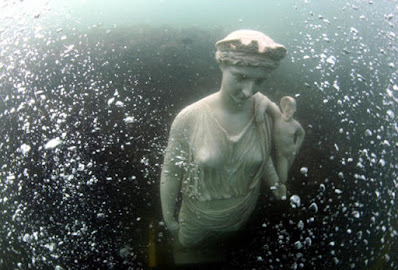 |
 | A series of dives involving historians and scientists from across the world revealed vast villas, priceless statues and breathtaking mosaics, as well as heated spas, cobbled streets and even a nymphaeum – a grotto of pleasure. The chambers of volcanic molten rock that lay beneath Baiae, providing the hot water that served the spas, were eventually its undoing. The chambers emptied as the lava found a way to escape, causing the resort to sink beneath the waves. |  |
One of its most notorious events was in CE 39, when Emperor Caligula ordered a floating bridge of nearly five kilometers across the gulf to be built and rode across it on horseback. Suetonius recorded that Thrasyllus, an astrologer, had said to the previous Emperor Tiberius, “as for Gaius [Caligula], he has no more chance of becoming emperor than of riding a horse dry-shod across the Gulf of Baiae.”
Caligula donned purple silk robes adorned with precious stones and gold, a sword, a shield, and a crown of oak leaves. He wore what he claimed was the breastplate of Alexander the Great, that he had stolen from the conqueror’s tomb when in Alexandria.
 | 
 | 
A palace was built in Baiae by Emperor Nero, and Hadrian died among its baths in CE 138. Cicero had a villa in Baiae. |


No comments:
Post a Comment