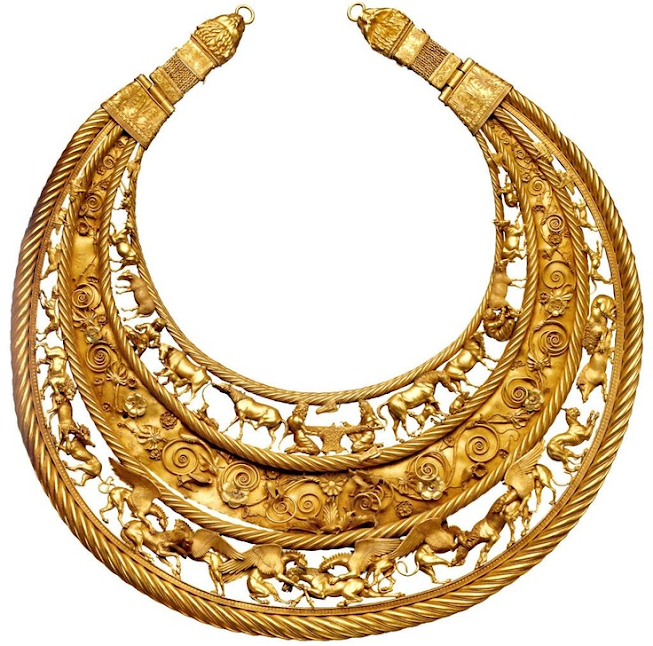
The Golden Pectoral from Tovsta Mohyla is a Scythian treasure discovered on this day (June 22) in a large kurgan near the city of Ordzonikidzhe in Ukraine in 1971. It dates to the 4th century BC, and was made by Greek goldsmiths, probably in a workshop located in Scythian lands.
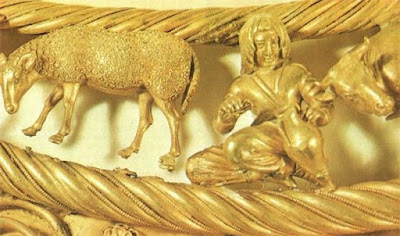
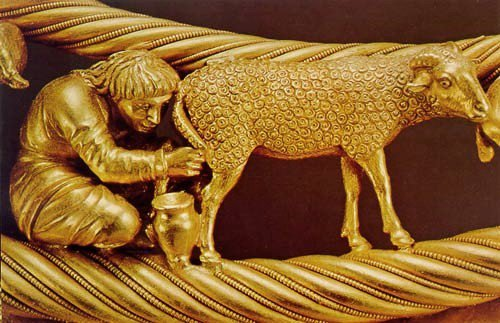
 | The top section reflects daily life.
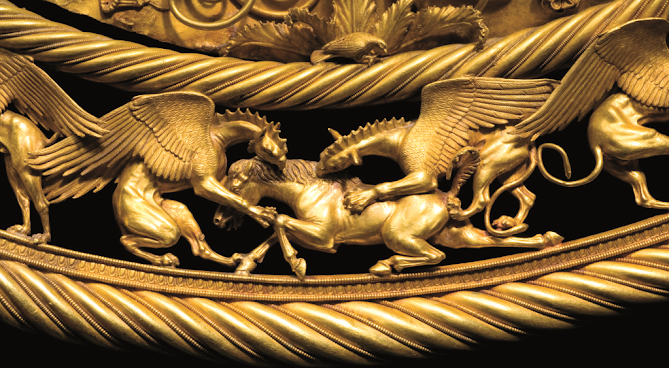
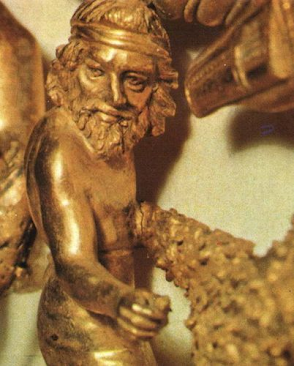
 The middle section is believed to represent nature. The third section is thought to represent Scythian belief in their mythology. The middle section is believed to represent nature. The third section is thought to represent Scythian belief in their mythology.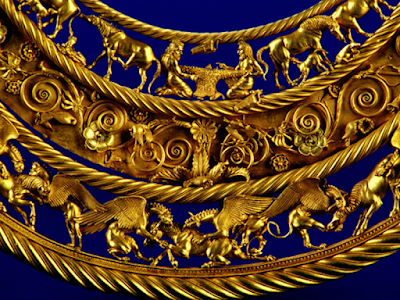 |
The pectoral is made of 24-carat gold, and weighs just over 1,150 grams. The pectoral consists of four torques arranged in a concentric arc, forming three crescent-shaped fields.
 | | 
The Golden Pectoral is a masterpiece of Greco-Scythian metalwork. |
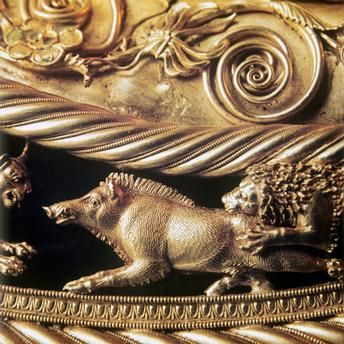
 | Borys Mozolevsky, a Ukrainian Soviet archeologist, found the treasure while digging on the western bank of the Dnipro River in central Ukraine. The grave mound belonged to a high status Scythian aristocrat and despite being looted in antiquity, the Golden Pectoral from Tovsta Mohyla survived. Few objects remain due to grave robbers. The Golden Pectoral from Tovsta Mohyla remains one of the most astounding pieces of gold jewelry to ever survive from the ancient world. The high quality of filigree craftsmanship astonishes modern jewelers. All details of the 160 elements are finely detailed - feathers, muscles, ribs, hoofs, horns, and even the genitalia of the depicted creatures - are anatomically precise and meticulously exact. |


No comments:
Post a Comment