 | The Greek Island of Santorini was in the headlines in early 2025 because of a swarm of severe earthquakes. The earthquake swarm prompted an exodus from the island. Santorini, classically Thera, is an island in the southern Aegean Sea, about 200 km (120 mi) southeast of Greece's mainland. It is the remnant of a volcanic caldera. |
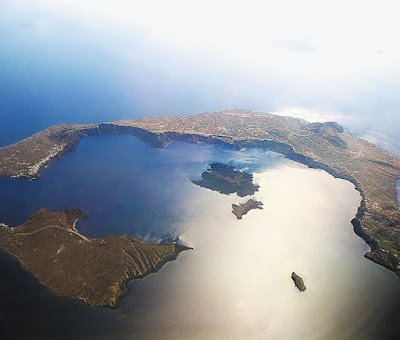 | The eruption of Thera was a catastrophic eruption which is thought to have occurred some 3,400 years ago at the height of the Minoan civilization. It was the largest volcanic event on Earth in recorded history. The eruption devastated the island of Thera, and may have led to the collapse of the Minoan civilization on Crete. | .webp) |
Kolumbo is a submerged active volcano. Its most recent eruption in 1650 CE, generated a tsunami causing destruction in the islands of Santorini, Ios, and Sikinos, while the poisonous gas emitted from the eruption killed 70 in Santorini.
 | Kolumbo’s edifice was created by at least five eruptive cycles, the earliest dating back more than 1M years. |  |
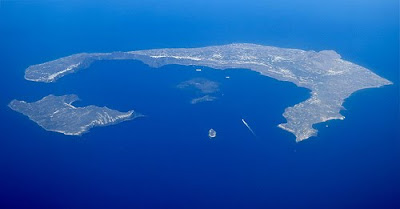 | New research into ancient tree rings from half a world away helped settle lingering questions about when Thera erupted. Scientists believe the volcano erupted in the 16th century B.C., about 3,400 years ago, blowing some 24 cubic miles of rock and ash into the atmosphere. The eruption had long lasting and wide ranging effects world wide. Researchers were able to determine colder years in the tree rings of Irish oaks and bristlecone pines in California. Scientists believed that the eruption happened between 1600 and 1525 B.C. |
Evidence of a catastrophic tsunami that followed the eruption of Thera was found at Çesme-Bağlararası on Turkey’s Aegean coast, more than 100 miles north-northeast of Santorini.
 | Researchers found an articulated skeleton of a man (and his dog) believed to have been killed by the tidal wave following the eruption that devastated the Aegean island. Calibrated radiocarbon ages found within the tsunami deposit say the remains date no earlier than 1612 BCE. The eruption left a large caldera surrounded by volcanic ash deposits hundreds of metres deep. | 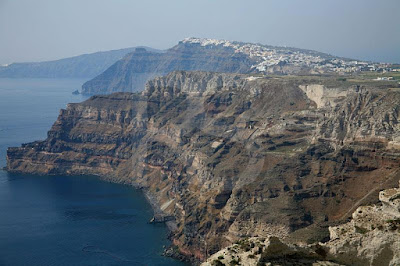 |
The myth of Atlantis, described by Plato, may be based upon the Santorini eruption. Excavations in 1967 at Akrotiri made Thera the best-known Minoan site outside Crete.
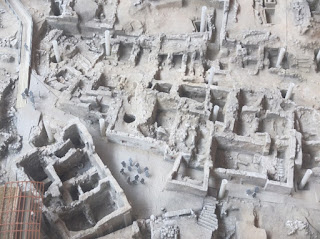
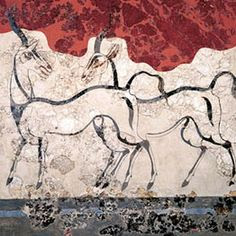 | Only the southern tip of a large town was uncovered, yet it revealed complexes of multi-level buildings, streets, and squares with remains of walls standing as high as eight metres, all entombed in the solidified ash. Pipes with running water and water closets found at Akrotiri are the oldest ever discovered.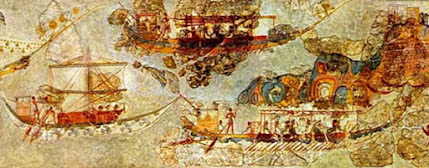  | 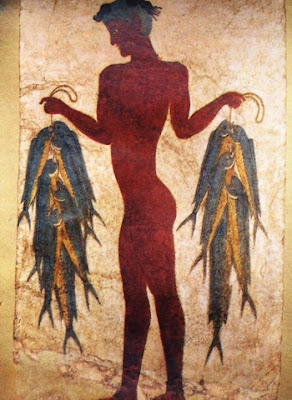
The advanced architecture, and the layout of Akrotiri resemble Plato's description of the legendary lost city of Atlantis. |
 | Dense patches of crocus flowers on the fresco ‘The Saffron Gatherers’ from Santorini suggest cultivation. Saffron crocuses are effectively clones dating back to saffron’s emergence in ancient times. | |
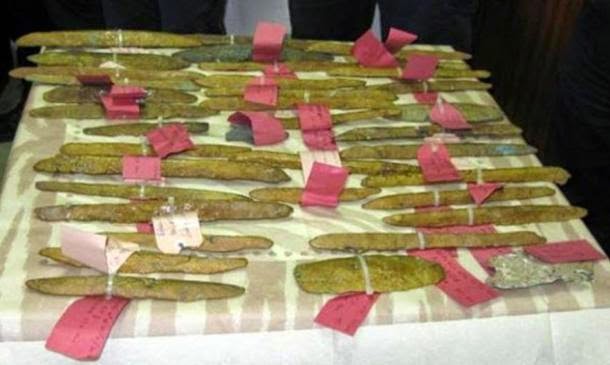 | In 2015 archaeologists discovered 39 ingots scattered across the sea floor near a 2,600-year-old shipwreck off the coast of Sicily. The ingots were made from orichalcum, a cast metal which ancient Greek philosopher Plato wrote was from the legendary city of Atlantis. X-ray fluorescence analysis indicate the ingots were made from a mixture of zinc (15-20 per cent), charcoal and copper (75-80 per cent) with traces of nickel, lead and iron. Orichalcum is a brass-like alloy, which was made in antiquity through the process of cementation, which was achieved through the reaction of zinc ore, charcoal and copper metal in a crucible. | |
In Plato's Critias, orichalcum was described as a lustrous metal second only to gold in value. It was used to cover the walls of the inner sanctuary in the Temple of Poseidon in Atlantis.

Dupondius of Faustina the Younger. | Roman coins were made of orichalcum. Orichalcum was officially valued higher than bronze, but sat just below silver and gold. The Romans standardized their use of orichalcum during Augustus's monetary reforms in 23 BCE. The alloy was typically reserved for higher end base metal coins, the prestigious sestertius and slightly smaller dupondius. Coins were brightly gold coloured when newly struck but tarnished over time to a darker or greenish patina. |


Based on the animals depicted in the Akrotiri frescoes, we can infer a link between Santorini and the Arabian Peninsula. The fauna suggests the depiction of a Red Sea port:
ReplyDeletehttps://www.academia.edu/142965808/Article_Frescoes_of_Akrotiri