
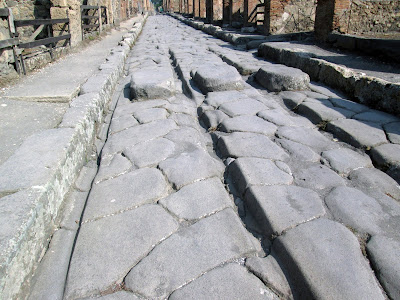
 Pompeians devised another option for street repair. | Ancient road workers used molten iron to repair Pompeii's streets. The discovery reveals a previously unknown method of ancient Roman street repair and represents "the first large-scale attestation of the Roman use of molten iron." Many of Pompeii's streets were paved with stone, but over time the passage of carts eroded those stones to form deep ruts. Repaving streets was an expensive and time-consuming process. High volumes of traffic concentrated in narrow streets could wear down even a stone-paved surface quickly. |  |
 This method of repair was much cheaper and faster than repaving. | After heating iron or iron-rich slag to a molten state, they poured out repairs onto, into and below the paving stones. After the molten iron was poured, it filled the holes and hardened as it cooled. In addition to iron, other materials such as stone, ground-up pieces of terracotta and ceramics were also inserted into the holes to help fill them. |  |

No comments:
Post a Comment