
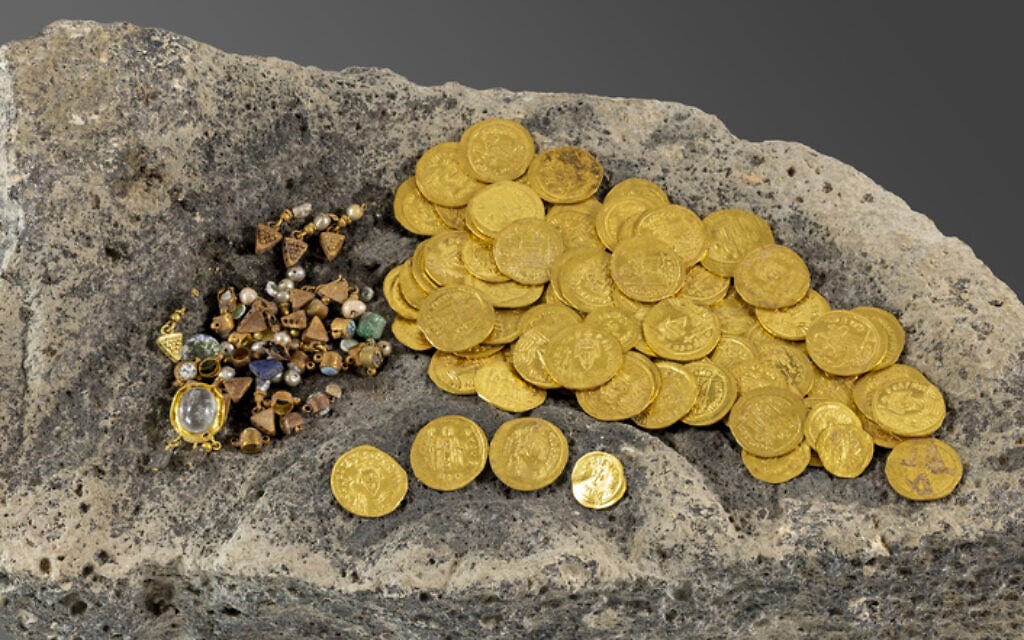
Nearly 100 gold coins and dozens of jewelry fragments have been unearthed in an excavation at the ancient city of Hippos, east of the Sea of Galilee. The hoard was buried during the final years of the Christian Byzantine era (early 7th century CE), as the Sassanid (Sasanian) Empire swept into Israel in 614 CE. Stashed by an extremely wealthy resident as the Sasanids advanced on the city, the treasure lay undisturbed for some 1,400 years before being uncovered by pure chance. Hippos was founded by Greek Seleucids on the eastern shore of the Sea of Galilee in the 2nd century BCE. During the Byzantine period (330 CE-636 CE), Hippos became an important Christian town. It endured the Arab conquest in the 7th century until a devastating earthquake in 749 CE leveled the city, which was then permanently abandoned.
 | It is a Byzantine hoard and can be dated with precision. It spans roughly a century, beginning with Emperor Justin I [518–527 CE] and ending in the early reign of Emperor Heraclius [610–613 CE] |
 | Hippos-Sussita site at the Sussita National Park. Hippos likely persisted as a Christian settlement but gradually declined until the earthquake of 749 delivered the final blow. |

No comments:
Post a Comment