Thursday, April 30, 2026

Bulgarian Valley of Kings

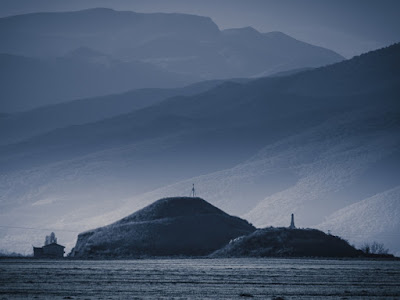
The Valley of the Thracian Rulers (or Kings) in central Bulgaria, near Kazanlak, represents a major concentration of Thracian elite tombs from the 5th–3rd centuries BC.
A four-wheeled wooden chariot, its intricately carved bronze plating and fittings, plus the skeletal remains of two horses and a dog have been preserved in situ instead of being removed to a museum. Thracian chariots were often buried with up to eight horses and their elaborately decorated bridles. Thracians established a powerful kingdom in the fifth century B.C.

The capital was thought to be Seutopolis, whose ancient ruins lie under a large artificial lake near Shipka, in an area dubbed 'the Bulgarian Valley of Kings' for its many rich tombs. It is believed that there are over 1500 funeral mounds in the region, with only 300 being researched so far.
The Kazanlak Tomb was found accidentally on 19 April 1944 by soldiers who were digging for entrenchment against aircraft. It dates to the first half of 3rd century BC.
The Svetitsa mound revealed a spectacular gold mask, which was laid on the face of the deceased person. It was made of a solid 673-g gold plate with individual features - thick hair, beard and mustache, the eyes half-closed. This is one of the earliest and richest tombs discovered in the Valley.
"To Seuthes," was written in one of the silver vessels and on a bronze helmet. It led some historians to suppose that the tomb belonged to King Seuthes III (ca. 330-300/295 BC). See ---- https://ancientbulgaria.bg/listings/valley-thracian-kings

Wednesday, April 29, 2026

Legio IX Hispana - 9th Legion

Legio IX Hispana ("9th Legion – Spanish") was a legion of the Imperial Roman army that existed from the 1st century BC until at least AD 120. The legion fought in various provinces of the late Roman Republic and early Roman Empire.
Legio IX Hispana was stationed in Britain following the Roman invasion in 43 AD. The Caesarian Ninth Legion fought in the battles of Dyrrhachium and Pharsalus (48 BC) and in the African campaign of 46 BC. After his final victory, Caesar disbanded the legion.
Octavian (Augustus) later recalled the veterans of the Ninth to fight against the rebellion of Sextus Pompeius. The Ninth remained with Octavian in his war of 31 BC against Mark Antony and fought by his side in the Battle of Actium.
The legion was sent to Hispania to take part in the campaign against the Cantabrians (25–13 BC). The Ninth participated in the invasion of Caledonia in 82–83. The legion narrowly escaped complete destruction after a surprise attack at night on their fort. The last attested activity of the Ninth in Britain is during the rebuilding in stone of the legionary fortress at York (Eboracum) in 108.

The last records came from Nijmegen and date 120. These are the latest records of Legion IX. It's fate remains speculation.

Monday, April 27, 2026

Hoard of Pompeii charms

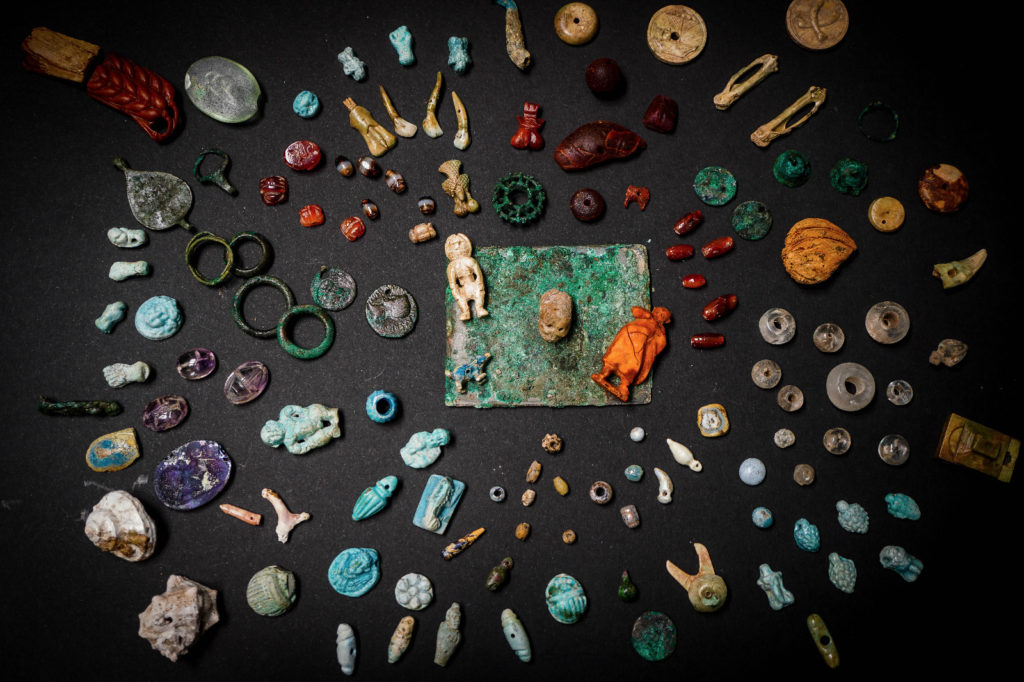
In 2019 archaeologists in Pompeii discovered a treasure trove of good luck charms and fertility amulets.
Most of the items would have belonged to women. A room with the bodies of 10 victims, including women and children, was excavated in the same house.
The trove was found in what remained of a wooden box.
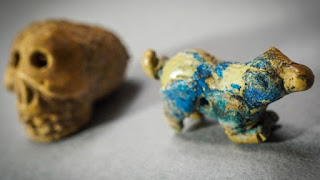
The wood itself had decomposed and only the bronze hinges remained, preserved by the volcanic material which hardened over it. The objects included crystals, amber and amethyst stones, buttons made of bones, beetles from the orient, amulets, dolls, bells, miniature penises, fists and a tiny skull. They were found at the Casa del Giardino.
Amulets were essential in Roman daily life to ward off the 'evil eye', bad luck, and disease. They were commonly worn or carried by children, soldiers, and women.

Grave of Celtic Prince reveals gold

In June 2015 French archaeologists completed excavations of an ancient burial site revealing the decorated skeleton of a Celtic prince. The tomb dating back some 2,500 years was discovered in an industrial area of Lavau, a village near Troyes, about 150km southeast of Paris.

The finding was described as "extraordinary" by experts. Buried with a two-wheeled chariot, the body is believed to be a high-ranked aristocrat from the Hallstatt culture that dominated central Europe during the Early Iron Age.

The skeleton sported ancient pieces of jewellery including a richly decorated gold torque weighing more than half a kilo and gold bracelets.
Remains of the deceased's clothes, such as shoe parts, finely worked amber beads that formed a necklace, and iron and coral hooks that attached to a piece of clothing were found.

Sunday, April 26, 2026

Grave of ‘Griffin Warrior’ at Pylos

The grave of a Mycenaean warrior was uncovered in 2016 in Pylos in the southwest of Greece was that of a warrior in his mid-30s who died around 1500 B.C. Buried with him thousands of objects, including silver cups, beads made of precious stones, ivory combs, a sword and four intricately decorated solid gold rings.

The discovery of the “Griffin Warrior” offers evidence that Mycenaean culture recognized and appreciated Minoan culture. The man's rings are made of multiple sheets of gold and depict very detailed scenes and iconography straight out of Minoan mythology. The rings probably come from Crete where they were used to place seals on documents or objects.
All the cups, pitchers and basins found were made of metal – bronze, silver and gold. The man was hugely rich.

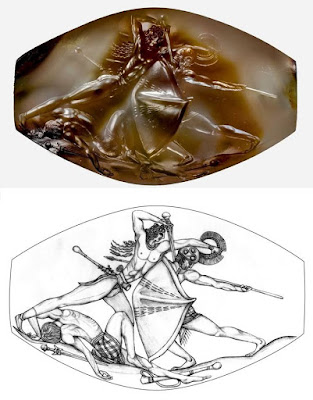
Since discovery the number of artifacts recovered from the grave has reached over 3,500, including a significant Minoan stone called the Pylos Combat Agate and four signet gold rings with detailed images from Minoan mythology.

A bronze mirror with an ivory handle.
Archaeologists digging at Pylos, an ancient city on the southwest coast of Greece, discovered the rich grave of a warrior who was buried at the dawn of European civilization.

Archaeologists expressed astonishment at the richness of the find and its potential for shedding light on the emergence of the Mycenaean civilization, the lost world of Agamemnon, Nestor, Odysseus and other heroes described in the epics of Homer.
The tomb is said to be the the most complete Greek find of its kind since the 1950s. The find includes gold, silver, ivory, and bronze artifacts, as well as engraved gemstones and an ornate ivory-and gilt-hilted sword.

The warrior was buried around 1500 B.C., next to the site on Pylos on which, many years later, arose the palace of Nestor, a large administrative center that was destroyed in 1180 B.C., about the same time as Homer’s Troy.

The palace was part of the Mycenaean civilization; from its ashes, classical Greek culture arose several centuries later.

Friday, April 24, 2026

The Cyrus Cylinder

Residing at the British Museum, the Cyrus cylinder is a clay cylinder containing an account of the conquest of Babylon by Cyrus the Great in 539 BC. Written in Akkadian cuneiform script, it describes his restoration of various temples and statues removed by Nabonidus, the previous king of Babylon, and of his own work at Babylon.
The Cyrus Cylinder serves as a declaration promoting the return of the deported and freedom of worship, aligning with the return of Jewish exiles mentioned in the Bible. It is regarded as a precursor to modern human rights and a testament to the multicultural management by the Achaemenid Empire. The artifact, about the size of a football, was designed to be embedded in the walls of Babylon as a foundation deposit.

Thursday, April 23, 2026

The Staffordshire Hoard

With more than 3,500 items, amounting to some 5kg of gold and 1.4kg of silver – plus thousands of garnets – the Staffordshire hoard is the largest cache of Anglo-Saxon metalwork ever found.
Archaeologists think the treasures were trophies, captured over multiple mid-seventh century battles.
It's likely that they were seized by the English midlands kingdom of Mercia from the kingdoms of Northumbria, East Anglia and Wessex.
The items are almost exclusively military. The hoard was made up of fittings from up to 150 swords, gold and garnet elements of high status seax (fighting knifes), a gilded silver helmet, crosses, and a probable bishop’s headdress.
The ornate bishop’s headdress is the world’s earliest surviving example of high status ecclesiastical headgear. One element bears an inscription – a quotation from the Book of Numbers. It reads “Rise up, LORD, and let thine enemies be scattered; and let them that hate thee flee before thee”. It's possible that the hoard was war booty captured by the pagan Mercian king, Penda, from armies led by Christians.
The hoard was found in the village of Hammerwich in Staffordshire.
A silver gilt strip bears the Biblical inscription in Latin – the only inscribed item in the haul.
The hoard was purchased jointly by the Birmingham Museum and Art Gallery and the Potteries Museum & Art Gallery for £3.285m under the Treasure Act.