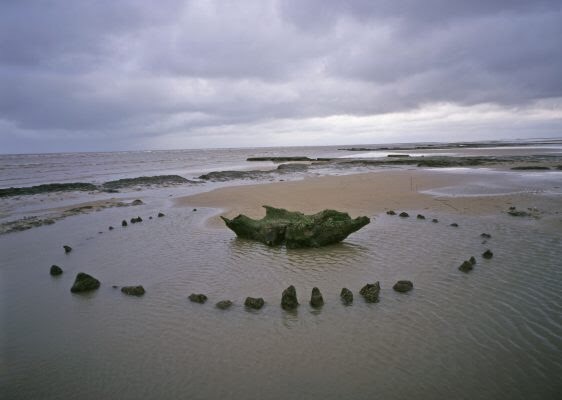
 | In 1998, a man walking along the beach at Holme-next-the-Sea stumbled upon a Bronze Age timber circle that had emerged overnight from East Anglia’s shifting sands. The 55 posts circling an upside-down tree is a relic from 2050 BC. In the centre of the ring was a large inverted oak stump. At the time of building, the site was surrounded by salt marshes. The centrepiece may have been a ceremonial altar from which bodies could travel to the afterlife. |

Sunday, November 9, 2025
Seahenge
Seahenge, also known as Holme I, was a prehistoric monument located in the village of Holme-next-the-Sea, near Old Hunstanton in the English county of Norfolk. In order to preserve the timber from exposure to air, due to recent exposure of the remains by the sea, it was excavated in Spring 1999. Its remains were taken to an archeological museum and then a maritime museum for preservation of the wood. In 1999, a reproduction was put up near the site.
Seahenge was constructed during the early Bronze Age. Those constructing the monument made use of at least fifty different bronze axes, which were used to shape the timber to the desired lengths and shapes, at a time when bronze tools were relatively rare. Trees used in the monument had all been felled in the same year, 2049 BC. Seahenge was inland, and then over eons came to being on a beach, where it was revealed by the eroding away of sand and peat by the late 20th century, four thousand years after its original construction.

Subscribe to:
Post Comments (Atom)
No comments:
Post a Comment