Sunday, September 28, 2025

Ulpius Cornelius Laelianus

A Roman coin minted for an ill-fated emperor was found in 2019 during road work. It is only the second of its kind to be unearthed in England. It depicts Ulpius Cornelius Laelianus, who reigned for several months in AD269. Ulpius Cornelius Laelianus was a usurper against Postumus, the emperor of the Gallic Empire. His revolt lasted from late February to early June 269 at which point he was executed.
A fake Ulpius Cornelius Laelianus areus
Another unusual coin discovered during the dig was a Gallic War Uniface coin, minted in 57BC by the Ambiani tribe in the Somme area of modern-day France. Experts believe it was exported to help fund the British Celtic resistance to Julius Caesar.

Friday, September 26, 2025

Gold coin hoard speaks of Galilee Christian city’s demise


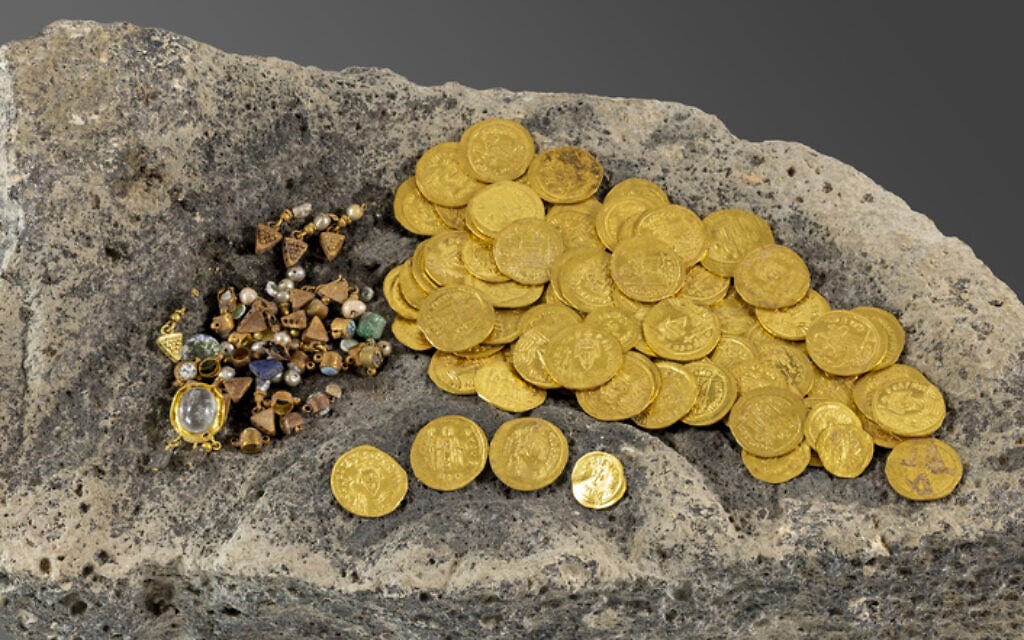
Nearly 100 gold coins and dozens of jewelry fragments have been unearthed in an excavation at the ancient city of Hippos, east of the Sea of Galilee. The hoard was buried during the final years of the Christian Byzantine era (early 7th century CE), as the Sassanid (Sasanian) Empire swept into Israel in 614 CE. Stashed by an extremely wealthy resident as the Sasanids advanced on the city, the treasure lay undisturbed for some 1,400 years before being uncovered by pure chance. Hippos was founded by Greek Seleucids on the eastern shore of the Sea of Galilee in the 2nd century BCE. During the Byzantine period (330 CE-636 CE), Hippos became an important Christian town. It endured the Arab conquest in the 7th century until a devastating earthquake in 749 CE leveled the city, which was then permanently abandoned.
It is a Byzantine hoard and can be dated with precision. It spans roughly a century, beginning with Emperor Justin I [518–527 CE] and ending in the early reign of Emperor Heraclius [610–613 CE]
One of the hoard’s unique features is its mix of denominations: while some coins are solidi — full-value coins weighing 4.45 grams — others are semisses, worth half a solidus, or tremisses, a third of a solidus.
Hippos-Sussita site at the Sussita National Park.

Hippos likely persisted as a Christian settlement but gradually declined until the earthquake of 749 delivered the final blow.

Thursday, September 25, 2025

Worst Roman Emperors

Some Roman emperors reputation for cruelty, excess, and debauchery, enabled by unbridled power at the head of a decadent society, serves as a warning of the pitfalls of absolute power today. Roman emperors had short lifespans after ascending to the throne. Of the 69 emperors from the accession of Augustus to the reign of Theodosius, 43 suffered a violent death.
Tiberius ruled AD 14–37. He sank into morbid suspicion of everyone around him. He retreated to the island of Capri and revived the ancient accusation of maiestas (treason) and used it to sentence to death anyone he desired. Tiberius living on Capri is recorded as a depraved sexual predator.

Tiberius Gold Aureus. Lugdunum. AU Strike 5/5 - Surface 3/5. US$11,150
Caligula ruled from 37–41 CE. He became infamous for his extreme feats of carnage. Nero was his nephew. Caligula was cruel, depraved, and insane. In January 41 CE officers of the Praetorian Guard, led by Cassius Chaerea, killed him.

Caligula, formally Gaius, Gold Aureus. Rome, A.D. 40. Laureate head of Gaius facing right, Germanicus, Caligula's father who died in A.D. 19, facing right. Au strike 5/5, surface 2/5. US$45,000.
Nero (AD 54 to 68) debased currency and confiscated senators' property and severely taxed to fund his palace, the Domus Aurea. Rome burned for nine days. Its said Nero used the fire to clear space for his palace. Nero blamed the Christians, executing thousands.

Nero Gold Aureus. Lugdunum, A.D. 56-8. Nero facing right, VF, Strike 4/5, Surface 2/5. US$10,800.
Domitian (81–96) was fearful and paranoid. Conspiracy theories consumed him, and some were true. He curtailed the Senate and expelled those he deemed unworthy. He executed officials who opposed his policies and confiscated their property. Domitian was assassinated in 96 CE.

Domitian Gold Aureus. Rome. Struck AD 90-91. Superb EF. US$29,500.
Commodus (177–192) was cruel, debauched, and a corrupt megalomaniac who viewed himself as reincarnated Greek gods. He too devalued Roman currency mercilessly, instituting the largest drop in value since Nero.

Commodus Gold Aureus. Rome mint. Struck AD 183. Superb EF US$24,500
Elagabalus (218 to 222). Elagabalus's sin was not bloody, but acting unlike any Emperor. Writers told of his sexual perversion, feminity, bisexuality, and transvestism.

Elagabalus Gold Aureus. Slow quadriga moving right, on which is set the conical stone of Emesa. Very rare. Graded NGC Ch VF Strike: 5/5 Surface: 2/5. Graffito. Marks. Bent. US$20,000
Caracalla (AD 211–217) dealt brutally with opponents: he exterminated all of them. Caracalla quickly turned the surplus he inherited from his father into a deficit. He was assassinated by a group of army officers, including Praetorian prefect Opellius Macrinus.

Caracalla Gold Aureus. Rome mint. Struck AD 213. Near EF. Extremely rare and important. Caracalla renovated the  Circus Maximus in AD 213, and rare aurei and sestertii were issued to celebrate. This aerial view depicts the Circus as it would be seen from the Palatine Hill. US$140,000
Diocletian (AD 284–305) conducted a ruthless persecution of Christians. Diocletian set about it's total eradication. Churches were destroyed, scriptures burnt, and Christians who refused to give up their faith were tortured and executed.

Diocletian Gold Aureus. Grade NGC Ch AU Strike: 5/5 Surface: 4/5, edge marks. US$20,000

Sunday, September 21, 2025

Nero's bathtub

Nero's 25-foot-diameter bathtub, better described as a porphyry basin, was commissioned by Nero between 54-68 AD for his Domus Aurea (Golden House). It was carved from a single, rare slab of Imperial porphyry from Egypt.
Imperial Porphyry is a prized, deep purple, volcanic igneous rock with white feldspar crystals, quarried exclusively by the Romans in ancient Egypt at Mons Porphyrites (now Jabal Dokhan). At the center of the Pantheon in Rome is a large circle of Imperial porphyry on the floor where, for 300 years, new emperors stood to be crowned.
Its immense value comes from the rarity of the purple porphyry and its historical connection to Roman imperial power. The quarry is now depleted, making the artifact irreplaceable. It is now located in the Pio Clementino Museum at the Vatican Museums in Rome.

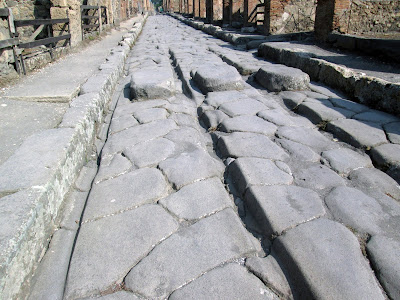
Molten iron used in Pompei road repairs


Pompeians devised another option for street repair.
Ancient road workers used molten iron to repair Pompeii's streets. The discovery reveals a previously unknown method of ancient Roman street repair and represents "the first large-scale attestation of the Roman use of molten iron." Many of Pompeii's streets were paved with stone, but over time the passage of carts eroded those stones to form deep ruts. Repaving streets was an expensive and time-consuming process. High volumes of traffic concentrated in narrow streets could wear down even a stone-paved surface quickly.

This method of repair was much cheaper and faster than repaving.
After heating iron or iron-rich slag to a molten state, they poured out repairs onto, into and below the paving stones. After the molten iron was poured, it filled the holes and hardened as it cooled. In addition to iron, other materials such as stone, ground-up pieces of terracotta and ceramics were also inserted into the holes to help fill them.

Saturday, September 20, 2025

Ancient ‘Texas Serengeti’ had rhinos, alligators, 12 kinds of horses

From 1939 to 1941 a federal agency that provided work to millions of Americans during the Great Depression put unemployed Texans to work as fossil-hunters. They dug up tens of thousands of specimens from sites near Beeville, Texas.
For the past 84 years the fossils have been stored at the University of Texas at Austin and virtually forgotten.
The fossil trove of nearly 4,000 specimens represent 50 animal species, all of which roamed the Texas Gulf Coast around 12 million years ago.
Among the finds was a new genus of gomphothere, an extinct relative of elephants with a shovel-like lower jaw.
Other fossils include the American alligator and an extinct relative of modern dogs.

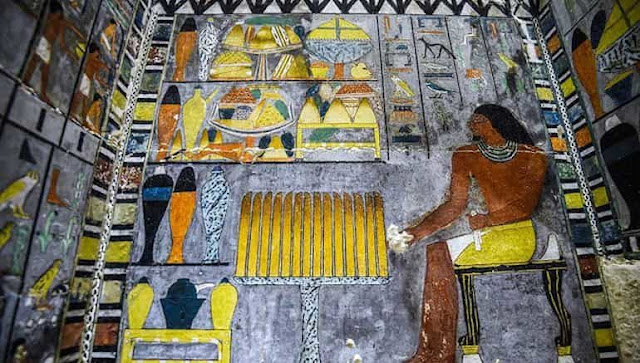
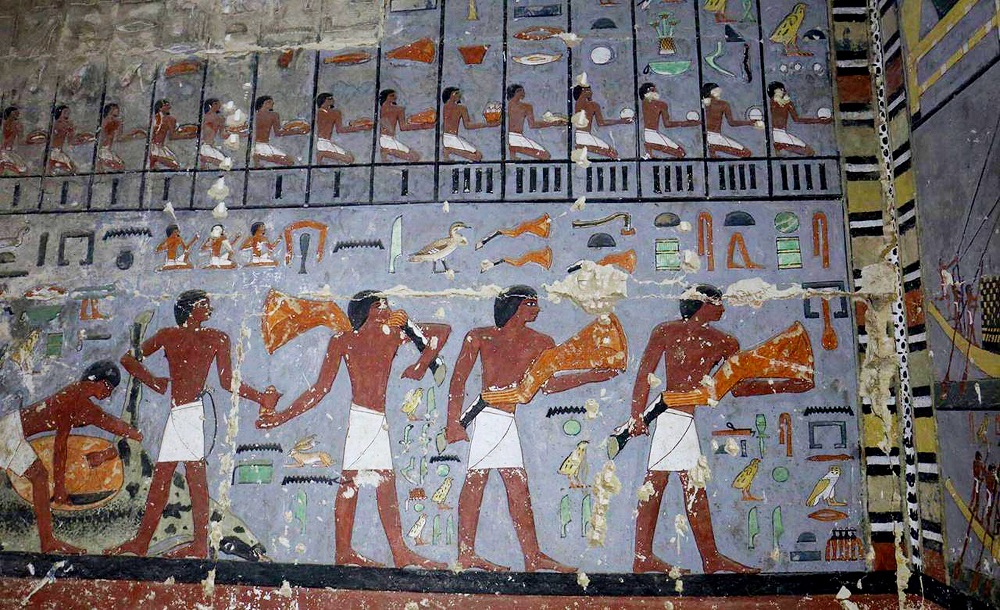
Ancient Egyptian Tomb found with spectacular art

In 2019 researchers discovered a 4,300 year old tomb belonging to a high-ranking official covered in colorful reliefs and well-preserved inscriptions.

The tomb dates to the Fifth Dynasty, around 2400 BC.
Saqqara, where archaeologists made the discovery, once served as the necropolis for the Egyptian capital of Memphis. It's located on the west bank of the Nile, 15 miles south of Cairo.

Friday, September 19, 2025

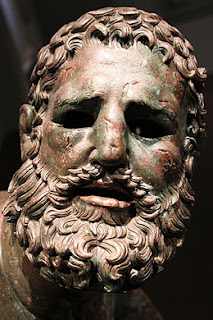
Spectacular Ancient Bronze

Dated to 330 BC, the Boxer at Rest is a sculpture of a sitting nude boxer at rest, still wearing his caestus, a type of leather hand-wrap, in the National Museum of Rome.
The Boxer was discovered in 1885, possibly from the remains of the Baths of Constantine.
“Portrait of Seuthes III” (310-300 B.C.), Greek. Bronze, copper, calcite, alabaster, and glass. Seuthes III was a ruler of the Odrysian kingdom of Thrace from 331 BC to ca. 300 BC. This bronze was found in his tomb.

“The Medici Riccardi Horse” About 350 B.C. Italian Bronze and gold.
The bronze "Chimera of Arezzo" is one of the best known examples of the art of the Etruscans. It was found in Arezzo, an ancient Etruscan and Roman city in Tuscany, in 1553. Inscribed on its right foreleg is an inscription, TINSCVIL, showing that the bronze was a votive object dedicated to the supreme Etruscan god of day, Tin or Tinia. The statue is thought to have been made around 400 BC.
The over-lifesize "Dancing Satyr" of Mazara del Vallo is a Greek bronze statue recovered from the sea floor at a depth of 500m (1600 ft.) off the southwestern coast of Sicily in 1998.

The satyr is depicted in mid-leap, head thrown back ecstatically and back arched, his hair swinging with the movement of his head. The figure is highly refined; the whites of his eyes are inlays of white alabaster.
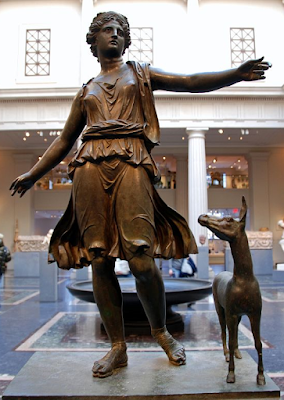
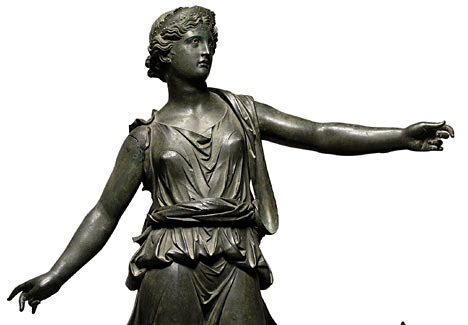
Artemis and the Stag is an early Roman Imperial or Hellenistic bronze sculpture of the ancient Greek goddess Artemis. In June 2007 the statue fetched $28.6 million at auction, the highest sale price of any sculpture at the time. The statue depicts Artemis, the Greek goddess of hunting and wild animals. She stands in a pose that suggests she has just released an arrow from her bow. At some point in its history, the bow was separated from the sculpture and was lost.
Alexander the Great on Horseback, 100-1 B.C., bronze and silver.

Victorious Athlete, "The Getty Bronze" 300-100 B.C.

Statue of Athene (“The Peiraeus Athena”). Bronze. 340—330 BCE
The Artemesium Zeus
The horses of St Mark's Basilica. 2nd or 3rd century AD.
The Riace Bronzes (The Riace Warriors) Around 460 BC.

British woman accused of stealing ancient tiles from Pompeii

In 2019 Caprice Arnold, then 21 from Tunbridge Wells, Kent thought it would be great idea to loot tiles from Pompeii. She climbed over a barrier and used a sharp object to cut 20 tiles from a floor.
A caretaker of the grounds spotted her. The guard stopped her and asked for her details to make a report, but she walked away, leaving the mosaic pieces on the ground. "The woman showed no remorse" said a statement. Back in the UK, she claims she only bent down to 'inspect loose tiles.' She cannot explain how 3 tiles ended up in her bag. "It ruined the trip from then on and I was not able to enjoy it" she said.
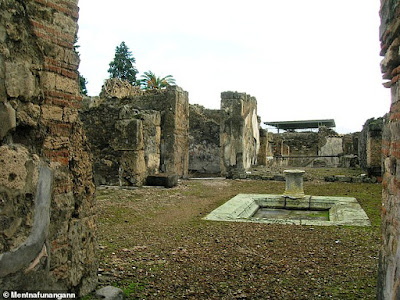
Authorities spotted Arnold scaling the security rail at the House of the Anchor, one of the most famous homes at the ancient historical site. The house is known for the mosaic tile anchor design at the front of the residence.
The damage is thought to be around $5k. It is far from the first time Italian police has taken action on tourists vandalizing and looting the historic city.
Caprice Arnold never took responsibilty or apologized for her looting.