Saturday, August 7, 2021

Crimea Gold

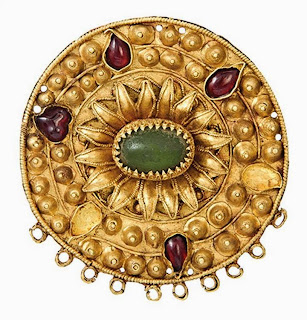
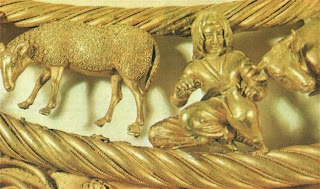
A priceless collection of ancient gold artifacts from Crimea that was on loan to a Dutch museum when Russia annexed the region is still in legal limbo. The trove of Scythian treasures, which including a magnificent 4th century BC Scythian helmet, had been lent by several Crimean museums to the Allard Pierson Museum in Amsterdam when Russian forces seized control of the peninsular in March 2014.
The Crimea and the Black Sea were and remain an important crossroads between Europe and Asia.

The recorded history of the Crimean Peninsula, historically known as Tauris or Tauric Chersonese, begins around 500 BC when several Greek colonies were established along its coast. Crimea since that time has endured a long series of conquests and invasions.

The modern history of Crimea began with the annexation by the Russian Empire in 1783. In 1921 the Crimean Autonomous Soviet Socialist Republic was created. This republic was dissolved in 1945.

Since 1991 it has had the status of an Autonomous Republic within Ukraine until its recent annexation by the Russian Federation in the 2014 Crimean Crisis.
Nearly a year after the exhibition “Crimea: Gold and Secrets From the Black Sea” wrapped up at the Allard Pierson Museum 565 rare treasures on loan from four Crimean museums remain in boxes in a storage facility, awaiting a court decision about where they should be shipped.

“Russia is attempting to appropriate valuable exhibits from Crimean museums that are currently on loan abroad," Ukraine’s vice prime minister for social affairs, Oleksandr Sych, said during a news briefing.
Construction of the Olympic venues in the Imereti Valley resulted in over a dozen archeological expeditions, and close to 400 artifacts have been handed over to the city's history museum. "The construction of the Olympic venues in Sochi over the past five years has triggered large-scale archaeological excavations previously unseen in this resort city," said Alla Guseva, Deputy Director for Research at the museum.
In October 2013 the museum unveiled the Ancient Gold of Kuban and the Black Sea Region exhibition as part of the Cultural Olympiad's Year of Museums. This is the first exhibition to feature artifacts unearthed during the Olympic construction.

The excavations in the Imereti Valley started in the wake of the Olympic construction. Previously, the area was considered unattractive for archeological expeditions. However, the first excavations have demonstrated that the area has been populated since ancient times.

The Bosporan Kingdom was an ancient state located in eastern Crimea and the Taman Peninsula, on the shores of the Cimmerian Bosporus (now known as the Strait of Kerch).

Gold Stater - Bosporan Kingdom
It was named after the Bosphorus, also known as Istanbul Strait, a different strait that divides Asia from Europe.

The Bosporan Kingdom was the longest surviving Roman client kingdom. It was based on the export of wheat, fish and slaves. The profit of the trade supported a class whose conspicuous wealth is still visible from the newly discovered archaeological finds.


Thursday, August 5, 2021

Gaius Cassius Longinus

Gaius Cassius Longinus, often referred to as simply Cassius, was a Roman senator and general best known as a leading instigator of the plot to assassinate Julius Caesar on March 15, 44 BC. He was the brother-in-law of Brutus. Cassius had a successful military career including taking part in the infamous Battle of Carrhae in 53 BC, where he was serving under the Triumvir Marcus Crassus as a quaestor. Crassus was part of the First Triumvirate, with Julius Caesar and Pompey. The Battle of Carrhae would be one of Rome's greatest defeats. Crassus was killed.

A coin of Gaius Cassius Longinus.
By 50 BC civil war was looming. Without Crassus the First Triumvirate was finished. With Caesar and Pompey at each other's throats, Cassius, along with his friend Brutus, sided with Pompey. Caesar was victorious at the Battle of Pharsalus in 48 BC, causing Pompey to flee to Egypt where he would be murdered. Cassius fled but was intercepted by Caesar and he promptly surrendered. Cassius found Caesar to be very forgiving. Now allies, he promoted Cassius to the position of legate.
On the Ides of March, 44 BC, Cassius and the other conspirators murdered Caesar in the Theatre of Pompey. Caesar suffered 23 stab wounds, with one to the heart fatally wounding him.

Babylonian proto-trigonometry predates Greek

Our understanding of trigonometry dates to ancient Greek astronomers studying celestial bodies. Now it appears the ancient Babylonians likely developed their own “proto-trigonometry” more than 1,000 years before the Greeks. A 3,700-year-old cadastral survey, Si.427, depicts a surveyor’s plan of a field. It is one of the oldest examples of applied geometry from the ancient world.
The need for accurate surveying is apparent from ancient writings. Measuring rope and the unit rod were tools of the trade. These were revered symbols of fairness and justice in ancient Babylon and were often seen in the hands of goddesses and kings.

Monday, August 2, 2021

The Spanish galleon San José

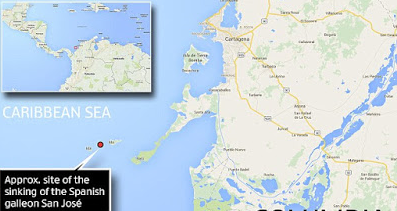
The San José was a 60-gun galleon of the Spanish Navy. The ship is considered the holy grail of Spanish colonial shipwrecks. It was sunk off the coast of Cartagena, Colombia in 1708.

Colombia and Spain have disputed ownership of the Galleon San Jose for years. Built in 1698, the ship was sunk after a battle with a British squad commanded by Captain Charles Wagner.
The San José was part of a Treasure fleet during the War of the Spanish Succession, under General José Fernández Santillán.

On 8 June 1708, the fleet encountered a British squadron near Barú. During the battle, the powder magazines of San José detonated, sending the ship to the bottom.
All but 11 of the 600 people on board perished, either incinerated in the explosion or drowned at sea. The San José was located by an international team led by Colombia’s Institute of Anthropology and History on Nov. 27, 2015 nearly 1,000 feet deep about 16 miles from Cartagena.

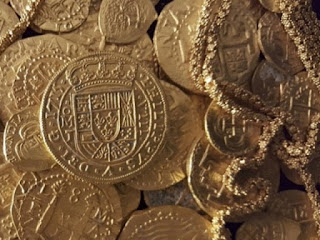
Speculation says it likely had 7 to 10 million Spanish pesos on board at the time of its sinking, similar to its surviving sister ship, the San Joaquín.

Colombian president Juan Manuel Santos announces the discovery of the remains of the Galleon San Jose
The San Jose was carrying one of the largest gold and silver hoards ever lost at sea. Estimates place the value of the cargo to at least $1bn.


A seafloor image of the shipwreck identified as the San Jose. The wreck has yet to undergo exploration, leaving questions about what riches might be found. The type and number of bronze cannons found at the site leaves no doubt that the ship is the San Jose.

Sunday, July 25, 2021

Ancient textiles returned to Peru

Peru recovered 79 pre-Hispanic textiles in 2017 that had been illegally located in Sweden since 1935. In 1935, Swedish ambassador to Peru Sven Karrell acquired the fabrics hailing from the Nasca and Paracas cultures and took them to Sweden illegally. They were anonymously donated to The Museum of Gothenburg, according to the Peruvian government.

The fabrics were made of cotton and wool from vicunas, the national animal of Peru. The textiles were made between 700 B.C. and A.D. 200

Saturday, July 24, 2021

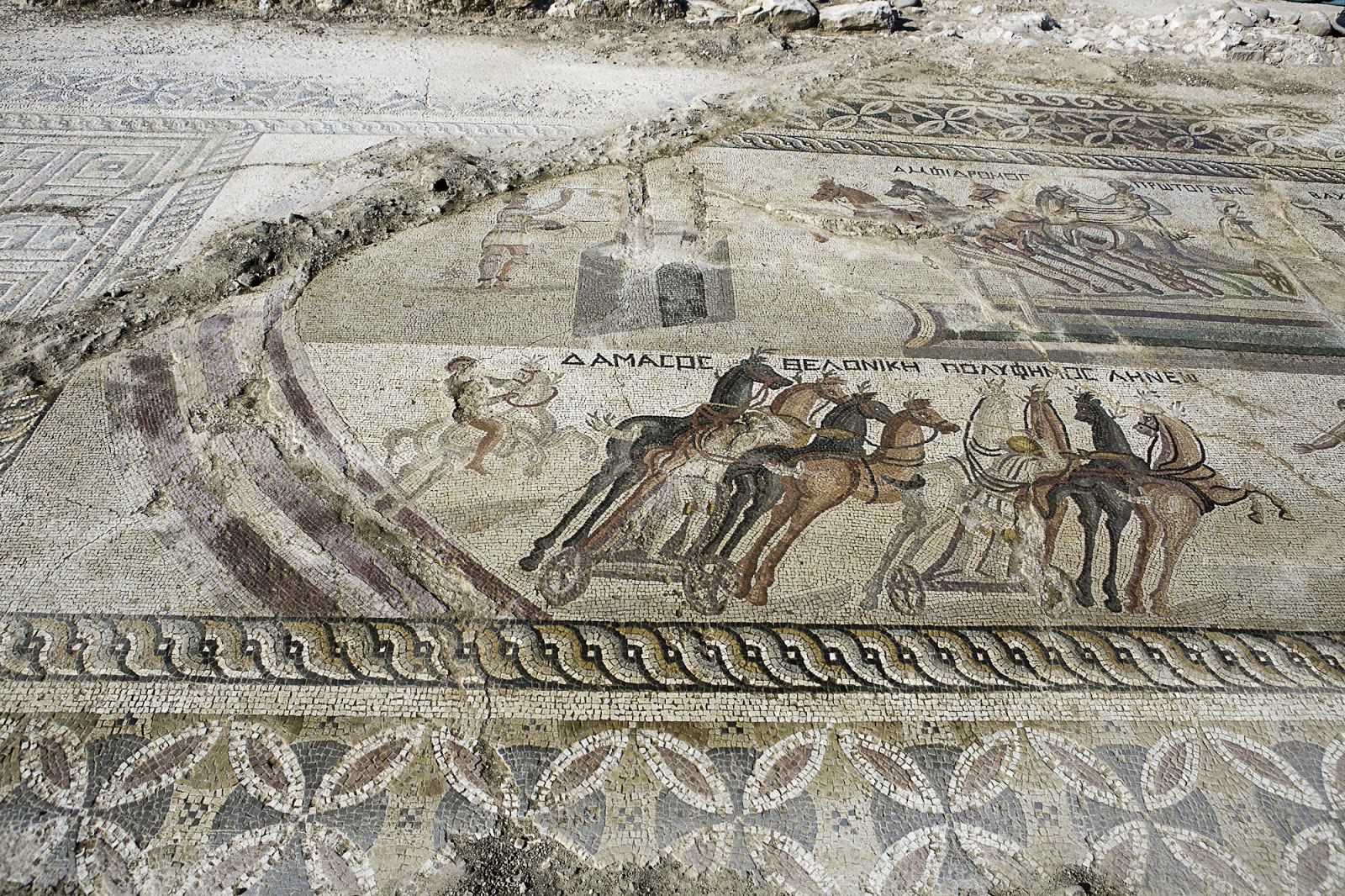
Rare Roman horse race mosaic

Scenes from a chariot race are depicted in a rare Roman mosaic excavated in rural Cyprus in 2017. Dating from the 4th Century AD, it is in Akaki, a village not far from Nicosia. Only a handful of similar mosaics - showing a hippodrome race - have been found at ancient Roman sites.

The ornate 26-metre-long (85ft) mosaic was probably part of a wealthy man's villa.