Tuesday, June 30, 2026

Ancient gold returned to Romania

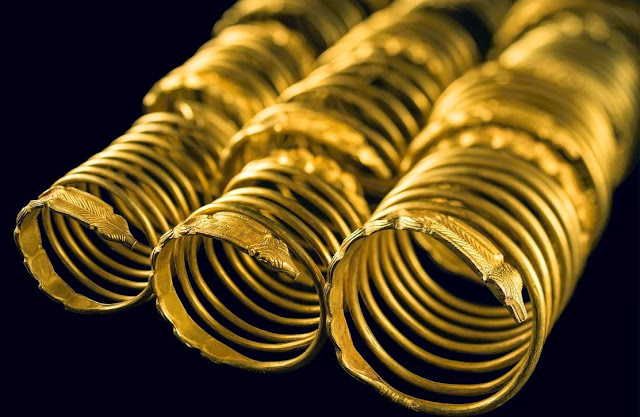
The first of what archaeologists called the 'most sensational finds of the last century' surfaced not in a museum but at Christie's New York. Among pieces of ancient jewelry for sale on December 8, 1999, was Lot 26, a spiraling, snake-shaped gold bracelet that the auction house identified as a "massive Greek or Thracian gold armband."

Lot 26, "a massive Greek or Thracian gold arm band" circa 2nd-1st BCE.
Christie's estimated it would sell for as much as $100k. When bidding stalled at $65k, the sale was called off, and the bracelet and its owner disappeared back into the underworld of stolen ancient artifacts.
Lot 26 set off an international search to recover the lost heirlooms of Dacia, an empire that was once a rival to ancient Rome. After nearly a decade by everyone from FBI to Interpol investigators and Romanian prosecutors, more than a dozen similar bracelets were found, along with hundreds of gold and silver coins. Their discovery has led to new insights into Dacia.

Sarmizegetusa was once the capital and sacred center of the Dacians, a civilization crushed by Trajan in two bloody wars. The victory yielded one of the largest treasures the ancient world had ever seen: half a million pounds of gold and a million pounds of silver.

Trajan took the spoils to Rome, where they paid for his famous forum. In the complex the Roman Senate erected a column dedicated to Trajan and illustrating the story of the wars. Sarmizegetusa was leveled and forgotten for centuries. But stories of Dacia's gold lived on, inspiring peasants who lived nearby to dig in the steep valleys.

It wasn't until Romania's communist dictatorship collapsed in 1989 that dreams of striking it rich came true. Groups of local treasure hunters started using metal detectors (unavailable in communist times) to hunt for artifacts in the thick forests at the rugged site. Treasure hunters hit the mother lode in May 2000, according to Romanian police.
Their metal detector pinged over a stone slab about two feet wide, embedded in a steep hillside. Underneath, in a small chamber made of flat stones propped against each other, they found ten spiraling, elaborately decorated Dacian bracelets—all solid gold. One weighed 1.2kg. Over the next two years looters found at least 14 more bracelets at Sarmizegetusa.

The bracelets are now on display in Bucharest.
Sarmizegetusa's stolen gold was nearly lost. Recovering it involved authorities in Europe and the US and a decade of dogged sleuthing.

Romanian authorities recovered 13 hammered gold bracelets and more than 27.5 pounds (12.5kg) of gold.
The braclets on display are only ones of their kind ever found in Romania. At least another dozen, including the one still known as Lot 26, remain missing.

Canis Pugnax

The Canis Pugnax, Latin for “fighting dog,” was the living weapon of the Roman legions. A massive and ferocious breed descended from the Molossian hounds of Epirus, they were the same war dogs used by Alexander the Great.
The fierce mastiff-like dogs were used for guarding, hunting, and as combat weapons. They weren't mascots, the dogs were trained as specialized shock troops. They often were outfitted with spiked collars, leather armor, or even chainmail. Released in packs before infantry advances, they charged directly into enemy lines, targeting cavalry horses to unseat their riders. Their role was to sow panic and chaos in the moments before the Roman assault.
Roman historians describe them as “braver than lions and more faithful than men”. They offer high praise for their courage, loyalty, and effectiveness. At night the dogs guarded camps. They also tracked deserters.
When the Western Roman Empire fell, the breed didn't vanish; its bloodline survived and eventually resurfaced centuries later in modern Italian mastiff breeds like the Cane Corso and Neapolitan Mastiff. Canis Pugnax retain a legacy as Rome’s most loyal and terrifying soldiers. They embodied Roman ideals of virtus (courage) and fides. (loyalty)

Roman wine

The Roman belief that wine was a daily necessity made it ubiquitous. It was readily available to slaves, peasants and aristocrats, men and women alike.
Ancient Roman wine was a daily staple, not a luxury. It was cloudy, highly acidic, and stored in large clay jars called dolia. With no modern preservation methods, Romans heavily diluted it with water, spices, or honey. Romans fermented and aged wine in large, partially buried earthenware clay vessels. The porous clay and egg-like shapes allowed for micro-oxygenation, which gave the wine grassy, nutty, and dried fruit flavors.
Conditum Paradoxum was a popular sweet, spiced wine made by boiling wine with honey, black pepper, laurel, saffron, and mastic. Posca was a drink for soldiers and the lower classes made by mixing water with soured wine or vinegar.

Premium wines were highly prized and expensive. Falernian was a sweet, strong white wine that was the most expensive drink in the empire. Produced on the slopes of Mount Falernus (modern-day Monte Massico) in the Campania/Lazio region of Italy, it was a symbol of luxury for the Roman elite.
Falernian wine was a luxury product. A standard half-litre amphora cost about 25% of a Roman labourer’s daily wage.
Premium, well-aged vintages were very expensive. Pliny the Elder wrote that Falernian is the only wine that takes light when a flame is applied to it. To catch fire a liquid needs be at least 40% alcohol. Wine produced by fermentation tops out around 15 or 16%. It's suspected Romans were accidentally distilling it, concentrating the alcohol through a process they didn't fully understand. The grapes were harvested late, dried, fermented to maximum strength, then aged for fifteen to twenty years in clay amphorae.

The wine trade drew merchants to do business with tribes native to Gaul and Germania, bringing Roman influences to these regions long before the arrival of the Roman military. Evidence of the trade and the significant ancient wine economy is found through amphorae – the ceramic jars used to store and transport wine and other goods. One of the most important wine centres in the Roman world was Pompeii, located on the Campanian coast. An expanse of farms and vineyards covered the slopes of Vesuvius, exploiting fertile soil to produce fine wines.

Trajan - optimus princeps

Trajan (Marcus Ulpius Traianus) was Roman emperor from 98 to 117 AD. He was officially declared by the Senate optimus princeps. ("the best ruler") Trajan is remembered as a successful soldier-emperor who presided over the greatest military expansion in Roman history, leading the empire to attain its maximum territorial extent by the time of his death. Trajan was the first emperor born outside Italy. Trajan is best known for his public building program, which reshaped Rome and left many landmarks such as Trajan's Forum, Trajan's Market and Trajan's Column.
Early in his reign, he annexed the Nabataean Kingdom, creating the province of Arabia Petraea. His conquest of Dacia enriched the empire greatly, and paid for many of Rome's monuments. Trajan's Column was the crowning glory of the Forum Traiani. Covered by a continuous frieze of the war's events, the column was capped with a gilded heroic statue of the emperor.

Trajan was succeeded by his adopted son Hadrian.
In 107 Trajan devalued Roman currency. He decreased the silver purity of the denarius from 93.5% to 89% – the actual silver weight dropping from 3.04 grams to 2.88 grams. This devaluation, coupled with the massive amount of gold and silver carried off after the Dacian Wars, allowed the emperor to mint a larger quantity of denarii than his predecessors. In late 117, while sailing back to Rome, Trajan fell ill and died of a stroke in the city of Selinus. He was deified by the Senate and his ashes were laid to rest under Trajan's Column.

In April 2025 a Trajan aureus, dating from 114-117 CE, was unearthed at Newstead in the Scottish Borders. The obverse features a portrait of the Emperor, while the reverse shows the Parthian king surrendering.
Rare and highly desired is an aureus struck circa 113-summer 114 showing Trajan's column.
The Roman Empire reached it's maximum extent under Trajan.

Monday, June 29, 2026

The Harpax - Battle of Naulochus

The naval Battle of Naulochus was fought on 3 September 36 BC between the fleets of Sextus Pompeius and Marcus Vipsanius Agrippa, off Naulochus, Sicily. The victory of Agrippa, admiral of Octavian, marked the end of the Pompeian resistance to the Second Triumvirate. Both fleets were composed of 300 ships, all with artillery, but Agrippa commanded heavier units, armed with the harpax, a newer version of the corvus. It was invented by Agrippa himself. Agrippa used his new weapon to great success. Agrippa lost three ships, while 28 ships of Sextus were sunk. At least 17 ships of Sextus fled, and the others were burnt or captured. The battle marked Octavian's rise to power.
Sextus fled to Asia Minor where, in 35 BC, he was captured and executed without trial by general Marcus Titius on the orders of Mark Antony. Sextus Pompey was the youngest son Pompey the Great had with his third wife, Mucia Tertia, around 75 BC.

The harpax was a grappling-iron. Its name is derived from the Greek verb harpazo (ἁρπάζω), meaning "to seize" or "to snatch". It was a versatile tool used in both ancient Greece and Rome. In warfare, the harpax took on a much larger and formidable form. They were large iron hooks designed to latch onto the rigging or hull of opposing vessels.
Once a harpax secured its hold on an enemy ship, it could be used to drag the ship closer, allowing for easier boarding. The harpax had a distinct advantage over the traditional naval boarding device, the corvus, as it was much lighter. The corvus boarding bridge is estimated to have weighed a ton. The harpax could be thrown long distances due its light weight. It was discharged by a ballista as if it were a heavy dart. The enemy was then winched in.

Sextus lost 183 of a total force of 300 warships. 28 were sunk by ramming and 155 by capture or destroyed by fire.
Agrippa's design of the harpax included iron bands that could not be cut, and the ropes could not be cut due to the length of the iron grapple. Appian notes "As this apparatus had never been known before, the enemy had not provided themselves with scythe-mounted poles."

Notable ancients

ROMAN IMPERATORIAL, SEXTUS POMPEY AS IMPERATOR (44-36 B.C.) Sextus Pompey used dynastic imagery on his coins. He and his brother portrayed their deceased father on denarii as early as 45-44 B.C. This example sold for $336k in 2018.
Macedonian Kingdom. PHILIP II (359-336 B.C.) The obverse of this posthumous issue of the ancient city of Colophon bears a portrait. Comparison with the posthumous Alexander coins under King Lysimachus and surviving portraits leave no doubt the portrait is Alexander the Great himself. The coin sold for $36k in 2020.
Posthumous Alexander coins struck under King Lysimachus are among the most famous of the ancient world. Rather than traditional Heracles/Zeus designs like his peers, Lysimachus revolutionized coinage by depicting the deified Alexander the Great on the obverse to legitimize his own rule.
Zeugitana, Carthage. (circa 350-320 B.C.) Carthage became a naval powerhouse in the 5th century B.C. and challenged the cities of Sicily and Southern Italy for control of the Mediterranean. By the early 3rd century B.C., most of Central North Africa, Spain and Sicily had fallen to the Carthaginians. Mints produced coins to pay the largely mercenary army. This early stater indicates the dies were created by a Greek engraver with superior skill. This coin sold for $15k in 2019.
A powerful army was put to use by the third king of the Ptolemaic dynasty, Ptolemy III Euergetes (246-222 B.C.). Shortly after inheriting the throne, he launched an invasion of the neighboring Seleucid Kingdom of Syria. He crushed all resistance reaching Babylon, where he proclaimed himself King of Kings. The coin sold for $49,350 in 2016.

The Colossus of Rhodes


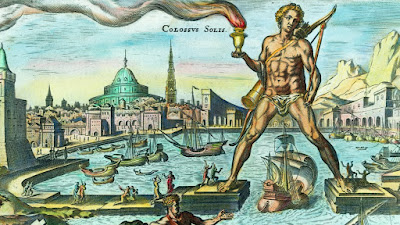
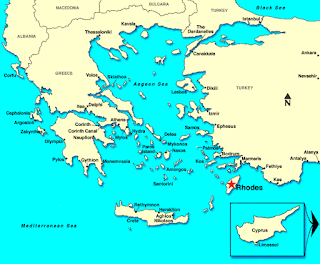
The Colossus of Rhodes was a statue of the Greek god of the sun Helios, erected in the city of Rhodes in 280 BC.
It cost 300 talents of bronze and 300 talents of iron. A talent was 26–33 kilograms. The Rhodians funded the statue by selling off the siege weapons abandoned by the invading Macedonian army after a year-long siege.

Colossus of Rhodes by Giovanino
One of the Seven Wonders of the Ancient World, it was constructed to celebrate Rhodes' victory over Cyprus, who unsuccessfully besieged Rhodes in 305 BC. It took 12 years to complete.
According to most descriptions, the Colossus stood about 33 metres (108 feet) high — about the same as the Statue of Liberty. It was the tallest statue of the ancient world.
It was destroyed during an earthquake in 226 BC. Ptolemy III offered to pay for the reconstruction of the statue, but the oracle of Delphi made the Rhodians afraid that they had offended Helios, and they declined to rebuild it. The remains lay on the ground for over 800 years. Pliny the Elder remarked that few people could wrap their arms around the fallen thumb and that each of its fingers was larger than most statues.
In 653, an Arab force under Muslim caliph Muawiyah I captured Rhodes, and the statue was melted down and sold.

Marble torso of a Roman emperor at Sothebys

Sothebys will auction a marble torso of a Roman emperor from the first half of the 1st century A.D.
The torso represents one of the Julio-Claudian emperors, possibly Augustus. The piece sold for $7,362,500 in 2010, more than six times it's high estimate. Sothebys will put the statue up for auction again in October with an estimate of $8m to $12m.

The bronze breastplate is decorated in relief on the chest with the Sun god Sol emerging from the waters in a frontal quadriga and on the abdomen with two Victories flanking a trophy and hanging shields onto it.
Driving price is rock solid providence. The statue is from the Twin Temples on the northeast corner of the forum of Salona in Dalmatia. It was handed down by family descent.
The Amphitheatre of Salona stood at the northwestern edge of ancient Salona, once the capital of Roman Dalmatia. Built in the second half of the 2nd century AD, the elliptical arena could seat 15,000.

Sunday, June 28, 2026

Classical Greek Statues

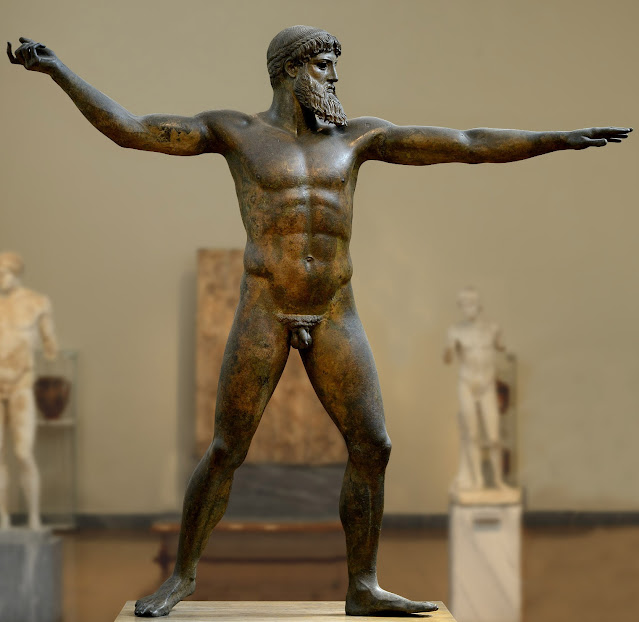
The Artemision Bronze (God from the Sea) is an ancient Greek sculpture that was recovered from the sea off Cape Artemision, in northern Euboea. It represents either Zeus or Poseidon, is slightly over lifesize, and would have held either a thunderbolt, if Zeus, or a trident if Poseidon.
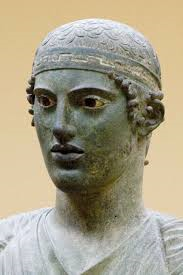
The Charioteer of Delphi is one of the best-known statues surviving from ancient Greece, and is considered one of the finest examples of ancient bronze statues. The life-size statue of a chariot driver was found in 1896 at the Sanctuary of Apollo in Delphi. It is now in the Delphi Archaeological Museum.


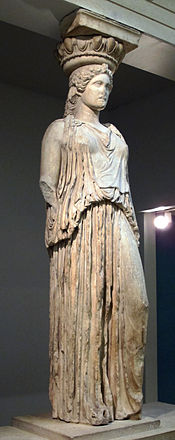
Caryatids from Erechtheion. A caryatid is a sculpted female figure serving as an architectural support taking the place of a column or a pillar. The Greek term karyatides literally means "maidens of Karyai", an ancient town of Peloponnese. The best-known and most-copied examples are those of the six figures of the Caryatid Porch of the Erechtheion on the Acropolis at Athens.
The statue of Laocoön and His Sons was excavated in Rome in 1506 and placed on public display in the Vatican. The marble figures are near life-size and the group is a little over 2m (6 ft 7 in) in height, showing the Trojan priest Laocoön and his sons Antiphantes and Thymbraeus being attacked by sea serpents.
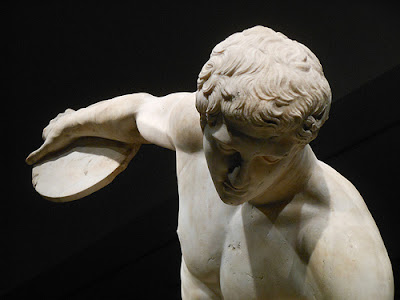
The Discobolus of Myron ("discus thrower") circa 460–450 BC. The original Greek bronze is lost but the work is known through numerous Roman copies, both full-scale ones in marble and smaller versions in bronze.