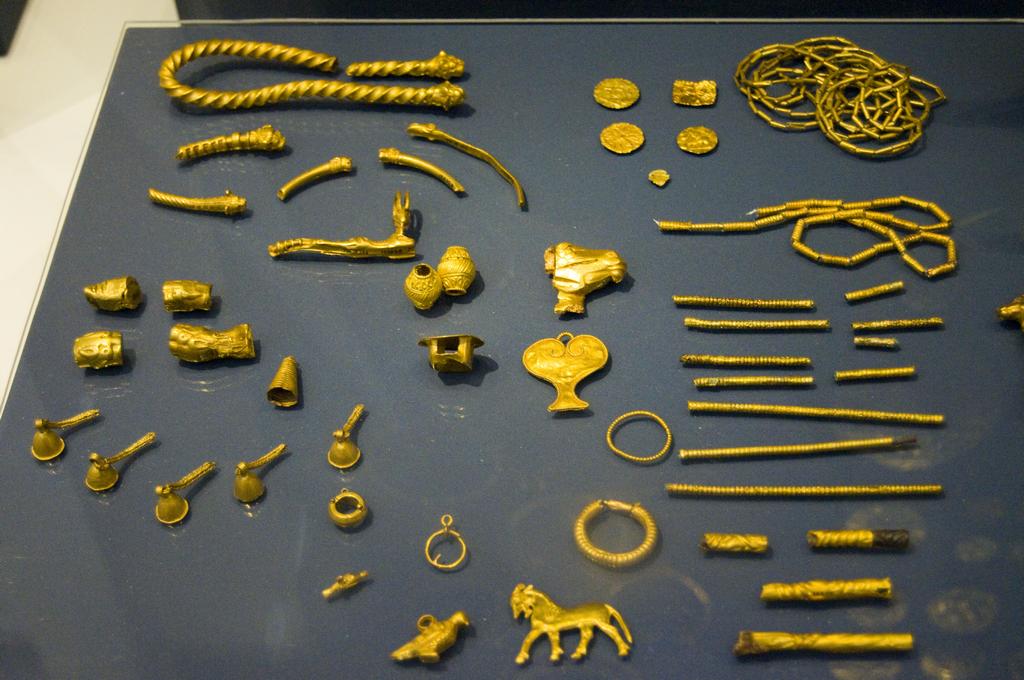
| In 2014, a metal detectorist in southwestern Scotland made a stunning discovery. The trove of more than 100 objects, seemingly Viking and hidden around A.D. 900, became known as the Galloway Hoard. It is the richest and most varied collection of Viking-age treasures ever found in Britain or Ireland. A cluster of four decorated Viking arm rings, bound together by a smaller fifth ring. Much of the silver had been treated as bullion or 'hacksilver' A cluster of four decorated Viking arm rings, bound together by a smaller fifth ring. Much of the silver had been treated as bullion or 'hacksilver' | |
Three inches below that trove, researchers found a Carolingian pot, a lidded metal vessel buried upside down, perhaps to keep out ground water. It turned out to be packed with treasures, many carefully swathed in leather and fine textiles. Only six of these Carolingian vessels have ever been found. Scholars believe they were used during important ceremonies in the Catholic Church.
 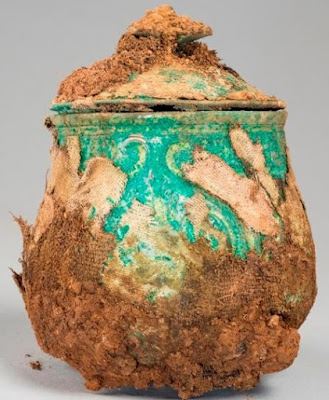 | The array of curious artifacts challenged researchers. Among the more surprising finds were a gold bird-shaped pin, an Anglo-Saxon cross, a rock crystal jar made for a bishop and a lidded vessel containing imported treasures from distant lands. The gold bird pin, decidedly not Viking, was crafted with intricate detail, and would have been extremely valuable. It could only have been worn by an abbot, a bishop, or royalty. In the upper layer, the team excavated the gold bird pin as well as 67 silver ingots and arm rings. |  |
 | This portable silver served as ready cash in the Viking world: the elite hacked off pieces to buy cattle or other commodities, reward loyal followers, or pay troops in Viking mercenary armies. |  |
 | A silver brooch (center) and a collection of glass beads, pendants, and curios were placed inside the hoard’s lidded silver vessel. |
 | It's thought that the hoard was buried some time in the mid-ninth or tenth century. The items among the treasure originated across a wide geographic area that includes Ireland, Scandinavia, and central Europe. |
 | Medieval texts date the arrival of the Vikings in the British Isles to the 790s A.D., when fierce raiders appeared along the coasts, plundering rich monasteries and terrorizing local communities. During the three centuries that followed, ambitious Viking chiefs and their followers arrived to conquer and colonize territories in England, Ireland, Wales, and Scotland, until they and their descendants were finally defeated or assimilated.
Around the early 10th century Viking forces had suffered a serious setback in Ireland, and local Galloway folklore “referred to a Viking army being defeated by a Scots army” at Galloway. | 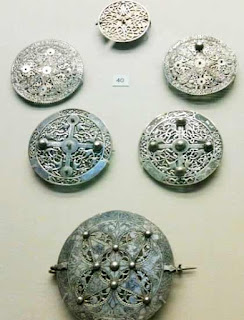 |
 | The hoard's mixture of gold, silver, glass, enamel, and textiles is unique.

 |
 | An Anglo-Saxon silver cross buried for more than a millennium was revealed. The cross, decorated using black niello and gold-leaf, features engravings depicting each of the writers of the Gospels. The Galloway Hoard is regarded as one of the richest and most significant finds of Viking objects ever found in the UK. The cross was made in Northumbria -- what is now northern England and southern Scotland -- in the 9th century for a high-ranking cleric. 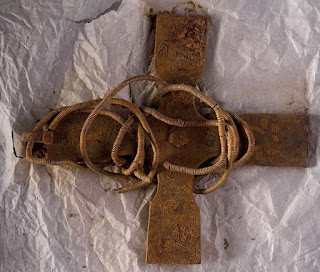 |
| The Galloway hoard is the richest collection of Viking-age objects ever found in Britain or Ireland. One of the artefacts was within a pouch that was mangled and misshapen. Its contents were restored, revealing an extraordinary Roman rock crystal jar. Research suggests that the rock crystal carving was Roman. It was perhaps 600 years old when it was transformed into a jar. | |
 | Rock crystal is unusual in itself. It was greatly prized in the ancient world for its transparency and translucency. It was associated with purity. An unexpected Latin inscription appears on the jar’s base. Spelled out in gold letters, it translates as “Bishop Hyguald had me made”. This is evidence that some of the hoard may have come from a church in the Anglo-Saxon kingdom of Northumbria. Research into the Galloway Hoard has uncovered the name of one of its original owners on a silver arm ring. An expert examining Anglo-Saxon runic inscriptions on arm rings in the hoard found the name “Ecgbeorht”, which would be Egbert in its modern form. | |





 Greek Cycladic marble female figure, circa 2500 BCE. Est. $80k-$100k.
 Enormous Early Byzantine (400 to 600 CE) liturgical table finely carved from a single piece of creamy white marble. $100k-$300k
 Chinese Han Dynasty terracotta horse, circa 206 BCE to 220 CE. Est: $75,000-$150,000
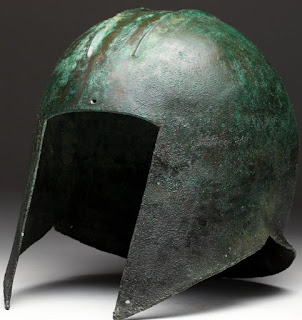
 Urartu bronze helmet, 8th-7th century BCE. Est. $250k-$350k