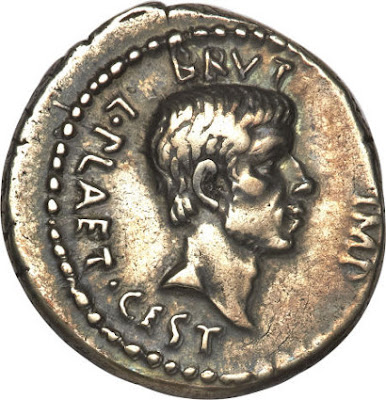
An 'Ides of March' coin appeared on PawnStars in 2017.
The Ides of March was a day in the Roman calendar that corresponds to 15 March. It was marked by several religious observances and was notable for the Romans as a deadline for settling debts. The Ides is the 13th for most months, but the 15th in March, May, July, and October. In 44 BC, it became notorious as the date of the assassination of Julius Caesar which made the Ides of March a turning point in Roman history.
The Ides of March marked the transition from the Roman Republic to the Roman Empire. According to Plutarch, a seer had warned that harm would come to Caesar no later than the Ides of March. On his way to the Theatre of Pompey, where he would be assassinated, Caesar passed the seer and joked, "The Ides of March are come", implying that the prophecy had not been fulfilled, to which the seer replied "Aye, Caesar; but not gone."
Caesar's death was a closing event in the crisis of the Roman Republic, and triggered the civil war that would result in the rise to sole power of his adopted heir Octavian.
One of the most famous coins of all time is the EID MAR denarius issued by Brutus in 43/42 BC. Marcus Antonius took advantage and loudly condemned Brutus' actions. Brutus was forced to flee Rome with his soldiers. After several military encounters, Brutus's forces fell to Mark Antony and Octavian. Brutus committed suicide before he could be taken prisoner.
About 60 examples of Brutus's coin are estimated to exist in silver, with only 3 genuine examples in gold. Silver specimens in fine condition have sold at auction for $120k to $150k. Lower grade silver coins occasionally come on the market for around $50k.
In 2011 a exceptional example fetched a record $546,250.




No comments:
Post a Comment