In AD 121, on the anniversary of Rome's founding, Hadrian inaugurated new games and chariot races at the Circus Maximus. A rare aureus commemorates the event, providing an absolute date of 874 years since the founding of Rome.
The coin depicts the Genius of the Circus Maximus holding a chariot wheel while reclining around the three-pointed metae (the turning posts that mark either end of the spina) of the Circus Maximus, accompanied by the accompanying legend:
ANN. DCCCLXXIIII NAT. VRB. P. CIR. CON.
ann(is) dccclxxiiii nat(ali) urb(is) P(rimum) cir(censes) con(stituti)
Year 874 Since the Birth of the City; First Circus Games Established.
The crucible of Roman chariot racing was the Circo Massimo, or Circus Maximus. Chariot racing was fast and dangerous. According to the historian Livy, the inaugural events and wooden seating were instituted by Tarquinius Priscus in the sixth century BC.
Julius Caesar gave the Circus Maximus its iconic shape in the first century BC by greatly extending the racing track and seating capacity.
At its largest, the Circus Maximus reached a length of 621 metres and 190 metres in width. It had three tiers of seating, with the lowest, nearest the action, reserved for the elite. It's said the Circus Maximus could accommodate over 100,000 spectators. Located in the valley between the Palatine and Aventine hills, the arena had many additions over the centuries and major rebuilds. Greek historian Dionysius of Halicarnassus called it “one of the most beautiful” structures in Rome.
Races began when the sponsor dropped his napkin and ended seven laps later. A race consisted of 13 turns of the spina, totalling seven laps of the Circus Maximus, run counterclockwise. Those who didn't get maimed or killed and finished in the top three won prizes. Crashes were called naufragia ('shipwreck'). Drivers who became entangled in a crash risked being trampled or dragged along the track by their horses. Most commonly raced were four-horse chariots, known as quadrigae. Drivers (aurigae) wrapped the reins around their waists to steer with weight shifts, holding a knife (falx) to cut themselves free if needed. The two middle horses provided the primary pulling power, while the outer horses were steered.
Life expectancy of the highly paid aurigae was short.
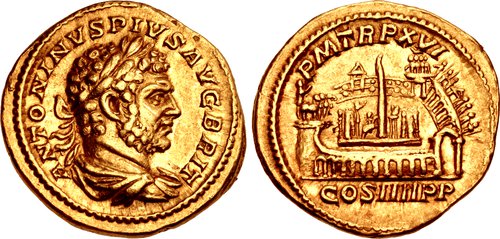
Caracalla. AD 198-217. AV Aureus Rome mint. Struck AD 213. Near EF. Extremely rare with 4 known and an important architectural type. Est $75,000. Sold for $140,000.
Trajan's Circus Maximus Sestertius. (c. 103–111 AD) Viewed from the nearby Forum Boarium, the coin offers rich detail.




No comments:
Post a Comment