| Following the assassination of Caesar in 44 BCE, Rome was plunged into chaos. Many of Caesar’s conspirators, including M. Junius Brutus and C. Cassius Longinus, (Brutus and Cassius) fled Rome in fear of reprisal. Caesar’s ally, M. Antonius (Marc Antony) seized control during the power vacuum, with the conspirators on the run and Caesar’s designated heir, G. Octavius Thurinus, (Octavian) still with an army in Macedonia. He returned to Rome with a new name, G. Julius Caesar Octavianus. |
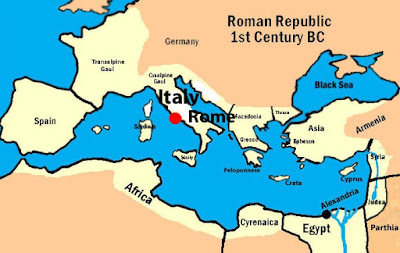 | In the spring of 43 BCE, Octavian, along with the consuls Aulus Hirtius and G. Vibius Pansa Caetronianus, conquered Antony and his five legions at the Battle of Mutina in Cisalpine Gaul. Though victorious, Hirtius was killed and Pansa died of possible poisoning. This left Octavian in command of all of their eight legions. Octavian, Antony, and Lepidus established a three-man dictatorship. |  |
 | Mark Antony’s Legionary Denarii celebrate his many legions – 23 of them, with two extra coins celebrating additional cohorts. They were struck in a lower-purity alloy of silver and copper and remained in circulation for centuries. The legionary issue was Antony's last. |
 | About a dozen gold aurei struck with the same dies as the silver denarii are known. Unlike the debased silver (85 – 90% pure) for the denarius, the gold is very pure and the surviving coins are full weight — about eight grams. A Legion II aureus, pedigreed to the famous Hunt Collection, sold for over $205k. A Legion XIII aureus brought almost $160k in 2015; a Legion XIX made over $67k in 2008. |
 | The coins allude directly to the events of the day, as they feature a praetorian galley. On September 2, 31 BCE, the forces of Octavian and M. Vipsanius Agrippa defeated Mark Antony and Cleopatra at Actium, a promontory between the Ambracian Gulf and the Ionian Sea. Antony and Cleopatra were forced to retreat for Egypt. The final defeat was the Battle of Alexandria on August 1, 30 BCE. It was the official end of the Roman Republic and the start of the Roman Empire. |
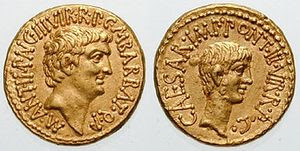 Mark Antony (left) and Octavian (right). Struck in 41 BC, the coin was issued to mark the establishment of the Second Triumvirate.  38 BCE Marcus Antonius aureus minted in Athens during the Second Triumvirate. Mark Antony and Octavia. $220k. | 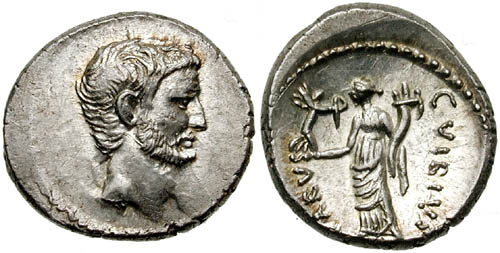 Marcus Antonius portrait. Denarius, 42 B.C. 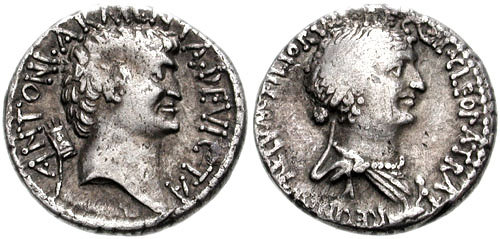 Mark Antony and Cleopatra. 34 BC. |
 Aureus of Antony and his son Antyllus. 34 BC. |