Monday, October 13, 2025

The Princess of Ukok


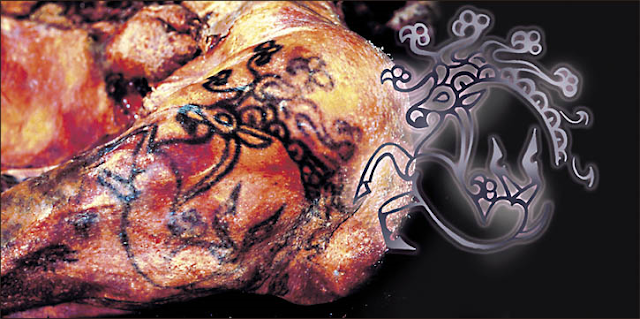
The Princess of Ukok is a mummy of a woman from the 5th century BC, found undisturbed and in spectacular condition in 1993 in a kurgan in Republic of Altai, Russia. She is among the most significant Russian archaeological finds of the late 20th century. Buried around her were six horses, saddled and bridled, her spiritual escorts to the next world, and a symbol of her status.

Her tattoos are said to be best-preserved, and most elaborate, ancient art ever found.
The Ice Maiden was buried in balm and bandages in a chamber built of larch logs. Her organs were removed and her body stuffed with grass and wool, and placed in a wooden coffin. Water flooded her tomb helping to freeze her and preserve her remains. Her head had been shaved and her hair replaced with a wig that was draped with a tall wooden head-dress, decorated with carved cats and swans. It is extremely rare to find a woman buried alone in such a tomb.
When she was around 20 years old, she became ill with breast cancer. It eventually killed her. She was very high status and was buried in a separate mound, rather than a line of family tombs. Locals claim that her presence in the burial chamber was ‘to bar the entrance to the kingdom of the dead’. By removing this mummy, the elders contend that ‘the entrance remains open’. Today she rests in a specially-built museum in the city of Gorno-Altaisk, capital of the Altai Republic.

She belonged to a tribe called the Pzyryks, close relatives of the Scythians.

Saturday, October 11, 2025

1600-year-old gold bead from the ancient City of David


A tiny gold bead turned up in soil from the City of David. It is dated to the end of the Roman era and it survived whole, which is unusual for something so small. The bead was recovered during wet sifting at excavations in the Jerusalem Walls National Park.

The soil came from a large Roman structure, and the bead’s fine work points to a skilled maker and a wealthy owner. A grand Roman building once stood along the Pilgrimage Road. It was at least about 82 feet long, with imported ceramics and a mosaic floor that signal high status. The gold bead likely belonged to a necklace or bracelet and was lost. The bead was fashioned with granulation, a technique that joins tiny gold spheres to create patterns or whole objects.
Highly skilled artisans controlled heat and solder to bond granules without collapsing the form, a complex production method. It demands steady temperature control so the small balls fuse to a ring without melting the whole piece, a balancing act few could master. The craft sits at the boundary of chemistry and art.
It leaves no room for error because one extra degree can erase hours of work. Specialists read such work as a mark of wealth and access to high level makers. Likely lost in a street, layers here build up quickly when streets are rebuilt, washed by winter runoff, or covered by repair fills. A stray bead can lodge in debris and stay hidden for centuries. Gold jewelry tends to be recycled, so it rarely survives outside hoards and graves. That makes tiny, intact gold items in excavations rare finds.

Friday, October 10, 2025

'Commodus Passage' to Colosseum unveiled

For the first time in nearly 2,000 years, visitors to Rome’s Colosseum can walk through a hidden imperial passage that once allowed Roman emperors to reach the ancient amphitheater unseen. It gave exclusive access to the arena without them having to walk through crowds. The once-secret corridor — known as the 'Commodus Passage' opens to the public on October 27.
The passage was initially constructed between the reigns of Domitian and Trajan and included luxurious stucco and marble coverings. Over centuries, natural wear nearly erased these decorations. Meticulous restoration was required.
Roman emperors would use the passage to enter the arena unseen and protected, leading them directly to their reserved honor box overlooking the games. The passage was named after Commodus, who lived between 180 and 192 A.D., when it was discovered in the 1810s. Commodus was passionate about combat in the arena. When passing through the tunnel, he was attacked by an assassin, but survived that attempt on his life.

Commodus was assassinated on December 31, 192 AD by his wrestler, Narcissus.
See ----->Commodus

Thursday, October 9, 2025

Ancient gold and silver coins found in Czech Republic

Archaeologists in the Czech Republic have revealed a trove of coins, gold jewelry and other artifacts that date to about 2,500 years ago, during the region's Celtic period. Objects were discovered during excavations at a site in the Pilsen region in the west of the Czech Republic.
Other metal objects — including fragments of gold and silver ingots, as well as bronze buckles, pins, bracelets, pendants and a horse figurine — were also found at the site. There were no signs of a permanent Celtic settlement, which implied the site might have been a seasonal market or fair.
The Celts are often thought of as occupying only the Western fringe of ancient Europe, such as Ireland; but excavations and historical records show that they spread at times across much of the continent, from the Iberian Peninsula to Anatolia and what is now the Czech Republic. The first phase of Celtic culture is known as the Hallstatt culture (between about 1200 and 450 B.C.), while its peak is recognized as the La Tène culture (between about 450 and 50 B.C.) across France, Germany and other regions.

Wednesday, October 8, 2025

Gold coin hoard in Israel

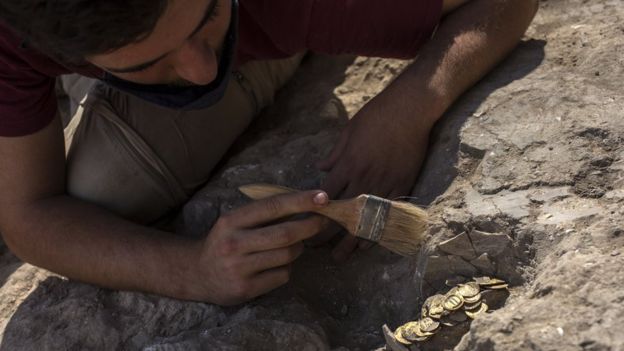
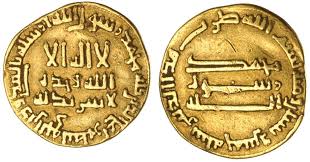
In 2020 students volunteering at an archaeological dig in central Israel landed 425 gold coins that had lain buried in a clay jar for 1,100 years. The coins date to the early Islamic period, when the region was part of the Abbasid caliphate.
The coins weigh 845g and would have been a huge sum when they were buried - enough to buy a luxurious home. The cache consisted of full gold dinars and 270 small gold cuttings - pieces of dinars cut to serve as 'change'. Some of the cuttings were from a gold solidus of the Byzantine Emperor Theophilos minted in Constantinople. This provides evidence of the continuous trade connections between the two rival empires during the period.
The Abbasid Caliphate was the third of the Islamic caliphates to succeed the Islamic prophet Muhammad. The Abbasid dynasty descended from Muhammad’s youngest uncle, Al-Abbas ibn Abd al-Muttalib (566–653 CE), from whom the dynasty takes its name.

Tuesday, October 7, 2025

The Gjermundbu Helmet

On March 30 1943, during World War II in Nazi-occupied Norway a rich discovery was made.
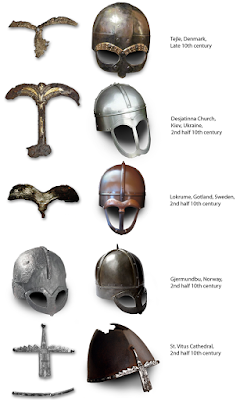
A burial mound on a farm in Ringerike contained the burnt remains of two males and 76 different objects. They were placed in a wheelbarrow and hidden from the Germans. Among the objects was a Viking helmet. 80 years after its discovery, the Gjermundbu helmet is still very special. Many Viking warriors used helmets, but only two survived enough to be reconstructed. The Gjermundbu helmet was found in nine fragments and restored.
The helmet was made some time between the years 950 and 975 and was part of a high status burial. A sword, pieces of chain mail, and stirrups from the Gjermundbu burial.
The helmet was made of iron and was in the shape of a peaked cap made from four plates.

The helmet remains the first and only known helmet dating back to the Viking era. Research indicates that Vikings rarely used metal helmets. Despite popular culture, there is no evidence that Vikings used horned helmets in battle.

Sunday, October 5, 2025

Expensive Ancient Statues at Auction


In 2002 the sale of the statue broke the world auction record for an antiquity sale (of that time) after selling for nearly $12m at Christie’s London.
The Jenkins Venus: $11.7m. The Jenkis Venus, also known as the Barberini Venus is a copy of the Aphrodite of Knidos statue, which is was one of the most famous works of Praxiteles, an ancient Greek sculptor.


Considered the most important Cycladic idol ever to come to auction, the Cycladic reclining female figure with an estimated value of $3-5m, was sold by Christie’s for a jaw-dropping $17m in December of 2010.

Bronze Figure Of A Tapir: $12m. This bronze figure is a preeminent example of Chinese figurines of the 4th century B.C. The bronze figure portrayed a pig-like mammal that became extinct in China about 10,000 years ago.
The statue depicting Leda and the swan was discovered around 1775 in Rome, and is a Roman replica of a Greek statue from about 300 B.C. The statue was sold by Sotheby’s New York for over $19m.

The sculpture, ‘Roman Bust of Antinous’, was sold by Sotheby’s in 2010 for almost $24m.

Artemis and the Stag: $28.6m. Artemis and the Stag, was the highest priced statue ever sold at the time (2007).
Found near Baghdad, Iraq, the Guennol Lioness is a 5,000-year-old limestone Mesopotamian statue. The sculpture was described by Sotheby’s as “one of the last known masterworks from the dawn of civilization remaining in private hands.” The sculpture portrays an anthropomorphic lioness-woman and was sold for $57.2m in 2007

$60k to $90k
On December 8, 2015 Sotheby's presented a sale dedicated to ancient Egyptian sculpture and works of art, the first auction of its kind in recent memory.

Highlights include a fine small-scale basalt bust of King Tuthmosis III, an imposing over-lifesize fragmentary red granite head of King Amenhotep III from the last ten years of his reign, and a monumental granite enthroned figure of the goddess Sekhmet, once the property of John Lennon

Black Basalt Head Of Tuthmosis III, 18th Dynasty, 1479-1426 B.C. $200k to $300k

Wood mask with inlaid eyes, 25th/26th Dynasty. $300k to $500k

Limestone mask, 30th Dynasty/early Ptolemaic Period. $200k to $ 300k

Granite enthroned figure of the goddess Sekhmet. $3m to $5m

Statuette of the Lady Iset , priestess of the god Sobek, dating to the early 19th Dynasty. $600k to $900k

A record for an ancient Egyptian work of art was set at Christie’s in 2012 when a 29 inch sculpture of the goddess, Isis, dating from the Late Period Dynasty, c 664 - 525 BC, sold for £3.7m.
A 30-inch statue representing the god Sekhemka broke the world record for highest auction price of an Egyptian artwork in 2014. The statue was estimated to sell for $7 to $11m, but sold for $27m. The Sekhemka statue is a tomb model of a high official, wearing a short kilt and tight-fitting wig, surrounded by his wife, son and seven offering-bearers. He holds a papyrus on his knees on which are inscribed a list of offerings designed to serve the needs of the dead, including beer and cakes.

An Egyptian Green Peridotite Head of a Man

Egyptian blue-glazed steatite figure of Taweret, goddess of childbirth

Block statue of a man and the sacred baboon of Thoth, Egyptian, serpentine, 26th/30th Dynasty, 664-342 B.C. Sold for $856,000 in 2006

Sphinx of Egyptian queen, green porphry, Roman Imperial, circa A.D. 81-96. $5,234,500.

Egyptian steatite figure of Sobek

Djehuty-Mose (Tothmes), polychrome limestone ushabti, Egyptian 19th Dynasty,1292-1190 B.C. $1,314,500

Black granite or basalt relief fragment from the 30th Dynasty/Early Ptolemaic Period, reign of Nectanebo II /Ptolemy I, 360-282 B.C. $211,500 in 1998

Limestone figure of lion, 30th Dynasty/Ptolemaic Period, 380-30 B.C. $154,250 in 2001.

Friday, October 3, 2025

4,500 year-old gold and jade — from ancient Troy

The city at the heart of Homer’s Iliad and the Trojan War resided between myth and history until the ruins of Troy were discovered in Hisarlık, Turkey in the late 1800s.
In the beginning ages of Troy, the city served as the capital of Troad and was the residence of the king and his various family, officials and staff. The rest of the population lived as farmers outside the city, taking refuge inside a city citadel in times of conflict. The city grew over the centuries, eventually becoming home to settlers and horse-raisers, before being struck by a devastating earthquake just after 1300 B.C. There are nine 'layers' of Troy, researchers found, and during recent excavations on the layer between Troy I and Troy II, a few improbable pieces were discovered. This layer dates to about 4,500 years ago, to the Early Bronze Age.
Archaeologists uncovered a gold brooch and piece of jade. The brooch is one of only three known similar pieces in the world.
Jade and gold were luxury items exclusive to the elite at the time.

The Troy likely described by Homer was the later Troy VIIa, later destroyed by the Greeks of Agamemnon, in what was called the Trojan War.
Troy VII is often subdivided into two different phases, Troy VIIa and Troy VIIb, as a major destruction event occurred between 1220 B.C.-1180 B.C. that demarcates two very different phases. After the city of Troy VI was destroyed by an earthquake around 1300 B.C., a much different settlement developed at the site.

Thursday, October 2, 2025

Rare Roman Gold

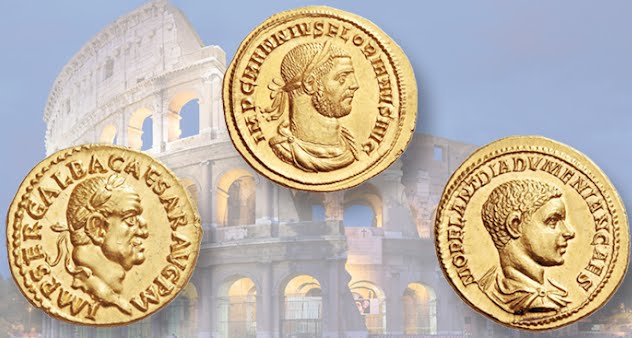
A trio of rare Roman gold aurei led bidding at Numismatica Ars Classica’s auctions in Zurich in 2018.
The coins were issued for some of the shortest-serving leaders of the Roman Empire. Galba’s reign as emperor was from July 68 to January 69, and a gold aureus that was “virtually as struck” was the top lot in the sale. It made $256k. Another rarity is a piece struck for the son of emperor Macrinus. The aureus of Diadumenian Caesar, struck late in 217, realized a hammer price of $239k. A gold aureus of Florian issued in Cyzicus in 276 A.D. realized a hammer price of $229k.