
 A silver cistophorus (three denarius) of 50-51 CE, portrays Nero at 13, before he became emperor.  Nero, as Caesar, AR Denarius. 51-54 AD. On the reverse sacral implements of the different priests.
| Maturing portraits on Roman coins is rare. Few emperors began their reigns young and ruled long enough that aging can be observed in their coinage. Nero evolved dramatically from a slender youth to a heavy-set autocrat, charting his psychological shift and physical decline from age 12 to 30. Nero was the son of Gnaeus Domitius Ahenobarbus and Agrippina the Younger, sister of Caligula. Due to his maternal family line, Nero was the great-great-grandson of Augustus. This helped him to legitimate his position as emperor. Nero became emperor in 50 CE at age 16 due to the influence of his mother over Claudius. |  Nero was 20 when this portrait appeared on silver denarii of 56-57 CE. Nero was 20 when this portrait appeared on silver denarii of 56-57 CE.  Nero was 22 or 23 on a tetradrachm struck 59-60 CE.  Nero was 25 in 62-63 CE. |

 A menacing portrait appeared on a silver tetradrachm of 65-66 CE. | Nero is also famous for persecuting Christians and blaming them for the great fire of 64 AD. The great fire cleared the way for Nero's Domus Aurea on the Oppian Hill in the heart of ancient Rome. | 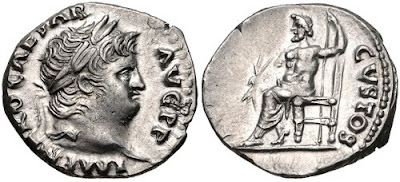 This coin was struck within a year of his death in 68. He was about 30. |


