Sunday, June 7, 2026

The Circus Maximus

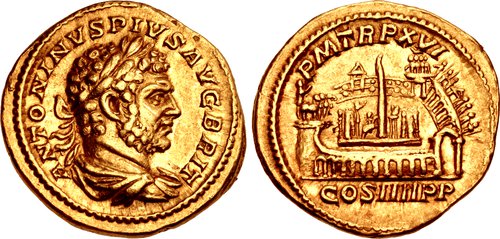
In AD 121, on the anniversary of Rome's founding, Hadrian inaugurated new games and chariot races at the Circus Maximus. A rare aureus commemorates the event, providing an absolute date of 874 years since the founding of Rome.
The coin depicts the Genius of the Circus Maximus holding a chariot wheel while reclining around the three-pointed metae (the turning posts that mark either end of the spina) of the Circus Maximus, accompanied by the accompanying legend: ANN. DCCCLXXIIII NAT. VRB. P. CIR. CON. ann(is) dccclxxiiii nat(ali) urb(is) P(rimum) cir(censes) con(stituti) Year 874 Since the Birth of the City; First Circus Games Established.
The crucible of Roman chariot racing was the Circo Massimo, or Circus Maximus. Chariot racing was fast and dangerous. According to the historian Livy, the inaugural events and wooden seating were instituted by Tarquinius Priscus in the sixth century BC.
Julius Caesar gave the Circus Maximus its iconic shape in the first century BC by greatly extending the racing track and seating capacity.
At its largest, the Circus Maximus reached a length of 621 metres and 190 metres in width. It had three tiers of seating, with the lowest, nearest the action, reserved for the elite. It was said the Circus Maximus could accommodate 150,000 spectators. Located in the valley between the Palatine and Aventine hills, the arena had numerous additions over the centuries as well as major rebuilds. The Greek historian Dionysius of Halicarnassus called it “one of the most beautiful” structures in Rome.
Races began when the sponsor dropped his napkin and ended seven laps later. A race consisted of 13 turns of the spina, totalling seven laps of the Circus Maximus, run counterclockwise. Those who didn't get maimed or killed and finished in the top three won prizes. Crashes were called naufragia ("shipwreck"). Drivers who became entangled in a crash risked being trampled or dragged along the track by their horses. Most commonly raced were four-horse chariots, known as quadrigae. Drivers (aurigae) wrapped the reins around their waists to steer with weight shifts, holding a knife (falx) to cut themselves free if needed. The two middle horses provided the primary pulling power, while the outer horses were steered.
Life expectancy of the highly paid aurigae was short.
Caracalla. AD 198-217. AV Aureus (20mm, 6.90 g, 6h). Rome mint. Struck AD 213. Near EF. Extremely rare with 4 known and an important architectural type. Est $75,000. Sold for $140,000.

Saturday, June 6, 2026

Mithridates VI of Pontus - the Poison King

Mithridates VI was king of Pontus and Armenia Minor in northern Anatolia (now Turkey) from about 120–63 BC.

In the decades following the death of Alexander the Great, many new kingdoms emerged from his empire. The Kingdom of Pontus was proclaimed by its founder, Mithradates I, in 281 B.C. Its kings proudly proclaiming a bloodline through Alexander himself. Mithradates became the republic’s most dangerous and relentless enemy.

Map of the Kingdom of Pontus, Before the reign of Mithridates VI (dark purple), after his conquests (purple).
In 88 B.C. between 80,000-150,000 Roman and Italian citizens were murdered on a single day in the Greek settlements of Asia Minor. The plan was orchestrated by Mithradates who had convinced his friends and allies to rid themselves of their Roman oppressors. It was a brutal move, considered to be one of the first genocides in history.
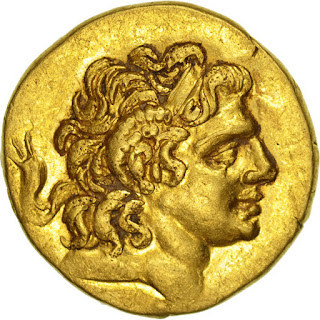
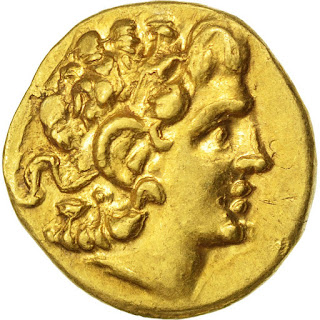
KINGS OF PONTOS. Mithradates VI Eupator, circa 120-63 BC. Stater. Very rare. Marks and scrapes, otherwise, nearly extremely fine. 7,500 CHF May 31, 2026.
Mithradates VI of Pontus was referred to as the Poison King. He was a brilliant toxicologist.
He was obsessed with poison and took small doses of a specially prepared poison to help him develop a resistance if someone tried to poison him. He impressed history by eating poison, murdering his own mother to become king, and as Rome's worst enemy. King Mithridates hated the Roman Empire and sent his army west to crush the "Romans, the enemy of all humanity." He engaged three of the prominent generals from the late Roman Republic in the Mithridatic Wars: Lucius Cornelius Sulla, Lucius Licinius Lucullus and Gnaeus Pompeius Magnus.
In the end, Rome was victorious and Mithradates lost his kingdom and his life. After Pompey defeated him in Pontus, Mithridates fled to the lands north of the Black Sea in the winter of 66 BC in the hope that he could raise a new army and carry on the war.
His preparations proved to be too harsh on the populace, who rebelled against him. He reportedly attempted suicide by poison. This failed because of his immunity.

According to Appian's Roman History, he then requested his Gaulish bodyguard, Bituitus, to kill him. Machiavelli praised his military genius. European royalty sought out his secret elixir against poison. His life inspired Mozart's first opera, while for centuries poets and playwrights recited bloody, romantic tales of his victories, defeats, intrigues, concubines, and mysterious death.

Friday, June 5, 2026

The Amphipolis Tomb

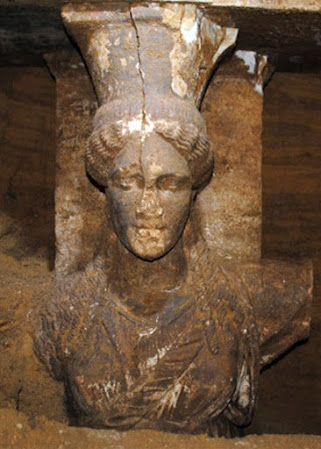
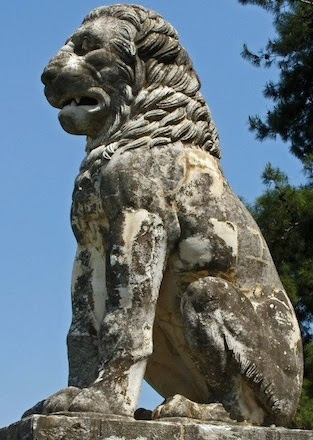
The Amphipolis Tomb lies within the Kasta Hill burial mound, 100 km east of Thessaloniki in Greece. See - Here
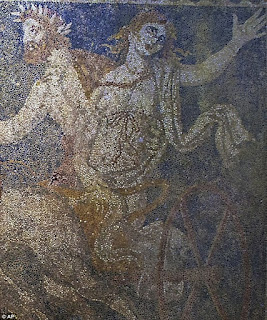
It's in what was once the ancient city of Amphipolis, conquered by Philip II of Macedon, father of Alexander the Great, in 357 BC. The tomb was found to contain sculptures of caryatids, an ornate mosaic, and coins featuring Alexander the Great. The tomb appears a memorial dedicated to the friend of Alexander the Great, Hephaestion.
Hephaestion was a Macedonian noble that grew up with Alexander, studying with him under the tutelage of Aristotle. They became close friends, as well as comrades. Hephaestion became a member of Alexander’s personal bodyguard and went on to command the Companion cavalry. Hephaestion died suddenly in Ecbatana, Iran, in 324 BC. Alexander ordered a series of monuments to be built for Hephaestion.
The remains of five were found in the burial chamber of the elaborate tomb. A woman over 60 years old, two men between the ages of 35 and 45, a newborn infant, and a set of cremated remains. Speculation is that the woman is Alexander the Great’s mother, Olympias, who was executed when she was about 60 years old.
According to legend Hephaestion was cremated.

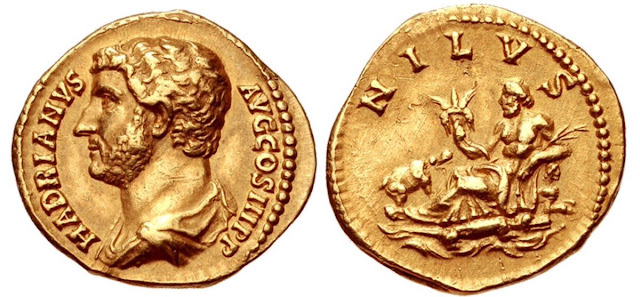
Aureus of Hadrian - 67k in 2019

Hadrian’s 'Travel Series' is a celebrated collection of gold, silver, and bronze Roman coins minted between AD 130 and AD 138. They commemorate the travels of Emperor Hadrian in 3 trips across the Roman Empire. The coins were meant to spread propaganda of the emperor's travels.
An aureus of Hadrian (A.D. 117 to 138). The reverse shows the river god Nilus reclining, half draped, with one arm supporting his weight on a sphinx and the other holding a cornucopia. Highly desired coins include depictions of Egypt (Aegyptos), Africa, and Germania. Some 28 regions are mentioned by name.
Between 128–132 Hadrian's second voyage included Africa.

Thursday, June 4, 2026

Roman usurper Emperor Allectus - $700k

Formerly the finance minister (rationalis) to the usurper Carausius, Allectus seized the throne by assassinating Carausius before being defeated and killed by the Roman Caesar Constantius Chlorus in 296 AD. Constantius was bestowed the title Britannicus Maximus. The Allectus aureus was estimated to sell for between $90k and $127k in 2019. Warring bidders pushed that to $700k.
A metal detectorist found a gold coin in Kent with the image of the Roman Emperor Allectus with two kneeling captives at the feet of the god Apollo on the obverse. In power from 293 to 296 AD, Allectus was one of two Roman emperors who ruled Britannia and northern Gaul as an independent nation between 286 and 296 AD. The British Museum owns the only other known example of this Allectus aureus, and nobody has found any coin bearing his visage in over 50 years.
Constantius Chlorus rose from obscurity to become the Emperor of the western Roman empire. A soldier who worked his way up through the ranks, his star rose in 289 after he married Theodora, the stepdaughter of the emperor Maximian. By this time Constantius had already fathered a soon to be famous son named Constantine by another woman, Helena. The Arras Medallion (AD 296) celebrating his victory weighs 26.79 gms.
A bronze antoninianus coin of Allectus is notable for the history it reflects. The coin realized a hammer price of €550 ($618 U.S.) against a pre-sale estimate of €200 ($225 U.S.).

Slender and shallow ships were used in Roman rivers until late antiquity and played a significant military role. The ship was easy to navigate and thus sailors could be trained quickly. Each carried 50 men, with 30 of them rowing.

Tuesday, June 2, 2026

Claudius aureus brings £4,000

A rare Roman gold coin unearthed by a beekeeper in the UK in 2023 made £4,000 at auction. Rob Turrell was metal detecting on a field near Diss in Norfolk when he hit the find of a lifetime. The aureus weighs 7.70 grams of pure gold, and was struck by the emperor Claudius in AD 41-2 with the portrait and name of his father Nero Claudius Drusus, a highly respected general and consul.
The inscription records Claudius Drusus's celebrated campaigns subjugating the Germanic tribes in 12-9 BC. Claudius Drusus was renowned in the Roman army for defeating many Celtic chiefs in combat before his untimely death in 9 BC after a riding accident.

Needing to establish military legitimacy, Claudius launched the invasion of Britain in AD 43. He sent a force of 4 legions plus auxillaries, some 40,000 to 50,000 men. Claudius died on October 13, AD 54, at the age of 63. Historians widely agree he was assassinated. The consensus implicates his wife, Agrippina the Younger, who allegedly had him fed a dish of poisoned mushrooms. The aureus, a month’s pay for a Roman soldier, was likely lost shortly after Claudius invaded in AD 43.

Nepotian

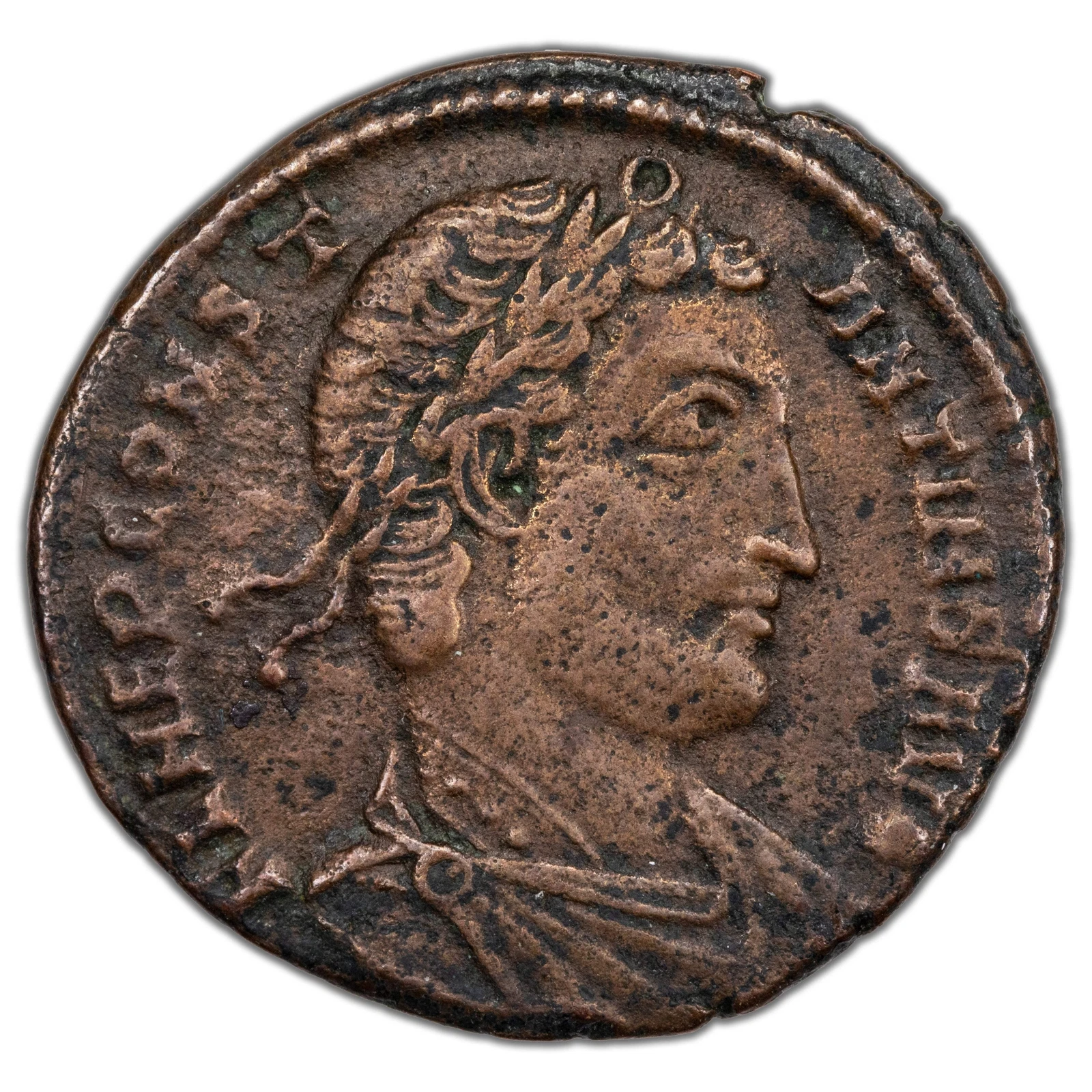
In AD 350, Magnentius revolted, murdered Constans and claimed the Western Empire. Nepotian (Flavius Julius Popilius Nepotianus Constantinus, nephew of Constantine I) did the same in Rome. On June 3, 350 CE Nepotian attempted to take control over Rome and proclaimed himself emperor. He challenged the usurper Magnentius and seized Rome with a small band of gladiators. After ruling for 28 days, he was defeated by Magnentius' general Marcellinus and killed on June 30, 350. Coin shown is extremely rare. VF, even hard brown surfaces. $6,400.
Nepotian managed to strike both gold solidi and bronze centenionalis coins at the Rome mint during his brief reign. Many of his coins, and certainly his gold, are museum pieces.

Monday, June 1, 2026

Pompeii reveals garum

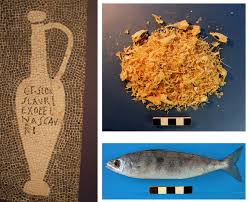
Garum is a fermented fish sauce that was used as a condiment in Phoenicia, ancient Greece, Carthage, Rome, and later Byzantium.
Garum was used extensively throughout the ancient world as a condiment and was a frequent trade item. What went into garum and how it was prepared was lost to time.

In 2014 a team from the University of Cadiz began excavating at Pompeii in search of garum. They found a garum store and, inside, were 2,000-year-old traces of the sauce itself. For the first time ever an actual sample of garum could be analyzed to find out exactly what it was made of. Microscopic analysis revealed pollen grains revealing which selection of herbs were used. The sample also told them exactly what species of fish was used.
The spices are characteristic of the Mediterranean – rosemary and coriander. Anchovies were used.
Like modern soy sauce, fermented garum is a rich source of umami flavoring, including monosodium glutamate. When mixed with wine, vinegar, black pepper, or oil, garum enhances the flavor of a wide variety of dishes, including boiled veal and steamed mussels. It was so common that even slaves used it to improve the taste of their bread.
Garum was produced in various grades and consumed by all social classes. After the liquid was ladled off the top of the mixture, the remains of the fish, called allec, were used by the poorest classes to flavor their staple porridge or farinata. The finished product was labour intensive. The best garum fetched very high prices. The highest-quality was made from prime fish like mackerel and red mullet, along with the blood and innards. The most expensive of these was dubbed haimation or garum sociorum. It was an extremely expensive, clear, amber liquid reserved for the Roman elite. The manufacture and export of garum was an element of global trade in the ancient world and a driver for Roman conquest of coastal areas.

Didius Julianus

Didius Julianus was executed on this day in 193, ending a 66-day reign that had begun when he purchased the throne at auction from the Praetorian Guard. Marcus Didius Julianus was Roman emperor from March to June 193, during the Year of the Five Emperors.
The Praetorian Guard arranged for army officer Pertinax to succeed the executed Commodus. He attempted reforms during his reign of 86 days. One was the restoration of discipline among the Praetorian Guards, and that led to his death. The Praetorian Guard expected a donativum, and agitated until he produced money, selling off Commodus' property. Pertinax was assassinated by the Guard on 28 March 193. The guard auctioned off the imperial title, which was won by wealthy senator Didius Julianus.

DIDIUS JULIANUS. 193 AD. AV Aureus, VF. $16k.
The mint of Rome was quick to produce new issues, as was the case with Didius Julianus. On the 28th March 193 he outbid Flavius Sulpicianus, the father-in-law of Pertinax, for the empire at the praetorian camp auction, by promising to pay each man 25,000 sestertii. The cohors praetorium was composed of 16 cohorts of 1000 men, meaning Didius had bid 40 million sestertii, 10 million denarii or 400,000 aurei. Threatened by the military, the Senate also declared him emperor. His wife and daughter both received the title Augusta.
Upon his accession, Julianus immediately reversed Pertinax's monetary reforms by devaluing the Roman currency. Pertinax had increased the silver content of the denarius to 87%, Didius Julianus ordered it reduced to 75%.
Julianus was killed in the palace by a soldier on 2 June 193 AD. According to the Roman historian Cassius Dio, Julianus' last words were: "But what evil have I done? Whom have I killed?"