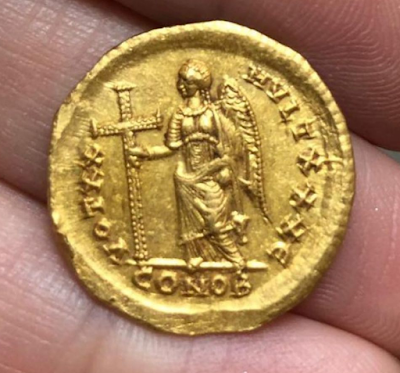
 | The coin was found along a stream in the Galilee region. The coin is a solidus minted by the emperor Theodosius II in Constantinople around 420–423 CE. Theodosius II was named to the throne as an infant in 402 and ruled until 450 when he died in a riding accident. A high quality (AU) Theodosius II solidus would expect to make at least $1500. | 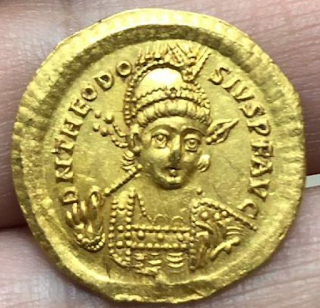 |

Monday, September 8, 2025
Rare Byzantine gold coin found by schoolboys in Israel
A rare Byzantine gold coin was found by a group of schoolboys in northern Israel in 1999.

Saturday, September 6, 2025
Assyrian Empire collapsed due to climate change
Ancient Mesopotamia, the land between the Tigris and the Euphrates rivers, was the center of the Neo-Assyrian Empire.
Rainfall patterns over Mesopotamia were deduced from cave stalagmites. These are the cone-like structures from the cave floor. They grow slowly, as rainwater drips down from the cave ceiling. Oxygen isotope ratios build a timeline of how conditions changed, but don't reveal the amount of time that elapsed between them. Stalagmites also trap uranium. Over time, uranium decays into thorium at a predictable pace. Experts made high-precision uranium-thorium measurements.
Repeated crop failures likely exacerbated political unrest in Assyria, crippled its economy, and empowered adjacent rivals.
 | The ancient superpower was the largest empire of its time, lasting from 912 BC to 609 BC in what is now Iraq and Syria. At its height, the Assyrian state stretched from the Mediterranean and Egypt in the west to the Persian Gulf and western Iran in the east. Then a reversal of fortune, and the Neo-Assyrian Empire plummeted from its zenith (circa 650 BC) to complete collapse within the span of a few decades. The reasons why were a mystery. New research shows that climate change was the double-edged sword that first helped the meteoric rise of the Neo-Assyrian Empire and then lead to its precipitous collapse. |
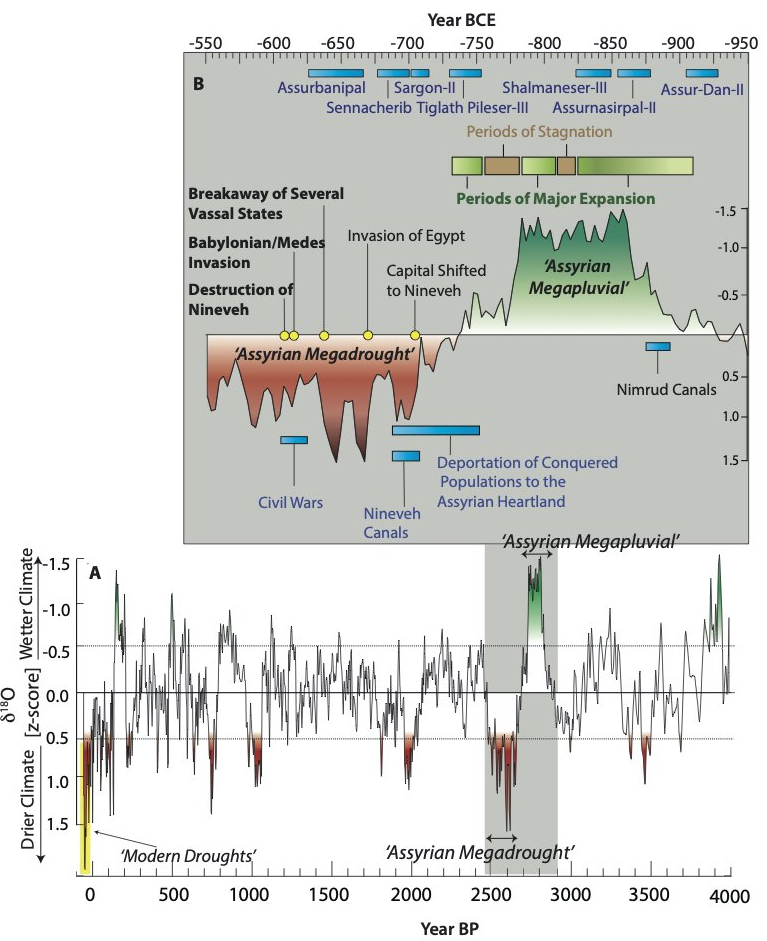 | The Neo-Assyrian state expanded during a 200 year interval of anomalously wet climate. This was followed by major droughts in the early-to-mid-seventh century BC. | 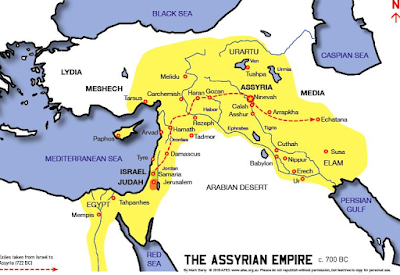 The period marked the swift collapse of the Neo-Assyrian Empire. |
Thursday, September 4, 2025
Skull of bear held captive to fight Roman gladiators discovered

 |
The amphitheater at Viminacium was built in the second century A.D. Oval-shaped with high walls, it could seat about 7,000. |
 |
The Siberian brown bear weighs as much as 360 kg (800 pounds), and approximates the size of the North American grizzly. |
Wednesday, September 3, 2025
Ephesus
Ephesus was an ancient Greek city on the coast of Ionia, three kilometres southwest of present-day Selçuk in İzmir Province, Turkey.
 | It was constructed in the 10th century BC by Attic and Ionian Greek colonists. During the Classical Greek era it was one of the twelve cities of the Ionian League. The city flourished after it came under the control of the Roman Republic in 129 BC. Ephesus was famed for the nearby Temple of Artemis (completed circa 550 BC), one of the Seven Wonders of the Ancient World. |  |
 | Among many monumental buildings are the Library of Celsus, and a theatre capable of holding 25,000 spectators. Ephesus was one of the seven churches of Asia cited in the Book of Revelation. The Gospel of John may have been written there. |  |
 | The Romans made Ephesus the capital of the Asian State, and the city became one of the biggest settlements in Anatolia. Today Ephesus is one of Turkey’s leading tourist attractions. |  |
 | A extremely rare ancient Ephesus coin (625-600 B.C.) crossed the block in New York in 2018. The electrum coin was a 'foundation deposit' and could be related to the god of light, Phanes. There are only two other known examples. It made $300k. |  |
Saturday, August 30, 2025
Siberian archaeologists unearth 2,500 yo Scythian grave
Archaeologists in Siberia unearthed a 2,500-year-old grave of an ancient couple in 2020.
 | Both are believed to have died in their 30s and were buried together with a newborn and an elderly woman. The couple are thought to be spouses, whereas the elderly woman might have been their servant as she had no valuables. Remains of the baby were scattered throughout the grave, most likely due to rodents eating the flesh. All of the people from the grave are from the Tagar culture that was part of the Scythian civilization. |
Friday, August 29, 2025
Commodus aureus
An extremely rare early aureus of Commodus was sold in 2019. Commodus was Roman emperor from 177 to 192, first serving as nominal co-emperor under his father Marcus Aurelius and then ruling alone from 180.
Dating to 178 AD and struck in Rome. 25,000 euros. |
 | Other rarities include a Manlia Scantilla aureus. 193 AD. Rome. Manlia Scantilla was the wife of Didius Julianus. Didius Julianus was Roman emperor for nine weeks from March to June 193, during the Year of the Five Emperors. He bought the title from the Praetorian Guard. Julianus was killed and succeeded by Septimius Severus. 35k Euro. Elagabalus aureus. 218-219 AD. Rome. 16k Euro. |  |
Tuesday, August 26, 2025
Trajan - optimus princeps
M. Ulpius Trajanus, was born at italica, near Seville, the 18th of September, 52. He was consul in 91, and at the close of 97 he was adopted by the Emperor Nerva, who gave him the rank of Caesar. He was the first emperor who was born out of Italy. Trajan was Roman emperor from 98 to 117 AD.
Early in his reign, he annexed the Nabataean Kingdom, creating the province of Arabia Petraea. His conquest of Dacia in 105–106 greatly enriched the empire. The conquest paid for many of Rome's monuments. In 107 Trajan devalued Roman currency. He decreased the silver purity of the denarius from 93.5% to 89% – the actual silver weight dropping from 3.04 grams to 2.88 grams.
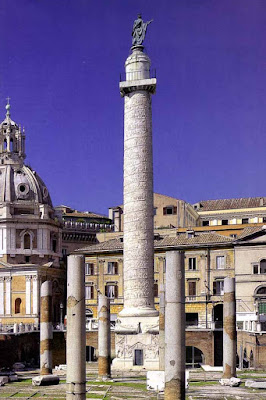
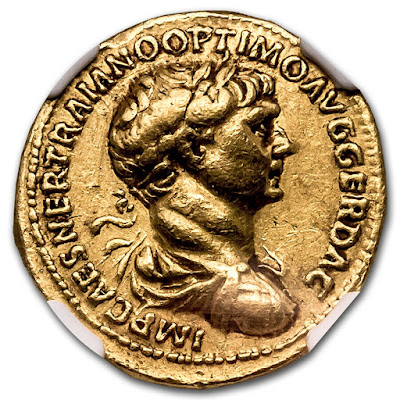 | Officially declared by the Senate optimus princeps ("the best ruler"), Trajan was a successful soldier-emperor who presided over the greatest military expansion in Roman history, leading the empire to attain its maximum territorial extent by the time of his death. Trajan was the first emperor born outside Italy. Trajan is best known for his public building program, which reshaped Rome and left many landmarks such as Trajan's Forum, Trajan's Market and Trajan's Column. |  |
 In late 117, while sailing back to Rome, Trajan fell ill and died of a stroke in the city of Selinus. He was deified by the Senate and his ashes were laid to rest under Trajan's Column. He was succeeded by his adopted son Hadrian. | This devaluation, coupled with the massive amount of gold and silver carried off after Trajan's Dacian Wars, allowed the emperor to mint a larger quantity of denarii than his predecessors.
 |  |
Monday, August 25, 2025
Malia Bee Pendant
The Malia Bee Pendant is a spectactular gold pendant discovered in 1930 at the cemetery of Chrysolakkos, ("pit of gold") in the ancient Minoan town of Malia in Crete.

Some researchers suggest the pendant shows European honeybees (Apis mellifera) in the process of making honey. This doesn't account for the three dangling circles. These may represent the fruits of the Mediterranean hartwort (Tordylium apulum), an edible herb that's common in Crete. If the dangling discs represent this fruit, the insects being depicted may be mammoth wasps (Megascolia maculata). Whatever the maker intended, the Malia Bee Pendant is one of the finest and most intricate examples of Aegean Bronze Age metalwork in the world.
 | It was made sometime between 1800 and 1700 B.C. Although the famed archaeologist Sir Arthur Evans suggested the pendant depicted bees, the meaning behind the design has been debated. It is 1.8 inches (4.6 centimeters) long and weighs 0.2 ounces. (5.5 grams) The ancient goldsmith combined several techniques to create the piece — filigree, granulation, repoussé and incised decoration. The pendant is considered a masterpiece. |
Some researchers suggest the pendant shows European honeybees (Apis mellifera) in the process of making honey. This doesn't account for the three dangling circles. These may represent the fruits of the Mediterranean hartwort (Tordylium apulum), an edible herb that's common in Crete. If the dangling discs represent this fruit, the insects being depicted may be mammoth wasps (Megascolia maculata). Whatever the maker intended, the Malia Bee Pendant is one of the finest and most intricate examples of Aegean Bronze Age metalwork in the world.
Sunday, August 24, 2025
Queen Berenice II gold found in Jerusalem
 | Archaeologists excavating the City of David in Jerusalem uncovered a rare 2,300-year-old gold coin. The obverse bears the profile of Queen Berenice II of Ptolemaic Egypt. It is a quarter drachma 99.3% gold and dates to 246–241 B.C. Only 20 of these coins are known. |
Saturday, August 23, 2025
Treasures of Thrace
Thrace is a historical and geographic area in southeast Europe, centered on the modern borders of Bulgaria, Greece, and Turkey. In antiquity, it was also referred to as Europe, prior to the term to describe the whole continent.
 | Thrace designates a region bounded by the Balkan Mountains on the north, Rhodope Mountains and the Aegean Sea on the south, and by the Black Sea and the Sea of Marmara on the east. The areas it comprises are southeastern Bulgaria (Northern Thrace), northeastern Greece (Western Thrace), and the European part of Turkey (Eastern Thrace). The biggest part of Thrace is part of present-day Bulgaria. The population of Thrace was a people called the Thracians, divided into numerous tribal groups. The region was controlled by the Persian Empire at its greatest extent, and Thracian soldiers were known to be used in the Persian armies. Later, Thracian troops were known to accompany Alexander the Great when he crossed the Hellespont. |  |
 | Some of Bulgaria’s famous Thracian treasures were part of a major exhibition at the Louvre Museum in Paris in 2015. The exhibition brought together more than 1,600 objects from 17 Bulgarian museums and several international museums including the Louvre and the Prado Museum, giving visitors an opportunity to see in one place some of the most significant Thracian artifacts that have ever been discovered. |  |
 | The Odrysian kingdom was mostly on the territory of present-day Bulgaria but also included parts of modern Greece and Turkey. It was a regional power which was involved in the struggle with the Macedonian kingdom and with Athens and Sparta. One of the exhibition highlights is the bronze head of Seuthes III.  Hilt with gold inlay of Seuthes III's sword. ca. 331 BC. |  |
 | Another highlight was the Panagyuriste gold treasure, which was excavated in 1949 and consists of gold drinking vessels that are elaborately decorated with mythological scenes and images, showcasing the artistic skills of the Thracians. |  |
 |  |  |
  |  |  |
  Rare gold hemidrachm from Thasos, Thracian islands. |  |  |
 |  |   |
Subscribe to:
Posts (Atom)