The Wari lords have been overshadowed by the later Inca. But in the 8th and 9th centuries A.D., the Wari built an empire that spanned much of present-day Peru.

A winged creature adorns an ear ornament worn by an elite Wari woman. | Their Andean capital, Huari, became one of the world's great cities. At its zenith, Huari boasted a population estimated at about 40,000 people. Paris, by comparison, had just 25,000 residents at the time. The capital at Huari is located at an altitude of 2800m extending over 15 square km. |  |
 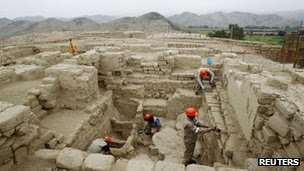 | In 2014 more than 60 skeletons were found inside a tomb, including three Wari queens. They were buried with gold and silver jewelery and painted ceramics.  | 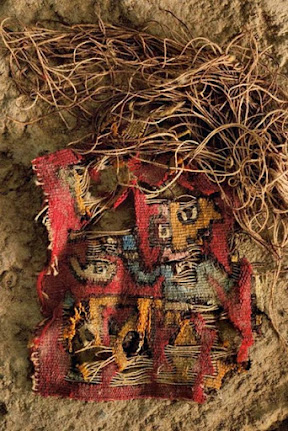
Mummified bodies were sitting upright - indicating royalty. |
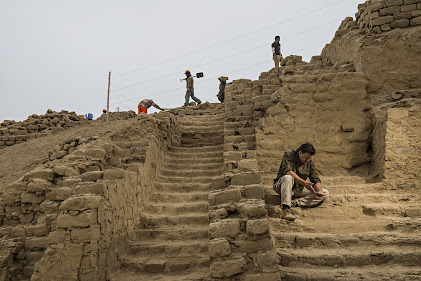 | The tomb was found in El Castillo de Huarmey, about 280km north of Lima. Researchers say the way other bodies were positioned indicated they were human sacrifices. Six of the skeletons in the grave were not in textiles. | 
They were placed on top of burials in strange positions. |
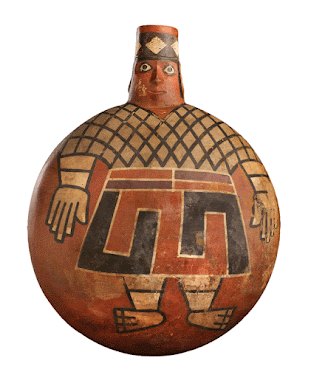
| Archaeologists found the remains of the Wari queens, gold, ceramics and skeletons to be about 1,300 years old. The Wari civilization thrived from the 7th to 10th centuries AD, conquering all of what is now Peru before a dramatic decline that remains unexplained. |  |



No comments:
Post a Comment