 | Toronto based designer Daniel Voshart made colorized, photorealistic portraits of 54 emperors from the Principate.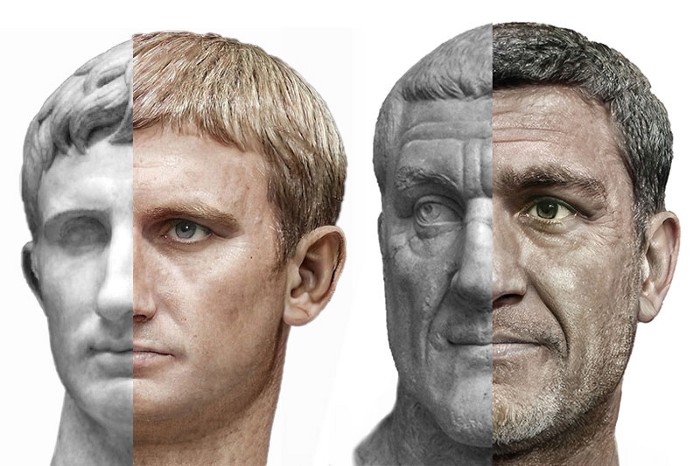 Roman emperors Augustus and Maximinus Thrax. Roman emperors Augustus and Maximinus Thrax. |

Wednesday, August 12, 2020
Emperors from the Principate

Saturday, August 8, 2020
Juukan Gorge - Rio Tinto = $135m
 | Two 46,000-year-old heritage sites in the Juukan Gorge were destroyed by mining company Rio Tinto. After being approved for destruction in 2013, significant archaeological discoveries were made at the site in 2014. The destruction was one of the worst violations of an important archaeological site in recent memory. Experts compared the blast to the destruction of artifacts by the Islamic State.  |
 | A decision by Rio Tinto Group to destroy Juukan Gorge delivered about $135 million in extra value to its iron ore division, according to the miner’s top executive. Rio rejected three other options that would have avoided damaging the two rock shelters in Western Australia in order to access about 8 million tons of high-value ore, Chief Executive Officer Jean-Sebastien Jacques said. “The destruction of the rockshelters has triggered some reflection in our company.” He is under increasing pressure to resign. |  |
Thursday, August 6, 2020
99 myo struggle captured in amber
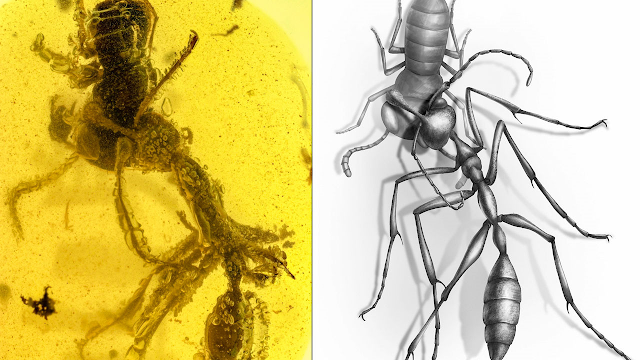 | A 99-million-year-old encounter between one of the earliest known ants and its prey, an extinct relative of the cockroach was preserved in amber. The ant grasps the victim’s neck between two sharp mandibles and a hornlike protrusion on its head. |
Tuesday, August 4, 2020
Metal detectorist lands silver coin hoard in Suffolk
 One theory suggests the coins were buried by a wealthy landowner who had gone off to fight in the Civil War. One theory suggests the coins were buried by a wealthy landowner who had gone off to fight in the Civil War. | Luke Mahoney, 40, discovered 1,061 silver coins on land belonging to The Lindsey Rose pub in Lindsey, Suffolk. The coins date to the 15th to 17th centuries.The earliest coin is an Elizabeth I era shilling dating to 1573-78, while it also contained a number of Charles I half crowns from 1641-43. |
Monday, August 3, 2020
Ancient treasure looted from Jerez de la Frontera
 | A man from Cadiz is facing up to three years in prison after looting ancient treasure near Jerez de la Frontera. Police became aware when the finder began posting photos of his loot online. The treasure included Phoenician gold jewellery estimated by experts to date back to 1,200 BC. A huge collection emerged when police searched the man’s home in Villamartín. Cops said the suspect’s activities were intricately planned and frequent. The suspect had received fines for similar crimes. Treasure hunting has been illegal in Spain since the mid 1980s. |
Sunday, July 26, 2020
Yamashita's Gold - Imelda Marcos’ jewelry
 | In the closing months of World War II General Yamashita Tomoyuki was in charge of hiding tons of Japan's looted gold and treasure. Expert teams accompanying Japan's armed forces systematically striped anything of value from conquered territories. An effective US blockade prevented shipment and at one time there were more than 175 Imperial treasure sites hidden in caves and tunnels throughout the Philippines. With US forces closing in, the chief engineers of all the vaults were called together with General Yamashita 67 meters underground in Tunnel 8 in the mountains of Luzon. They became drunk on sake and sang patriotic songs. |   |
 | At midnight, General Yamashita Tomoyuki and his aids slipped out. Dynamite charges were set off in the access tunnels, entombing the engineers. The General escaped to Tokyo by submarine and three months later surrendered to American troops. |  |
 | Yamashita's driver led the Americans to more than a dozen treasure vaults in the rugged country north of Manila. What they found astounded everyone. In November 1945, General MacArthur strolled down row after row of gold bars stacked two metres tall during a tour. In another 500 meter tunnel west of Mindanao, 12.5kg Gold bars were stacked 1 meter high. |  |
 |  |  |


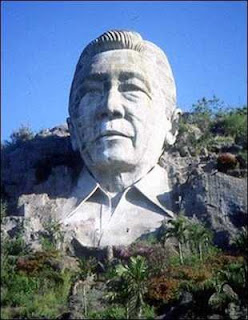 |  |  |  |
 | Former First Lady Imelda Marcos’ jewelry and real estate are among the P18.2 billion worth of recovered ill-gotten assets of the late dictator Ferdinand Marcos. The Hawaii collection comprises jewels seized by the United States Bureau of Customs from the Marcoses when they fled to Honolulu during the 1986 People Power revolt. | 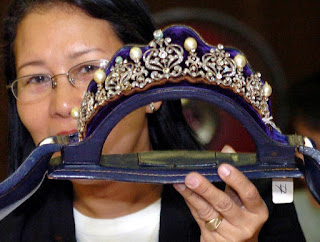 |
 | The government still holds about 760 pieces of Mrs. Marcos’ jewelry in three collections, valued at a total of $6 million. That includes 300 pieces of jewelry retrieved from the Malacanang Palace right after People’s Power Revolution, 400 items confiscated in Hawaii, and 60 items seized by the Philippines’ Bureau of Customs from a Greek national accused of smuggling the jewels out of the country. |  |
 |  |
Saturday, July 18, 2020
Angkorian gold
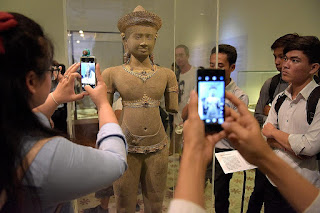
 | Angkorian gold jewelry that found its way to London in 2017 was returned to Cambodia after the government intervened to stop a planned sale. Cambodia’s Ministry of Culture and Fine Arts petitioned to return the Angkorian artifacts.  |  |
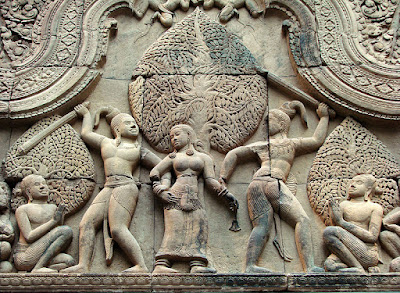 | They originated from the Khmer empire, a power in Southeast Asia from A.D. 802 to A.D. 1431. It once included much of today’s Cambodia, Thailand, Laos and southern Vietnam. After decades of war, Cambodia lost countless priceless historical artifacts to looters and smugglers who targeted ancient sites. The Khmer Rouge and other military groups often controlled looters in their areas. Looting artifacts has a history almost as old as the items themselves. The earliest known trial of looters in Egypt took place in Thebes in 1113 B.C. |  |
 |   |
Thursday, July 16, 2020
Kerala’s Sree Padmanabhaswamy temple
 | The Sree Padmanabhaswamy temple has great religious significance to Hindus. The temple is known for its six subterranean “kallara” or vaults. In 2011 five of the temple’s six vaults, designated A, B, C, D, E and F, were opened. In them lay around 3,000 tonnes of gold, coins, sacks of diamonds and jewellery. Treasures include gold in the form of pots and jars, crowns, religious iconography, as well as gold coins from civilizations around the world including the Romans, French, Dutch, Venetians and the Mughals. Some of the items in the vaults date back to 200 BC. All this does not include what is thought to be stored inside vault B. Ancient legend said if the vault were ever opened it would bring devastation to the world. |
Monday, July 13, 2020
$56 Chinese vase found in a cat-filled house goes for $9m
 | Once sold at auction for £44 ($56), the vase was made specifically for the Qianlong Emperor and went under the hammer for over 70 million Hong Kong dollars ($9 million) after being discovered in an elderly woman's country home. Described by Sotheby's as a "lost masterpiece," the rare 18th-century artifact survived the last 50 years in a remote house in central Europe surrounded by the owner's pet cats. The "double-walled" item is just one of a handful of similar designs, which were only attempted under the guidance of imperial kiln supervisor Tang Ying in the years 1742 and 1743. Described by Sotheby's as a "technical tour-de-force," the pear-shaped vase is an example of a style of porcelain known as "yangcai," or "foreign colors." | 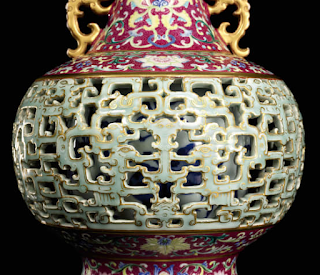 |
Saturday, July 11, 2020
Ancients doing well in uncertain economic times
 | Heritage is offering rarities and prices aren't going down as interest surges. Featured is a Titus as Augustus (AD 79-81). AE proto-contorniate sestertius. NGC VF 5/5 - 1/5, double holed and plugged. Rome, AD 80-81. Extremely rare and one of the most sought after architectural type of Roman coin. |
 | Aurelian (AD 270-275). AV binio or heavy aureus. NGC AU 5/5 - 3/5, brushed. Siscia. IMP C L DOM AVRE-LIANVS AVG, radiate, cuirassed bust of Aurelian right, seen from front / CONCORD-IA AVG, Concordia seated left, patera in right hand, double cornucopia in left. RIC V.I 164. Calicó 3982. Extremely rare - only example known. |  |
Friday, July 10, 2020
Unique ancients
 Sicily, Aitna (Catania) Silver tetradrachm c. 465 BCE obverse: bearded Silenus right AITNA ION, “of the people of Aitna.”, beetle below, reverse Zeus enthroned. Sicily, Aitna (Catania) Silver tetradrachm c. 465 BCE obverse: bearded Silenus right AITNA ION, “of the people of Aitna.”, beetle below, reverse Zeus enthroned. | The value of ancient coins is determined by three factors: historical interest, eye appeal, and rarity. Any unique coin of Alexander the Great or Cleopatra would be important (read expensive) no matter how battered. But a unique provincial copper of an obscure ruler would likely carry a modest price tag. |  Alexander III of Macedon, double daric, Mobile mint moving with Alexander’s Army in India, after 326 BCE 16.75 grams. Alexander III of Macedon, double daric, Mobile mint moving with Alexander’s Army in India, after 326 BCE 16.75 grams. |
 | In 1922 workmen in northern France unearthed a hoard of gold and silver buried c. 315 CE. Buried was a unique 10-aureus (52.88 gram) gold medallion of Constantius I, father of Constantine the Great. It commemorates his defeat of the British usurper Allectus in 296 CE.  |
Subscribe to:
Posts (Atom)