 | U.S. Immigration and Customs Enforcement (ICE), returned two 9th century Italian manuscripts and a Roman coin, a Contorniato, during a repatriation ceremony at the Italian Embassy in Washington. A “Contorniato di Traiano,” was a reward given to soldiers or civilians during the rule of Trajan. (98-117 A.D.) A contorniate, or contourniate, is a type of ancient Roman medal or medallion made of bronze. The coin was stolen from the Oliveriano Museum in Pesaro in 1978. In April 2016, an auction house contacted the museum to report that a suspicious coin had recently been consigned by the executor of an estate. The auction house surrendered the coin to HSI Philadelphia in 2018. |

Wednesday, November 18, 2020
ICE returns 'Contorniato di Traiano' to Italy

Tuesday, November 17, 2020
Hermes dug up in Athens
 | The head of an ancient statue of the Greek god Hermes has been unearthed during excavations for sewage system improvements in central Athens. The artwork dates to the late 4th century BC or early 3rd century BC. The marble head was found 1.3 metres (four feet) under the pavement on the busy Aiolou street. Herms or Hermas are sculptures, usually of the head of Hermes, and sometimes a torso, which were set on a squared column erected at road crossings as signs. According to Greek mythology, Hermes was the son of Zeus and the messenger of the gods, who also protected travellers and merchants. |  |
Saturday, November 7, 2020
Top ancients continue to do well
 | The latest Stacks Bowers sale returned high prices. A rare Caracalla aureus, A.D. 198-217. (7.43 gms), Rome Mint, A.D. 213. ANACS AU-50. Sold for $14,400, blowing past a $5,000-$7,500 estimate. A Lucius Verus aureus, A.D. 161-169. Rome Mint, A.D. 164. ANACS AU-55. It made $12,000 against an estimate of $4,000-$6,000. |  |
Friday, November 6, 2020
Greek island of Kythnos reveals secrets
 | Vryokastraki is a small rocky islet near the Greek island of Kythnos. It was once home to a significant city in the early Byzantine period. Artifacts have emerged from the island, which was continuously inhabited from the 12th century BC until the 7th century AD. One of the inscriptions describes a pirate named Glafketis who took control of Kythnos in the 4th century BC. According to the recently discovered artifact, Glafketis had support from the Macedonians, but was eventually forced out of power by the Athenians. |
 | Another inscription describes ancient bureaucratic processes on the island, including building regulations and a list of fines to be collected from those breaking them. The stones bearing these inscriptions had all been used for building purposes during the Byzantine period, a common practice.  |
Tuesday, November 3, 2020
Nanhai No 1

 |
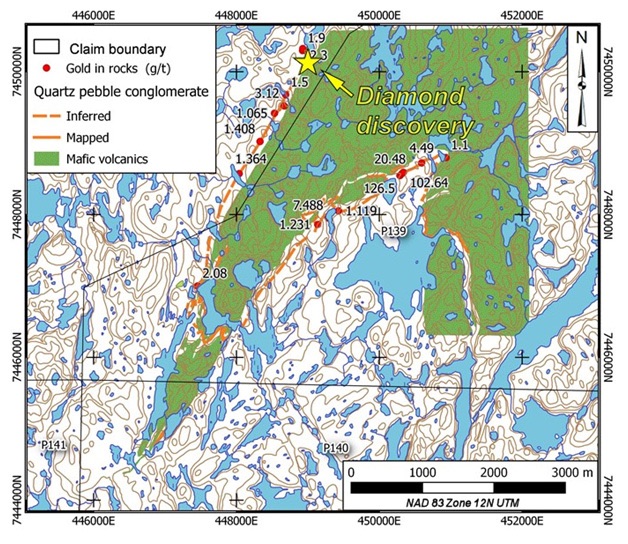
 | A unique diamond and gold deposit has been located near the Arctic coast, about 155 kilometres southeast of Kugluktuk in Nunavut. The deposit bears "striking" similarities to the world's largest, most dominant source of gold, the Witwatersrand Goldfields in South Africa. Rocks are 2.85b years old. Conglomerate samples contained diamonds. |  |
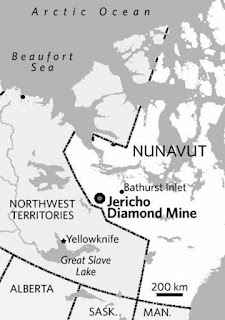 |  Your author was north for the construction of the Tahera Jericho Diamond Mine. |  |
 In April 2019 Silver Range collected a panel sample of the TRC that returned assay results of 36.3 (g/t) gold. In April 2019 Silver Range collected a panel sample of the TRC that returned assay results of 36.3 (g/t) gold. | In 1997 geologist Valerie Jackson collected samples from the Tree River Conglomerate 3.1 km NW of Cracker Lake. Tree River Conglomerate is an Archean metasedimentary rock unit in the Anialik Greenstone Belt within the Kitikmeot Region of Nunavut. The known exposures of the TRC are on permits staked on Silver Range's (SNG.v) Tree River Property and on adjacent Inuit Owned Lands. Parcel CO-69. |  The samples were processed to recover zircons and very unexpectedly yielded three diamonds. The discovery wasn't verified until recently. The samples were processed to recover zircons and very unexpectedly yielded three diamonds. The discovery wasn't verified until recently. |
TRC contains “abundant” pyrite and is anomalous for high-grade gold. |
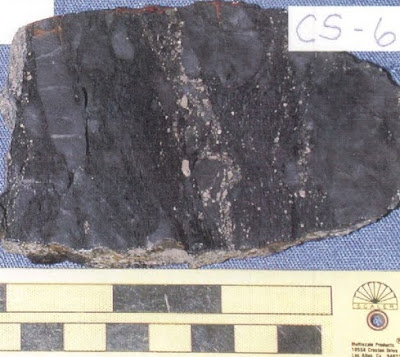 | "Pearson remembers the precise moment about a year later, when the council's Cristiana Mircea, who visits Edmonton to teach Diamond Exploration Research Training School (DERTS) students about diamond indicator mineral identification, matter-of-factly told him the sample produced three diamonds. "My jaw hit the floor," said Pearson. "Normally people would take hundreds of kilograms, if not tons of samples, to try and find that many diamonds. We managed to find diamonds in 15 kilos of rock that we sampled with a sledgehammer on a surface outcrop." https://www.eurekalert.org/pub_releases/2020-10/uoa-dfw100620.php |
https://services.aadnc-aandc.gc.ca/nms-scn/gv/indexForViewer.html?locale=en-US
Wednesday, October 7, 2020
59 ancient sarcophagi revealed in Egypt - update
| Archeologists unsealed the first of 59 sarcophagi, which contain the bodies of ancient Egyptian priests who were buried some 2,500 years ago. The first wooden sarcophagus contained a mummy wrapped in an ornate burial cloth, which had been decorated to resemble the deceased priest’s face. |
 | At least 59 sealed sarcophagi, with mummies inside most, were found. The coffins had been buried in three wells more than 2,600 years ago at Saqqara. The coffins are in a good state of preservation and maintain their original colors. The sarcophagi will be transferred to the Grand Egyptian Museum in Giza. |
Sunday, October 4, 2020
Remains of ancient Wales forest uncovered by storms
 | More of an ancient forest off the west coast of Wales was uncovered by extreme weather. This summer the UK has experienced a series of storms, including Storm Francis. When Francis hit Wales it uncovered more of the ancient forest that was buried by sand some 4,500 years ago. Carbon dating of the remains has placed the forest as having lived around 1,500 BC. |
Monday, September 21, 2020
New dinosaur discovered in China - Changmiania liaoningensis
 | Palaeontologists have discovered a new species of dinosaur estimated to be up to 125 myo. The fossils were found in the Lujiatun Beds, in north-eastern China, after being buried by a volcanic eruption. Scientists believe the eruption would have trapped the creatures at the bottom of their burrows. About 1.2 metres long, it is thought the dinosaur’s powerful hind legs and stiff tail would have made it a fast runner. The skeleton suggests that creature could dig burrows, much like rabbits do today. |
Friday, September 11, 2020
Silver and gold coins at Bulgaria’s Kaliakra Fortress
 | Researchers working at the site of the Kaliakra Fortress on Bulgaria’s northern Black Sea coast in 2018 found a small clay pot containing close to 1000 objects, including silver and gold coins and jewellery. The items in the clay pot included 873 silver and 28 gold coins, 11 appliqués and buckles, 28 silver and bronze buttons, 11 gold earrings, two rings, one of them gold, and four beads made of precious stones and gold. The discovery was beneath the floor of a room that was burnt in the 14th century. |
  | Kaliakra is a long and narrow headland in the Southern Dobruja region of the northern Bulgarian Black Sea Coast. Ottoman coins make up about 60 per cent of the hoard. They are from the time of Sultan Bayazid Yildirum (1389-1402), and his predecessor, Murad I.  |  |
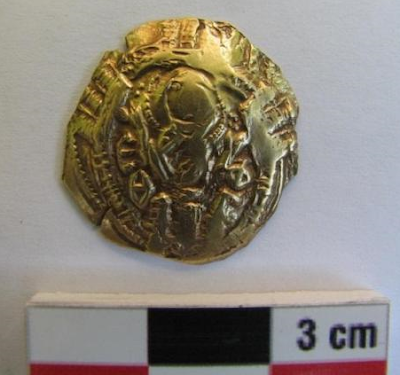 | This is the third treasure to be found at the site, following two finds in earlier years, one of 60 coins, and another of 80 coins. In 2014, three gold coins, dating from the Nicene dynasty in the 13th century were found. |  |
Thursday, September 10, 2020
Painted coffins found at Saqqara
 The 2,500-year-old wooden coffins are so well preserved that the intricate designs on them, painted in blue, gold, white, black and red, are still visible. The 2,500-year-old wooden coffins are so well preserved that the intricate designs on them, painted in blue, gold, white, black and red, are still visible. | Archaeologists have discovered more than 13 ancient Egyptian coffins piled one on top of the other within a burial well at the desert necropolis of Saqqara. |
 | Researchers have yet to look inside the sealed coffins, which haven't been opened since the bodies were interred within. Located 20 miles (30km) south of Cairo, Saqqara was the final resting place of the kings who ruled during the first and second dynasties, including Djoser, the first king of the third dynasty, who had the famous step pyramid at Saqqara constructed. |
Wednesday, September 9, 2020
Ancient Miocene infant ape skull
 | The complete cranium of a Miocene ape from Africa was found in 2017. It lived before the human lineage split off from the common ancestors we share with chimpanzees some 7 million years ago. Scientists in Kenya found the prize: an almost perfectly preserved skull roughly the size of a baseball from an infant. The remarkably complete skull was discovered in the Turkana Basin of northern Kenya. |  Researchers measured argon isotopes—which decay at a fixed, predictable rate—within the fossil’s rock layer, revealing that it was about 13 million years old. Researchers measured argon isotopes—which decay at a fixed, predictable rate—within the fossil’s rock layer, revealing that it was about 13 million years old. |
3D animation of the Alesi skull computed from the European Synchrotron Radiation Facility (ESRF) microtomographic data. It shows the skull in solid 3D rendering | X-rays fired at the skull turned up such high-res images of its teeth that the infant's age could be determined to within a matter of months. But the scientists were most excited about its ears. The inner ear structure suggests that it would not have had the balance to perform treetop aerial antics. |
Wednesday, September 2, 2020
1,000yo Christian cemetery in Poland yields mystery
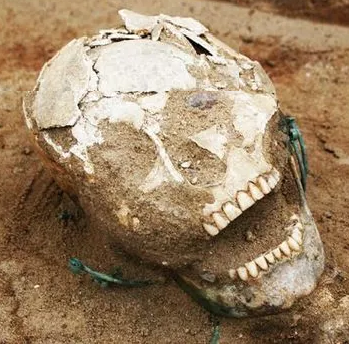 | A 1,000-year-old Christian cemetery in Northern Poland yielded a number of discoveries, including the body of a woman buried with a boulder on her chest. Most of the bodies uncovered at the site were children. One of the burials appears to have been a premature birth. A necklace was found in that burial. |  The corpses all featured grounded down teeth, a sign of a diet heavy in poorly refined flour. The corpses all featured grounded down teeth, a sign of a diet heavy in poorly refined flour. |
Subscribe to:
Posts (Atom)