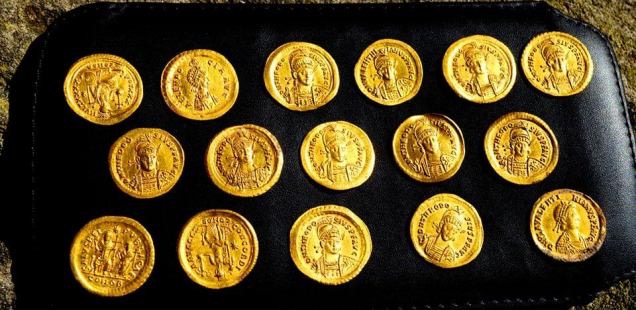
 | In 2019, 16 gold solidi, most of them minted by Theodosius II (408 – 450 AD), the third longest ruling Emperor of the Eastern Roman Empire, popularly known today as Byzantium, were discovered by archaeologists excavating the ruins of ancient Marcianopolis in Bulgaria’s Devnya. Marcianopolis (Marcianople) was a major Roman and Early Byzantine city. |

Monday, January 11, 2021
Theodosius Hoard

Sunday, December 27, 2020
11th century Hoard found in Sluszkow
 | About 6,500 silver coins dated to the 11th and 12th centuries AD were found in the village of Sluszkow in central Poland. The hoard was buried alongside golden wedding bands, rings and bits of silver and lead. 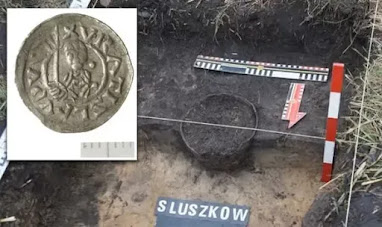 |
 | One of the rings bears an inscription in Cyrillic, which reads: "Lord, help your maid Maria." The woman may have been a Ruthenian princess. The wife of King Bolesław Wrymouth was a Ruthenian princess named Zbysława. Her sister was named Maria, who was married to Piotr Włostowic. |  |
Monday, December 21, 2020
Stunning 800 year old gold from 'Nanhai I'
 | Two exquisite gold necklaces found in an 800-year-old shipwreck have been put on display in the Guangdong Museum, China, along with other artifacts from the Song Dynasty. The Nanhai I is a Chinese merchant ship which sank off the south China coast during the Southern Song Dynasty between 1127 and 1279. It was first discovered by a joint Chinese-British diving expedition in 1987. | 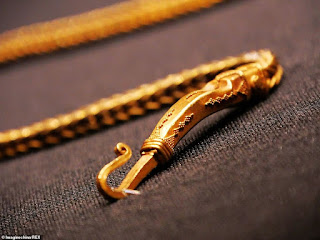 'The Route of the Sea: Nanhai I shipwreck and Maritime Trade in the Southern Song Dynasty' is being presented at the Guangdong Museum |
 | The entire shipwreck was lifted off of the seabed on December 21, 2007 and transferred into the specially-built Guangdong Maritime Silk Road Museum on Hailing Island, Guangdong. |  |
 |  |
Thursday, December 17, 2020
12th century abbot's grave
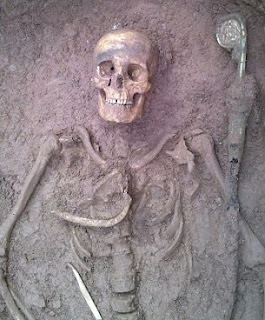 | Remains were found beneath the ruins of Furness Abbey when emergency repairs were made to the abbey at Barrow-in-Furness, Cumbria. Cracks appeared in the ‘mouldered walls.’ They were caused by medieval wooden foundations rotting away. Structural engineers found an unknown grave. Medieval jewellery and a silver and gilt crozier, a senior abbot’s staff of office was found. |  |
 | Furness Abbey is a former Catholic monastery that dates back to 1123 and was once the second-wealthiest and most powerful Cistercian monastery in the UK. Whoever was buried here had been placed in the presbytery – the most prestigious position in the abbey, usually reserved for those held in greatest esteem. |  |
Wednesday, December 16, 2020
Massive ancient hoard found in French looter's home
 | A French treasure hunter who claimed to have dug up 14,154 Roman coins in a Belgian field has been accused of being one of the greatest archaeological looters in European history. In France, metal detectors are only allowed to be used for scientific research, but in Dutch-speaking Flanders they can be used for personal searches. A raid by French officials on the man’s house revealed an astonishing hoard of 27,400 objects. There were bracelets and necklaces dating from the bronze and iron age, Roman brooches known as fibulae, Merovingian and Renaissance belt buckles, parts of statues and Roman and Gallic coins – all of which are said to have been illegally unearthed in France. |
 | A hollow copper Roman dodecahedron was recovered, of which there are only a hundred known copies. Their use remains an archaeological enigma. The looter, who is awaiting trial, had been exploiting the difference between French law and Flemish regulations to amass his cache. He faces huge fines and prison time for his many thefts. |  |
Monday, December 14, 2020
UK hoard donated to Hertford Museum
 | A hoard of 47 silver Roman coins and British Iron Age gold coins have been donated to a museum after being declared treasure. They were unearthed in a Hertfordshire field in 2017 by a group of metal detectorists. The oldest of the coins dates to 129 BC and is a Republican Roman denarius. The latest was issued during the reign of the emperor Claudius in AD 50‒54. The group waived a finder's reward of £2,500 to donate the hoard to the Hertford Museum, where the coins will be put on display. A report stated: "This is a typical hoard deposited between the Roman invasion in AD 43 and the Boudicca uprising of AD 61." |
Sunday, December 6, 2020
Coinage of the Normans in Sicily
 | The Norman conquest of England in 1066 is one of the most famous events in history. But few have ever heard of the Norman conquest of Sicily. Descendants of Vikings who settled in the French province of Normandy, the warlike Normans were eventually Christianized. They served as mercenaries across Europe. A band of Normans arrived in Sicily in 1059. Duke Robert de Hauteville (c. 1015 - 1085) led the conquest of Sicily. He was nicknamed Guiscard (meaning “wily” or “clever”). The only portrait coin of Robert was struck at Salerno on the Italian mainland. It depicts him in the regalia of a Byzantine emperor, a position he tried for years to attain, either by marriage or conquest. |  |
 | Roger I (c. 1031 – 1101) completed the conquest of Sicily begun by his brother Guiscard. The last Arab stronghold, Noto, fell in 1091. The obverse of Roger’s anonymous gold tari bears the Arabic inscription, “there is no God but Allah, Muhammad is the prophet of Allah”--an unusual choice for the coinage of a Christian knight. |
 | Roger II (1095 – 1154) was the second son of Roger I. He succeeded his short-lived elder brother, Simon, as Count of Sicily in 1105. After uniting all the Norman territories in Italy he was crowned as King of Sicily in 1130; his gold tari are relatively common |
 | After Roger II died in 1154, the throne passed to his fourth son, known to history as William the Bad. When he died in 1166, his son, only 11 years old, took the throne as William II. Known as “William the Good”, his reign of 23 years was remembered as a golden age of peace and prosperity. William II died in 1189 without an heir, and Tancred of Lecce, an illegitimate grandson of Roger II, seized the throne. He was nicknamed “the Monkey King” because of his short stature and unattractive appearance. On his rare gold tari, the Arabic inscription is “King Tancred the Victorious through Allah” |   |
Wednesday, November 25, 2020
Hegra
 | In the desert north of AlUla in Saudi Arabia, the archeological site of Hegra (Mada'in Saleh) has been left nearly undisturbed for almost 2,000 years. Once a thriving international trade hub, the rock-cut constructions at Hegra look similar to its famous sister site of Petra, a few hundred miles to the north in Jordan. Hegra was the second city of the mysterious Nabataean kingdom. Nabataeans were desert-dwelling nomads turned merchants, controlling the incense and spice trade routes through Arabia and Jordan to the Mediterranean, Egypt, Syria and Mesopotamia. Caravans laden with fragrant peppercorn, ginger root, sugar and cotton passed through Hegra, a provincial city on the kingdom’s southern frontier. The Nabataeans prospered from the 4th century B.C. until the 1st century A.D., when the expanding Roman Empire rose to prominance. |
 | Like Petra, Hegra is a metropolis turned necropolis: most of the remaining structures that can be seen today are tombs, with much of the architectural remains of the city still buried. |  |
Sunday, November 22, 2020
Sobek, the crocodile god
Egyptians had a complex relationship with the Nile’s crocodiles.
 | The crocodile god Sobek first appeared in the Old Kingdom as the son of Neith with the epithet “The Rager”. According to some myths his father was Set, the god of thunder and chaos, but he also closely association with Horus. Egyptions bred, raised, and mummified millions of baby crocs. Once hatched, the baby crocodiles would reside in shallow basins before being “sacrificed, mummified and then sold to worshipers as votive dedications.” Sobek and his affiliated reptilian deities had their headquarters in the Faiyum, an oasis in Upper Egypt. It was thought that Sobek could protect the Pharaoh from dark magic. |
 | During the Twelfth and Thirteenth Dynasties, the cult of Sobek was given particular prominence and a number of rulers incorporated him in their coronation names, including the first fully attested female pharaoh – Sobekneferu. |  |
Saturday, November 21, 2020
Master and slave discovered in Pompeii
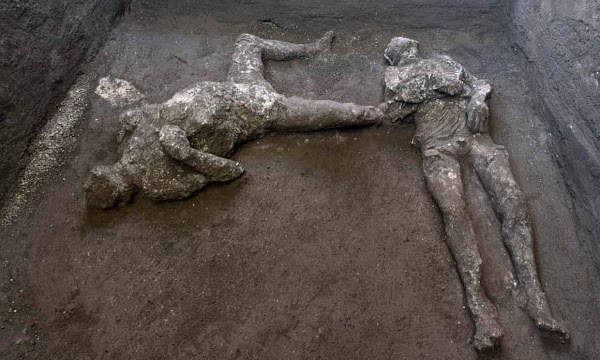 | The remains of two men have been unearthed in an extraordinary discovery in the ancient Roman city of Pompeii. The bodies of what are thought to be a wealthy man and his slave, believed to have died as they were fleeing the catastrophic eruption of Mount Vesuvius in AD79. The remains were discovered in the same location where a stable containing the remains of three harnessed horses were unearthed in 2017. Experts said the younger man was probably aged between 18 and 25. The elder man was aged between 30 and 40, and had a stronger bone structure. The two men are believed to have escaped the initial phase of the eruption when the city was blanketed in volcanic ash and pumice, only to then be killed by a blast that happened the following day. |
Saka Gold
 | In 2019 archaeologists found more than 500 artefacts made of gold, bronze and iron, believed to be from the 8th century BC, during excavations in the Yeleke Sazy burial sites in the Tarbagatai district in East Kazakhstan. The hoard was found at a depth of 1.5 metres in the niche of the ruined chamber of the largest kurgan, known as the Patsha mound. It was fused into a single lump in the remains of a leather bag apparently hidden in the stones by an ancient looter. The agglomeration was cleaned by a restorer and unique gold cast figures of leopards, griffins, as well as bracelets and other jewellery items were found. Among other findings were small sized nuggets and ingots made of gold of high purity, which were used by ancient goldsmiths for the manufacture of sheet gold. |
 | The findings from the Patsha mound are believed to belong to the elites of early Saka society. Over 50 ancient burial sites are in the Yeleke Sazy area, though virtually all were looted in ancient times. |  |
 |
Thursday, November 19, 2020
Mummy count continues to grow at Saqqara
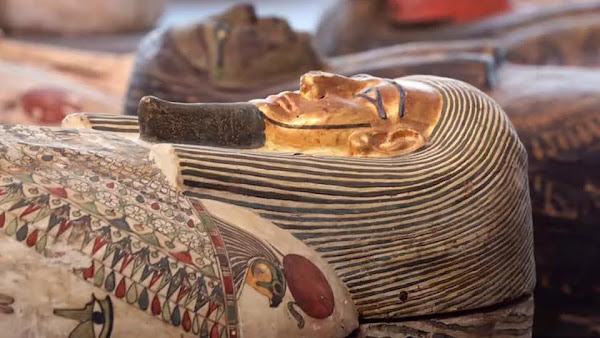 | The number of mummy-filled coffins found in a series of burial shafts at Saqqara in Egypt keeps growing. At the start of September, the team had found 13 coffins. By the beginning of October, that number had risen to 59, and now the number is over 100. Some are in a spectactular state of preservation. Archaeologists also found 20 wooden boxes showing depictions of Horus — an Egyptian sky god with a falcon head. Numerous shabti figurines were also found. Ancient Egyptians believed that shabtis acted as servants for the deceased in the afterlife. The various finds date back between roughly 712 B.C. and 30 B.C. |
Subscribe to:
Posts (Atom)