Thursday, August 12, 2021

Ancient Mysteries II

Tarim Mummies. During an excavation beneath the Tarim Basin in western China, archaeologists were surprised to discover more than 100 mummified corpses that dated back 2,000 years. Victor Mair was stupefied when he found blonde-haired and long-nosed Tarim mummies after they were dug up and put on display at a museum. In 1993 Mair returned to collect DNA samples from the mummies. Test results validated his hunch that the bodies were of European genetic stock. While ancient Chinese texts describe groups of far-East dwelling Caucasian people, there is no mention of how or why they ended up there.
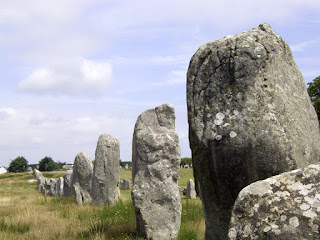
The Carnac Stones. With over 3,000 prehistoric standing stones, Carnac (in Brittany, France) is the largest megalithic site in the world. Not all of the Carnac stones were set up for the same purpose. There are stone circles, rows of stones aligned perfectly, and even mausoleums with roofs. Stones may have been periodically placed over thousands of years, but a rough calculation for the beginning of the stone placements is 4000 BC.

Minoan Palace Ruins at Knossos
Fall of the Minoans. The Minoans were an Aegean Bronze Age civilization that arose on the island of Crete and flourished from about 2600 to 1400 BC. The Minoan eruption on the island of Thera (Santorini) was among the largest volcanic explosions in history. The eruption is believed to have severely affected the Minoan culture. Evidence found on Crete indicate that a massive tsunami, generated by the Theran eruption, devastated the coastal areas of Crete and destroyed many Minoan settlements.

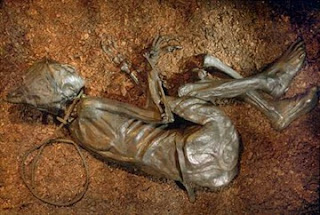
Bog Bodies. A bog body is a human cadaver that has been naturally mummified in a peat bog. Such bodies, sometimes known as bog people, are widespread. Bog bodies have retained their skin and internal organs due to the unusual conditions of the bog. These conditions include highly acidic water, low temperature, and a lack of oxygen. The overwhelming majority of bog bodies have been found in Northern Europe, particularly Denmark, Germany, the Netherlands, the United Kingdom and Ireland.

The Helike Delta with the Gulf of Corinth at left.
Lost City of Helike Helike was situated on the northwestern part of the Peloponnesian peninsula. During its heyday, Helike was an important economic, cultural and religious centre. One night during the winter of 373 B.C., the city of Helike was obliterated. The rescue party that came in the following morning found no survivors. No trace of the legendary society existed outside of ancient Greek texts until 1861 when an archaeologist found a bronze coin with the unmistakable head of Poseidon. In 2001, a pair of archaeologists located the ruins of Helike.
Rongorongo is an indecipherable hieroglyphic script used by the early inhabitants on Easter Island. While no other neighboring oceanic people possessed a written language, Rongorongo appeared mysteriously in the 1700s. The language was lost—along with the best hopes for ever deciphering it—after early European colonizers banned it.
The Anasazi appeared around 1200 BC. Over centuries they lived in the area where New Mexico, Colorado, Arizona and Utah meet. They developed advanced architecture and religion. The name Anasazi means “ancient strangers” or “ancient enemy” in the old Navajo language. They left behind many petroglyphs and other rock art. In the 13th century AD, the Anasazi mysteriously disappeared.
The Rock Ship of Masuda sits atop a steep incline of a hill near Okadera Station in Nara Prefecture of Kansai, Japan. Its purpose remains a mystery. The rock ship is 11 meters (36 feet) by 8 meters (26 feet), by 4.5 meters high (15 feet), and is made of solid granite. It weighs around 80 tons.

Wednesday, August 11, 2021

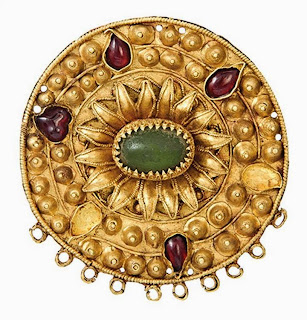
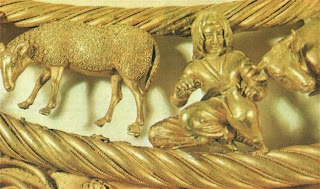
Saka gold on display in Cambridge

Gold belonging to ancient warriors buried 2,700 years ago is being displayed in the UK for the first time. The Saka culture of central Asia flourished from about the 8th century BC to the 3rd century BC. Treasures from Saka burial mounds will be on display at the Fitzwilliam Museum in Cambridge.
The exhibition features finds from three burial complexes in eastern Kazakhstan - Berel, Shilikti and Eleke Sazy.

Sunday, August 8, 2021

The Monaco Collection


Marcus Junius Brutus, Assassin of Caesar and Imperator (44-42 BC), with Pedanius Costa as Legate. AV aureus. NGC Choice Fine★ 5/5 - 4/5.
The Monaco Collection is an 82-lot standalone group of high-grade ancient coins – almost exclusively in gold. Highlight is Brutus, assassin of Caesar, with his ancestor, Lucius Junius Brutus, the first Consul of the Republic. The portraits are enclosed by the corona civica - an honored bestowed for displaying patriotism by saving lives of their comrades in battle, or by rescuing the Republic. Pedanius Costa was a lieutenant of Brutus in Asia, during the Civil War. 10 are known. Estimate is $150k to $200k.

C. Cassius Longinus, Imperator and Assassin of Caesar (44-42 BC), with P. Lentulus Spinther as Legate. AV aureus. NGC Choice AU 5/5 - 2/5, bent, brushed, scuffs.
At the first battle at Philippi, Cassius suffered a reverse and fell on his sword before he could be told that Brutus had counterattacked and saved the day. Demoralized by his friend's death, Brutus was easily defeated three weeks later and took his own life. This coin is estimated $50 to $60k.

Saturday, August 7, 2021

Crimea Gold

A priceless collection of ancient gold artifacts from Crimea that was on loan to a Dutch museum when Russia annexed the region is still in legal limbo. The trove of Scythian treasures, which including a magnificent 4th century BC Scythian helmet, had been lent by several Crimean museums to the Allard Pierson Museum in Amsterdam when Russian forces seized control of the peninsular in March 2014.
The Crimea and the Black Sea were and remain an important crossroads between Europe and Asia.

The recorded history of the Crimean Peninsula, historically known as Tauris or Tauric Chersonese, begins around 500 BC when several Greek colonies were established along its coast. Crimea since that time has endured a long series of conquests and invasions.

The modern history of Crimea began with the annexation by the Russian Empire in 1783. In 1921 the Crimean Autonomous Soviet Socialist Republic was created. This republic was dissolved in 1945.

Since 1991 it has had the status of an Autonomous Republic within Ukraine until its recent annexation by the Russian Federation in the 2014 Crimean Crisis.
Nearly a year after the exhibition “Crimea: Gold and Secrets From the Black Sea” wrapped up at the Allard Pierson Museum 565 rare treasures on loan from four Crimean museums remain in boxes in a storage facility, awaiting a court decision about where they should be shipped.

“Russia is attempting to appropriate valuable exhibits from Crimean museums that are currently on loan abroad," Ukraine’s vice prime minister for social affairs, Oleksandr Sych, said during a news briefing.
Construction of the Olympic venues in the Imereti Valley resulted in over a dozen archeological expeditions, and close to 400 artifacts have been handed over to the city's history museum. "The construction of the Olympic venues in Sochi over the past five years has triggered large-scale archaeological excavations previously unseen in this resort city," said Alla Guseva, Deputy Director for Research at the museum.
In October 2013 the museum unveiled the Ancient Gold of Kuban and the Black Sea Region exhibition as part of the Cultural Olympiad's Year of Museums. This is the first exhibition to feature artifacts unearthed during the Olympic construction.

The excavations in the Imereti Valley started in the wake of the Olympic construction. Previously, the area was considered unattractive for archeological expeditions. However, the first excavations have demonstrated that the area has been populated since ancient times.

The Bosporan Kingdom was an ancient state located in eastern Crimea and the Taman Peninsula, on the shores of the Cimmerian Bosporus (now known as the Strait of Kerch).

Gold Stater - Bosporan Kingdom
It was named after the Bosphorus, also known as Istanbul Strait, a different strait that divides Asia from Europe.

The Bosporan Kingdom was the longest surviving Roman client kingdom. It was based on the export of wheat, fish and slaves. The profit of the trade supported a class whose conspicuous wealth is still visible from the newly discovered archaeological finds.


Thursday, August 5, 2021

Gaius Cassius Longinus

Gaius Cassius Longinus, often referred to as simply Cassius, was a Roman senator and general best known as a leading instigator of the plot to assassinate Julius Caesar on March 15, 44 BC. He was the brother-in-law of Brutus. Cassius had a successful military career including taking part in the infamous Battle of Carrhae in 53 BC, where he was serving under the Triumvir Marcus Crassus as a quaestor. Crassus was part of the First Triumvirate, with Julius Caesar and Pompey. The Battle of Carrhae would be one of Rome's greatest defeats. Crassus was killed.

A coin of Gaius Cassius Longinus.
By 50 BC civil war was looming. Without Crassus the First Triumvirate was finished. With Caesar and Pompey at each other's throats, Cassius, along with his friend Brutus, sided with Pompey. Caesar was victorious at the Battle of Pharsalus in 48 BC, causing Pompey to flee to Egypt where he would be murdered. Cassius fled but was intercepted by Caesar and he promptly surrendered. Cassius found Caesar to be very forgiving. Now allies, he promoted Cassius to the position of legate.
On the Ides of March, 44 BC, Cassius and the other conspirators murdered Caesar in the Theatre of Pompey. Caesar suffered 23 stab wounds, with one to the heart fatally wounding him.

Babylonian proto-trigonometry predates Greek

Our understanding of trigonometry dates to ancient Greek astronomers studying celestial bodies. Now it appears the ancient Babylonians likely developed their own “proto-trigonometry” more than 1,000 years before the Greeks. A 3,700-year-old cadastral survey, Si.427, depicts a surveyor’s plan of a field. It is one of the oldest examples of applied geometry from the ancient world.
The need for accurate surveying is apparent from ancient writings. Measuring rope and the unit rod were tools of the trade. These were revered symbols of fairness and justice in ancient Babylon and were often seen in the hands of goddesses and kings.